Google and global researchers are opening new horizons in nature conservation by using AI models to map the biosphere, analyze animal sounds, and predict typhoon paths.
Introduction: Secret Conversations in the Forest, AI Becomes a ‘Translator’
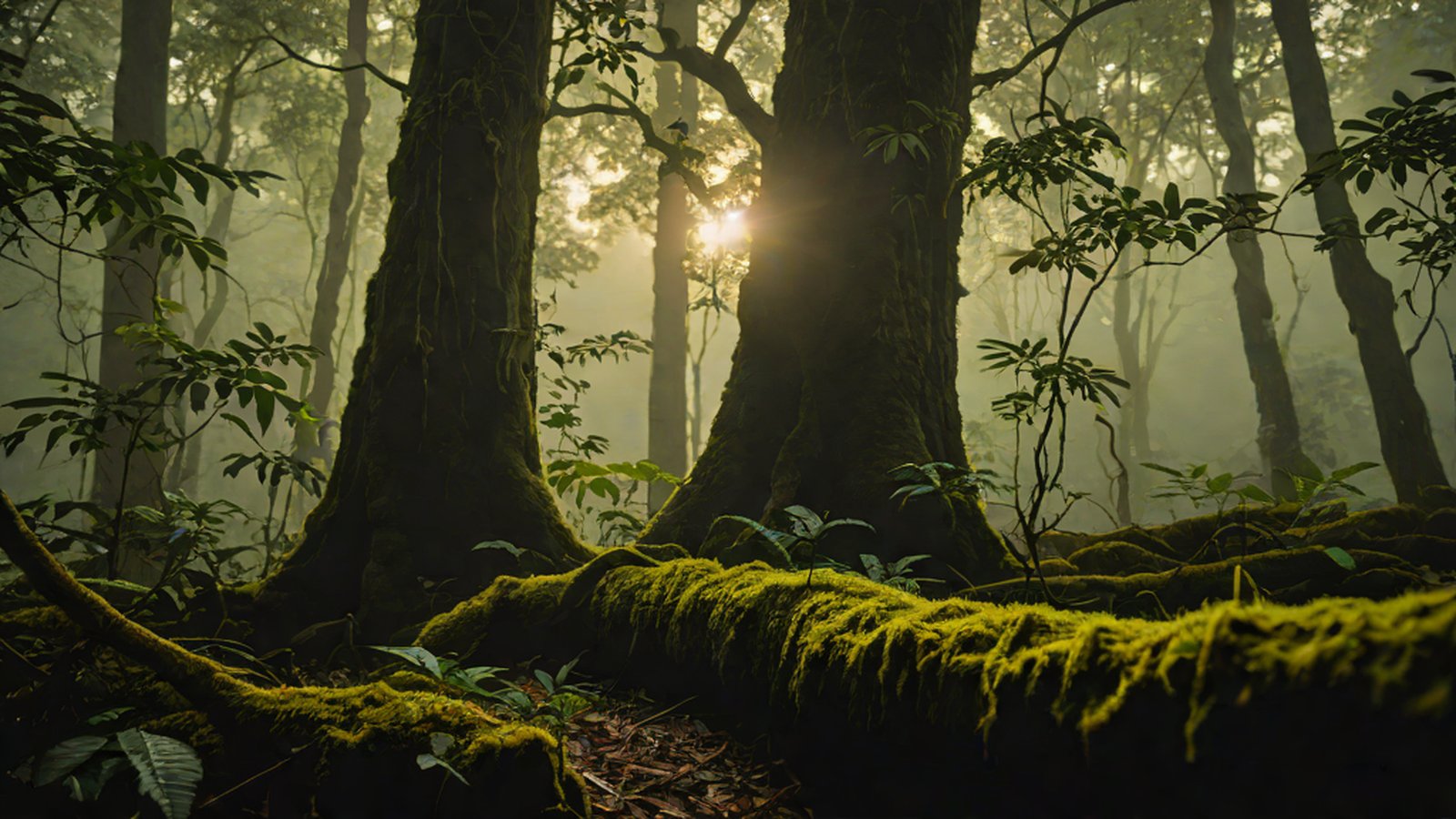
Imagine you are standing alone in the heart of the deep Amazon jungle. All around you, birds with unknown names are chirping, and in the unseen underbrush, you hear the rustling sounds of animals moving. In the past, these countless sounds were merely mysterious but incomprehensible ‘nature noise.’ But now, Artificial Intelligence (AI, a technology that learns from data to make judgments or predictions) has begun to act as a translator, unlocking the secrets hidden within these sounds.
Humanity has long viewed nature as something to be conquered or utilized. However, we are now using the power of AI as a formidable tool to understand nature more deeply and find ways to coexist. Scientists are using AI to precisely map and model the Earth’s biosphere (the regions of the surface, atmosphere, and hydrosphere of the earth occupied by living organisms like plants, animals, and fungi), diagnosing the health of our planet in ways we never could before Three ways Google scientists use AI to better understand nature.
Why Is This Important? ‘The Earth’s Physical Exam’ Directly Linked to Our Lives
When many people think of ‘AI,’ they often first imagine smart chatbots or tools that create cool pictures. However, one of AI’s most valuable roles is providing a ‘real-time physical exam for the Earth.’
Even at this moment, the number of endangered species is increasing due to climate change, and natural disasters like wildfires and typhoons are threatening us in more powerful and unpredictable ways than ever before. We are in a situation where we must detect and respond to changes in nature faster than ever.
Traditionally, thousands of scholars would have had to wander through rugged forests for decades to collect data manually. However, AI can analyze satellite imagery and vast amounts of sound data at the speed of light. In simple terms, AI is becoming a shield that protects the water we drink, the air we breathe, and our precious homes, solving in minutes what would take a human a lifetime.
Easy Understanding: How Does AI Become a Guardian of Nature?
1. A ‘Digital Stethoscope’ Listening to the Songs of Birds Worldwide
Google scientists are using AI models to analyze tens of thousands of hours of sound captured through microphones installed across the globe. It is nearly impossible for a human to listen to all these recordings and distinguish bird species individually.
However, AI can instantly identify the patterns of specific bird calls. This allows researchers to understand in real-time where these species primarily live and if their populations have recently dropped sharply Three ways Google scientists use AI to better understand nature.
By way of analogy, AI is like a ‘giant stethoscope’ installed across the entire planet. Through this stethoscope, it listens to the heartbeat (the activities of living creatures) of the massive patient called Earth and is the first to find signs of trouble where something is wrong.
2. ‘OlmoEarth’ Armed with 80 Petabytes of Knowledge
Recently, Google released ‘OlmoEarth,’ an open-source (a method where anyone can view the technology’s blueprint and use it freely) AI model to respond to the climate crisis Google’s OlmoEarth: Open-Source AI for Climate… - BroadChannel.
The amount of data this model learned is a staggering 80 Petabytes. Since one petabyte is about one million gigabytes, 80 petabytes is an almost unimaginable size that could hold tens of millions of high-definition movies. It is equivalent to reading all the knowledge in every library in the world thousands of times over. Researchers are using this powerful ‘digital library’ for free to accelerate research on preventing deforestation and preserving biodiversity Google’s OlmoEarth: Open-Source AI for Climate… - BroadChannel.
3. The ‘AI Weather Forecaster’ That Beat Supercomputers
Understanding nature also means knowing about upcoming disasters in advance. Surprisingly, AI has recently predicted the paths of typhoons more quickly and accurately than multi-million dollar state-of-the-art supercomputers.
For example, when predicting the path of Cyclone Alfred, AI showed significantly better performance than traditional complex meteorological models AI predicted Cyclone Alfred’s path and could be the future of…. While existing models spent time solving complex physical equations, AI recognized the vast meteorological data from the past several decades as ‘patterns’ and intuitively found the right answer.
Current Status: AI Guardians Arriving by Our Side
Currently, AI is moving beyond simple laboratory technology and is being deployed (set up to operate in a real environment) in the field.
- Forest Protection: AI analyzes daily satellite photos to immediately find spots where illegal logging is occurring in forests that were fine just yesterday, and sounds an alarm Mapping, modeling and understanding nature with artificial ….
- Biodiversity Mapping: It precisely records which rare plants and animals live in specific areas. This becomes critical data helping governments avoid destroying the environment when building new roads or buildings AI for Nature: How AI Can Democratize and Scale Action on ….
- Wildlife Monitoring: It tracks the migration paths of wildlife using only the sounds from remote mountains where humans rarely visit, protecting them from poachers Mapping, modeling and understanding nature with artificial ….
Experts like Jerome Massot, who is participating in a collaborative project between Google Research and Google DeepMind, are expressing great expectations, saying these technologies are completely changing the paradigm of how we treat nature Three ways Google scientists use AI to better understand nature.
What Lies Ahead? A Bright Future and Remaining Challenges
While AI is clearly a strong ally in nature conservation, there are challenges we must solve together. Critics point out that operating AI models that process enormous amounts of data consumes massive amounts of power, and the resulting carbon emissions could actually burden the environment. Furthermore, the issue of fairness—ensuring that these benefits are shared equally even in remote areas or poor countries with limited internet connectivity—is also important AI for Nature: How AI Can Democratize and Scale Action on ….
However, the most hopeful point is that AI is ‘democratizing’ nature conservation. This is because an era is opening where anyone in the world can participate in research to protect the forests and rivers of their own villages using the open-source models released by Google, without needing expensive equipment or numerous experts.
AI’s Perspective: A Word from MindTickleBytes’ AI Reporter
“Nature is like the most sophisticated and vast dataset for humanity. Perhaps we have ignored nature’s warnings because we haven’t understood its language. AI is the clue to untangling that complex web. By having AI convey the pain of the forest and the breath of the earth that humans have failed to see and hear, we are finally beginning a true ‘conversation’ with our planet.”
References
- Three ways Google scientists use AI to better understand nature
- Mapping, modeling, and understanding nature with AI – ONMINE
- Three ways Google scientists use AI to better understand nature (LinkedIn)
- Google’s OlmoEarth: Open-Source AI for Climate… - BroadChannel
- Mapping, modeling and understanding nature with artificial intelligence
- AI for Nature: How AI Can Democratize and Scale Action on Nature
- AI predicted Cyclone Alfred’s path and could be the future of weather forecasting

- Gemini Earth
- OlmoEarth
- GreenAI
- 80 Terabytes
- 80 Gigabytes
- 80 Petabytes
- Cyclone Alfred
- Hurricane Katrina
- Tsunami