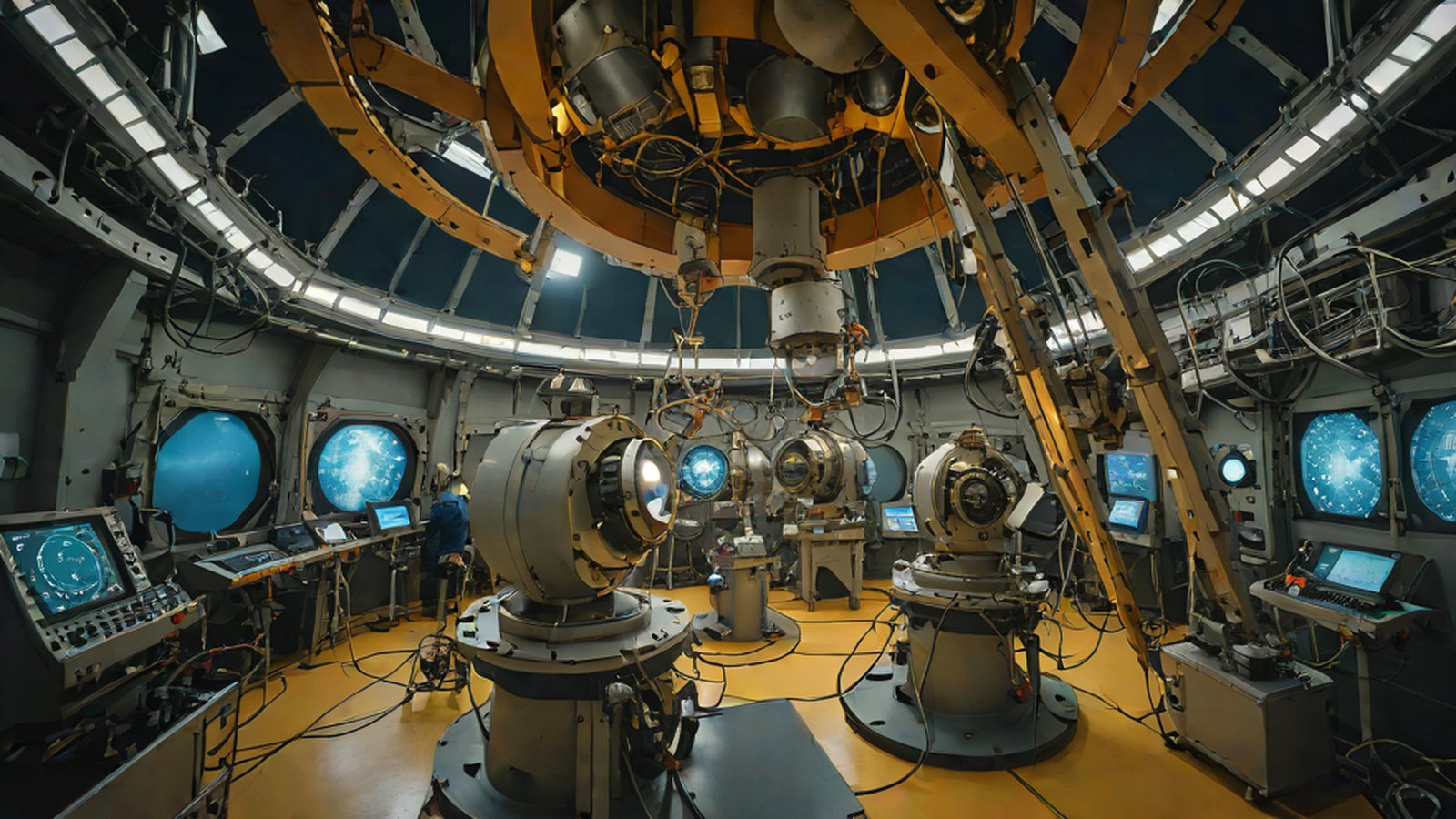
Scientists are using AI to precisely capture gravitational waves—the universe's most minute vibrations—and have boosted galaxy identification accuracy to 99.7%, gaining a new set of eyes (and ears) to observe the cosmos.
Have you ever wondered what lies hidden beyond the twinkling stars in the night sky? For thousands of years, humanity has quietly “seen” the universe through our eyes (visible light) and telescopes. However, with the rapid advancement of artificial intelligence (AI), a great wave of change is sweeping through the scientific community. We are now moving beyond simply seeing the universe with our eyes to a completely new stage of “hearing” the massive vibrations of the cosmos and “feeling” its rhythm.
Today, I’ll tell you the wondrous story of how AI, our dependable ally, is vividly uncovering the deep reaches of space.
Why is this important?
We have always wanted to know how the universe began and what happens when distant black holes collide. But the universe is so vast, and the information we can obtain on Earth consists of only the most minute signals.
In particular, signals called “gravitational waves” are a prime example. Gravitational waves refer to the ripples in spacetime caused by the movement of massive celestial bodies, much like waves on a lake caused by a thrown stone. By the time these signals reach Earth, they become incredibly faint, turning into vibrations much smaller than a single atom.
Just imagine. Someone drops a tiny needle in a city thousands of kilometers away, and you have to hear that sound accurately in the middle of a noisy construction site. It sounds almost impossible, doesn’t it? But AI plays a key role in cleanly removing unnecessary “noise” from this complex process and finding the “voice of truth” sent by the universe. Thanks to this, we can understand the origin and formation of the universe much more deeply and clearly than before Using AI to perceive the universe in greater depth - BAAI Community.
Easy Understanding: How to Listen to the ‘Bass Notes’ of the Universe
Rana Adhikari, a physics professor at the California Institute of Technology (Caltech), explained this with a wonderful analogy: “Studying the universe using gravity instead of light is like listening instead of seeing. This task allows us to tune into the ‘bass’ of the universe” Using AI to perceive the universe in greater depth - Solega Blog.
To put it in an analogy: The starlight we commonly see is like a brilliant, high-pitched melody, while gravitational waves are like the heavy sound of a bass guitar resonating throughout the entire universe. To hear this deep resonance, scientists use a special device called LIGO (Laser Interferometer Gravitational-Wave Observatory). LIGO is equipment that captures minute distortions in space using the interference of laser light Using AI to perceive the universe in greater depth.
1. AI Stabilizing the Trembling Heart: ‘Deep Loop Shaping’
However, LIGO has a very sensitive problem. Because the observation equipment is so precise, the readings often fluctuate wildly due to vibrations from a truck passing on a nearby road or even a faint breeze outside the window. This is where AI steps in as a relief pitcher.
In September 2025, a research team led by Brendan Tracey and Jonas Buchli announced an innovative AI technique called ‘Deep Loop Shaping’ Using AI to perceive the universe in greater depth - ONMINE. This technology precisely controls and stabilizes observation equipment in real-time, helping to capture massive cosmic events without interference Using AI To Perceive The Universe In Greater Depth.
| Simply put, it’s like equipping a “cutting-edge smart gimbal” that perfectly stabilizes image blur when taking photos on a boat rocking in a stormy sea. This research gained global recognition, being published in the prestigious scientific journal Science [Using AI to perceive the universe in greater depth | BARD AI](https://bardai.ai/2025/12/06/using-ai-to-perceive-the-universe-in-greater-depth/). |
2. 99.7% Accuracy: Mapping the Universe with Precision
AI’s performance doesn’t stop at stabilizing machinery. It also shows exceptional skill in accurately distinguishing which of the trillions of lights in the night sky are ordinary “galaxies” and which are “quasars” (extremely bright celestial bodies emitting immense energy from the center of a galaxy).
Remarkably, a recent AI identified galaxies and quasars with a stunning 99.7% accuracy compared to existing professional astronomical survey (GAMA survey) results A New AI Sees the Universe More Clearly Than Ever Before. It also analyzes the “spectra” (bands of color from light decomposed by wavelength) emitted by stars to instantly figure out their temperature, composition, and even age. It’s as if AI is reading a diary containing the history of the universe How AI is Revolutionizing Our View of the Cosmos.
3. Clearing the Fog: Reducing Cosmic Uncertainty
One of the most important questions for cosmologists is “how densely cosmic matter is clumped (clumpiness).” According to a study recently published in Nature Astronomy, AI has succeeded in reducing the uncertainty of these key cosmic parameters by more than half compared to before AI breakthrough unlocks hidden patterns in the universe’s structure.
By analogy, it’s like turning on very bright and powerful fog lights on a road where you couldn’t see an inch ahead due to thick fog. Thanks to this, humanity can now view the massive structures of the universe in much higher resolution than before.
Current Status: How Far Have We Come?
At this very moment, research teams around the world are doing their best to use AI to capture the universe’s most extreme events, such as collisions between black holes or neutron stars (the incredibly dense remnants left after a star explodes), in real-time AI finds new ways to observe the most extreme events in the universe.
In the past, a separate AI model had to be created for each specific task. Recently, however, interesting discussions have begun about whether a single Large Language Model (LLM) can integrate vast amounts of scientific data to act as an intelligence similar to a “PhD in Universe” Reflections on "Can AI Understand Our Universe?" - arXiv.org. The era where AI independently reads and learns the books in the vast library of the universe is fast approaching.
What Lies Ahead?
The continuous development of AI technology will throw wide open the doors to “next-generation gravitational wave science” Using artificial intelligence to perceive the universe with greater depth. Beyond simply seeing further, we may be able to capture the minute vibrations that occurred at the very moment the universe was born.
Imagine this. One morning, you hear on the news: “AI has perfectly restored signals from 0.0001 seconds after the birth of the universe.” The AI technology in the smartphones we use every day is now becoming the most reliable guide leading humanity to the origins of the cosmos.
AI Perspective: Reporter MindTickleBytes AI’s Take
For a very long time, we might have felt like we were touching an elephant while blindfolded in the vast darkness of the universe. But now, AI is letting us hear sounds, sharpening blurry shapes into focus, and guiding us along invisible paths. While one might think of technology as merely cold numbers and algorithms, it is truly wondrous that those algorithms are becoming the warmest light leading us to the home of the stars.
References
- Using AI to perceive the universe in greater depth
- Using AI to perceive the universe in greater depth - Solega Blog
- Using AI to perceive the universe in greater depth - TechAIApp
- How AI is Revolutionizing Our View of the Cosmos
- Using AI to perceive the universe in greater depth - ONMINE
- Using AI To Perceive The Universe In Greater Depth
- Using artificial intelligence to perceive the universe with greater depth
- Using AI to perceive the universe in greater depth - BAAI Community
- Reflections on "Can AI Understand Our Universe?" - arXiv.org
- Using AI to perceive the universe in greater depth
-
[Using AI to perceive the universe in greater depth BARD AI](https://bardai.ai/2025/12/06/using-ai-to-perceive-the-universe-in-greater-depth/) - A New AI Sees the Universe More Clearly Than Ever Before
- AI breakthrough unlocks hidden patterns in the universe’s structure
- AI finds new ways to observe the most extreme events in the universe
FACT-CHECK SUMMARY
- Claims checked: 17
- Claims verified: 17
- Verdict: PASS

- Visible light
- Gravitational waves
- Radio waves
- 85.5%
- 95.0%
- 99.7%
- Deep Loop Shaping
- Cosmic Neural Network
- Loop Guardian