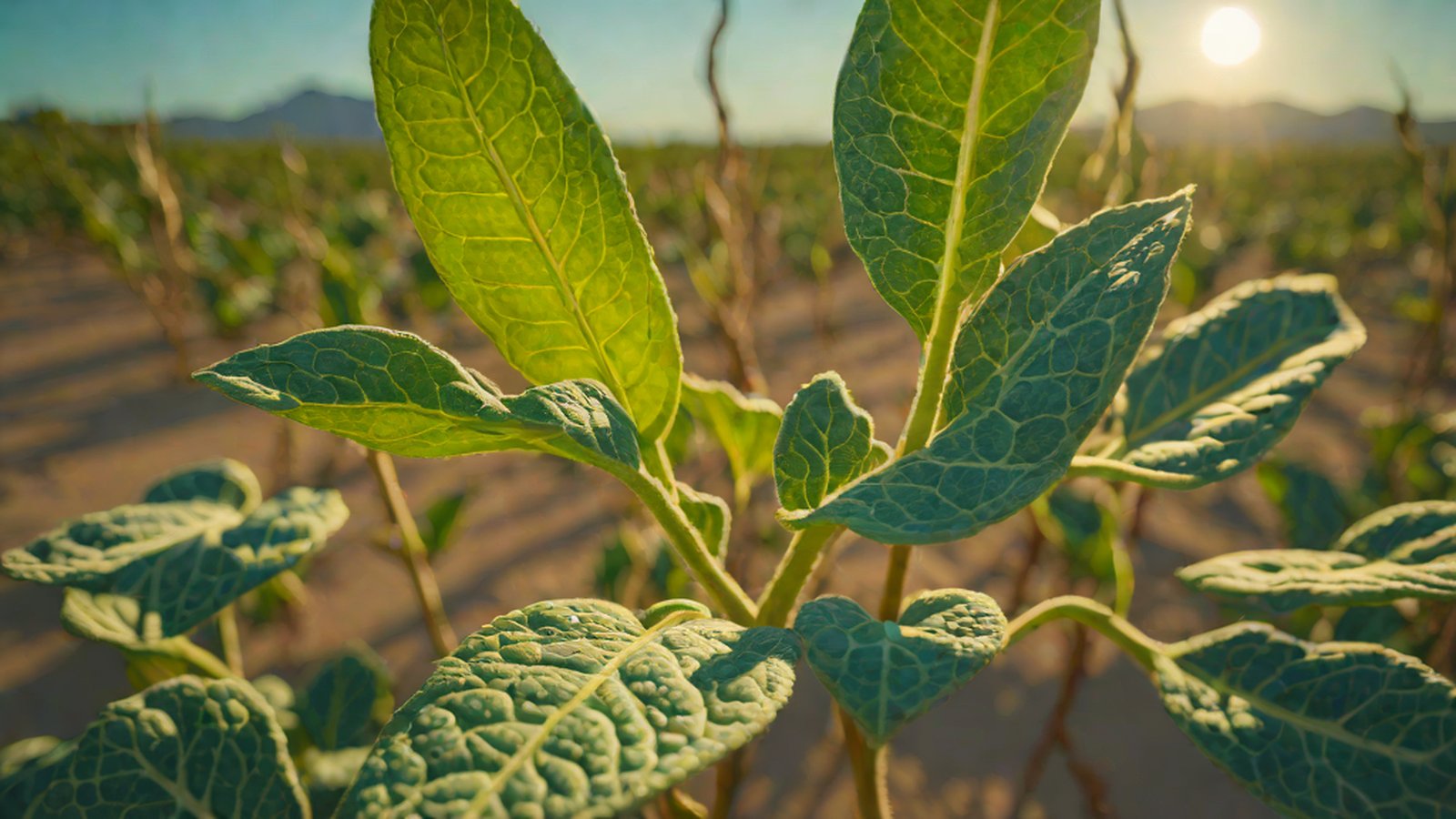
Scientists are leveraging AI AlphaFold and CRISPR gene-editing technology to develop 'climate-resilient crops' that can survive extreme heat and drought, addressing future food crises.
What Happens to Our Dining Tables as the Earth Warms?
Imagine for a moment: you go to the grocery store as usual, but the price of rice or bananas you buy every day has jumped tenfold, or they have disappeared from the shelves entirely. You might think, “Could that really happen?” But this isn’t a story of the distant future; it’s the harsh reality our planet is facing right now.
Due to global warming, farmland around the world is getting hotter, and crops are wilting, unable to withstand this punishing environment. Earth cracked like a turtle’s shell from drought and fields scorched by record heatwaves are no longer just stories from far-off countries seen on the news. But don’t worry too much. We have very ‘smart bodyguards’ to help solve this crisis: Artificial Intelligence (AI) and advanced genetic engineering. Engineering plants for a changing climate - PMC
Today, we’ll explain in simple terms how scientists are using cutting-edge tools like AI and genetic engineering to create ‘super crops’ that stand firm even under the scorching sun.
Why Is This Important to Us?
It’s not just a matter of “farming will be a bit harder because the weather is getting hotter.” Food security is a matter of survival, directly linked to our families’ health and national economies.
For example, farmers worldwide currently lose about 10% to 23% of their total crops each year due to fungal diseases. Scientists closer to engineering more resilient food crops Put simply, out of every ten bowls of rice we would eat, more than two disappear because of fungus before they even reach the table.
When drought and heatwaves caused by climate change are added, these numbers are bound to increase significantly. That’s why scientists are dedicated to improving the ‘constitution’ of plants so they can overcome diseases on their own and grow well in boiling heat, as if they were under an air conditioner. Climate-Resilient Crops: Ensuring Food Security in a Changing Climate
1. AI ‘AlphaFold’ Puts an Invincible Heat Suit on Plants
The first hero in action is Google DeepMind’s genius AI, AlphaFold. Originally an AI that predicts the 3D structure of proteins, what does this have to do with crops?
Think of it this way: inside our bodies and plants, there are tiny workers called ‘enzymes’ (substances that help chemical reactions in living organisms). These workers labor day and night in the ‘photosynthesis’ process, where plants take in sunlight to create energy. However, these workers have a fatal weakness: they are extremely vulnerable to heat. When the temperature rises too much, the workers get heatstroke and stop working or collapse entirely. This is one of the fundamental reasons plants wilt and die.
Scientists used AlphaFold to precisely analyze an enzyme named GLYK, which plays a key role in photosynthesis. How AlphaFold is helping scientists engineer more heat-tolerant crops — Google DeepMind Because the AI perfectly understood the structure of this complex worker, scientists were able to draw up a blueprint to strengthen this enzyme so it could withstand heat much better. Engineering more resilient crops for a warming climate – digitado
Essentially, it’s like giving the tiny workers inside plants cool and sturdy ‘high-tech heat-resistant work clothes.’ Now, no matter how much the temperature rises, the workers inside the plant can keep creating energy without getting exhausted. Engineering more resilient crops for a warming climate…
2. Genetic Circuits: A ‘Smart Home System’ for Plants
| Professor Brophy of Stanford University went a step further with a brilliant idea: Genetic Circuits. [Can we engineer crops to withstand climate change? | Stanford University School of Engineering](https://engineering.stanford.edu/news/can-we-engineer-crops-withstand-climate-change) |
This goes beyond simply changing some of a plant’s genes; it’s about implanting an artificial intelligence-like system that allows the plant to judge the situation and control ‘when’ and ‘how’ to activate its genes.
Imagine this: when you install a modern ‘smart home system,’ the air conditioner turns on automatically only when it gets hot outside, and the windows close themselves when it rains. Genetic circuits work the same way. When a plant detects a drought, it immediately activates genes that prevent moisture evaporation to protect its internal water; when it rains and conditions improve, it switches back to normal growth mode.
| Through this technology, plants are reborn as ‘intelligent plants’ that cope much more flexibly and smartly with environmental changes. [Can we engineer crops to withstand climate change? | Stanford University School of Engineering](https://engineering.stanford.edu/news/can-we-engineer-crops-withstand-climate-change) |
How Far Have We Come?
These amazing technologies are already being applied one by one beyond the laboratory to actual fields.
-
Disease-Resistant Bananas and Rice: A company called ‘Tropic Biosciences’ is using CRISPR (gene-editing technology that can target and cut specific gene segments). By ‘switching off’ only the gene segments vulnerable to disease in bananas and rice, they are creating strong crops that can overcome pests and diseases without pesticides. [Bio-engineered Crops: A Breakthrough for Climate-Resilient Farming Forward Fooding](https://forwardfooding.com/blog/foodtech-trends-and-insights/bio-engineered-crops-a-breakthrough-for-climate-resilient-farming/) Climate resilient plants (Green Technology Book) - Fertilizer-Free Grains: Usually, plants need expensive chemical fertilizers to grow well. However, scientists are now designing microbes so that grains can cooperate with microbes in the soil to absorb nutrients (nitrogen) on their own. Engineering Roots for Climate-Resilient Crops If successful, this can reduce environmental pollution and ease the burden on farmers.
- Multi-Faceted Approaches: In addition to gene editing, all technologies including traditional breeding and genomics (the study of all genetic information) are being mobilized to create crops that are unfazed by drought, floods, and even soil salinity. Multi-faceted approaches for breeding nutrient-dense, disease-resistant … Climate Resilience: Strategies for Enhancing Plant and Vegetation …
Future Outlook: Tables Protected by ‘Resilient Survivors’
Our future dining tables are expected to be more secure thanks to the reliable protectors of AI and genetic engineering.
In the future, beyond just harvesting large quantities, ‘super crops’ that are richer in vitamins and unfazed by harsh weather will continue to reach us. “Our goal is to develop resilient crops for a changing planet” Of course, scientists are very carefully monitoring whether these technologies cause side effects in our ecosystem and ensuring their safety is sufficient.
In the not-too-distant future, the apples or rice we casually pick at the mart might be ‘brave survivors’ that overcame the rough waves of the climate crisis thanks to sturdy genes designed by AI. It means technology is not destroying nature but acting as a warm shield helping nature protect itself.
MindTickleBytes AI Reporter’s Perspective
Climate change is an unavoidable reality that is already with us. However, as humanity has always done, we are finding answers through the tool of ‘technology.’ The sight of AI solving the secrets of invisible proteins and gene scissors changing the constitution of plants seems like a scene from a sci-fi movie, but it is ultimately the most realistic and noble effort to protect the warm bowl of rice our children will eat. It is very reassuring that technological progress is not in conflict with nature but is moving in a direction that maximizes nature’s vitality.
References
- How AlphaFold is helping scientists engineer more heat-tolerant crops — Google DeepMind
- Engineering Roots for Climate-Resilient Crops
- Climate resilient plants (Green Technology Book)
-
[Can we engineer crops to withstand climate change? Stanford University School of Engineering](https://engineering.stanford.edu/news/can-we-engineer-crops-withstand-climate-change) - Climate-Resilient Crops: Ensuring Food Security in a Changing Climate
-
[Bio-engineered Crops: A Breakthrough for Climate-Resilient Farming Forward Fooding](https://forwardfooding.com/blog/foodtech-trends-and-insights/bio-engineered-crops-a-breakthrough-for-climate-resilient-farming/) - Multi-faceted approaches for breeding nutrient-dense, disease-resistant …
- Climate Resilience: Strategies for Enhancing Plant and Vegetation …
- Engineering plants for a changing climate - PMC
- Engineering more resilient crops for a warming climate…
- Scientists closer to engineering more resilient food crops
- Engineering more resilient crops for a warming climate – digitado
- “Our goal is to develop resilient crops for a changing planet”
FACT-CHECK SUMMARY
- Claims checked: 12
- Claims verified: 12
- Verdict: PASS

- Plant root length
- Photosynthetic enzyme (GLYK)
- Leaf thickness
- Genetic Circuits
- Photosynthesis Booster
- Soil Microbe Enhancement
- 1~5%
- 5~10%
- 10~23%