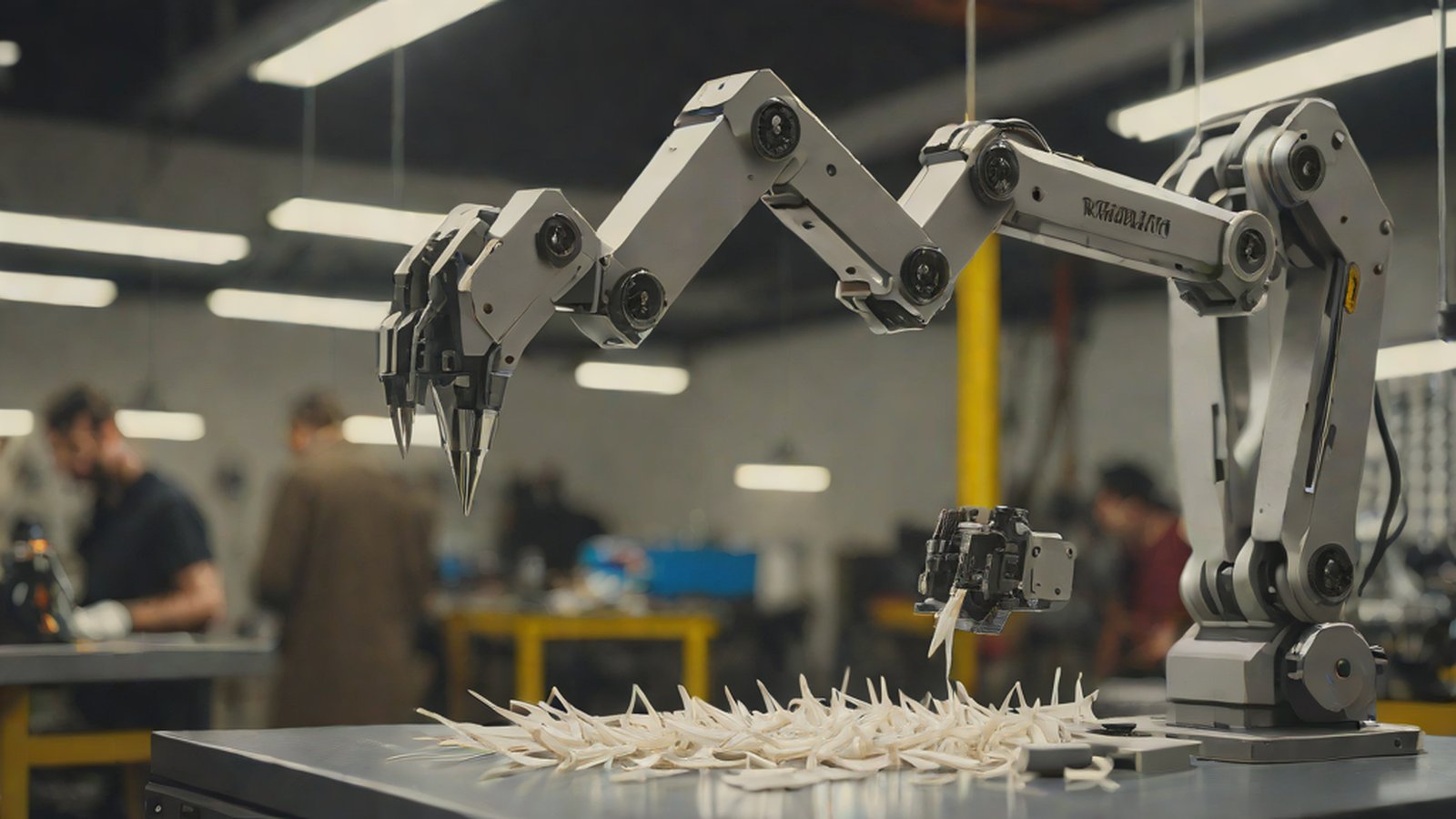
Google DeepMind has unveiled Gemini Robotics-ER 1.6, which significantly enhances 'Embodied Reasoning' capabilities, bringing us closer to an era where robots can independently understand and act in complex work environments.
What would happen if a robot saw your kitchen for the first time?
Just imagine. You visit a friend’s house for the first time, and they ask, “Could I have a cup of coffee?” Even though you’ve never seen that kitchen before, you don’t panic. Instinctively, you open cupboards to find a mug, locate the coffee machine near the sink, and adjust the water amount to fit the size of the cup.
Behind this short process, which seems so natural and easy for us humans, lies an immense amount of intelligence: ‘3D spatial understanding’ and ‘flexible situational judgment.’
For a long time, however, such a task was close to ‘Mission Impossible’ for robots. While they are great at repetitive, predefined movements like machines, they would often get lost or perform nonsensical actions if a cup was moved slightly or the kitchen was a bit messy. But on April 14, 2026, Google DeepMind announced a revolutionary upgrade to give robots this ‘common-sense brain’: Gemini Robotics-ER 1.6. [Source 5]
Now, robots are moving beyond just taking pictures of what’s in front of them; they are starting to ‘read’ the scene and create complex task plans on their own.
Why is this important for our future?
Until now, the robots we’ve seen have been like ‘skilled muscles.’ They were perfect at moving repeatedly along fixed paths in factories, but they lacked the ‘smart head’ (high-level brain) needed to judge their surroundings independently. Gemini Robotics-ER 1.6 performs exactly this role of a ‘High-level brain’ that understands situations and builds plans. [Source 8]
The changes this model brings can be summarized in three key points:
- Not flustered by messy environments: Real-world factories and warehouses aren’t always neatly organized like labs. The new AI has the ability to accurately find and count necessary items even in spaces where tools are scattered.
- Reads analog gauges directly: Robots can now ‘see’ old measurement devices (gauges) that lack digital signals and determine the current values to respond accordingly. This means robots can immediately start working even in decades-old factories. [Source 4] [Source 9]
- Reviews and retries autonomously: Robots have gained the ‘judgment’ to meticulously check if a task was successful from multiple angles and, if it failed, intelligently retry or decide on the next step. [Source 8]
Ultimately, this technology will be the key to moving robots out of fixed positions in cold factories and into the hospitals we work in, complex logistics warehouses, and our warm homes.
Understanding easily: What is ‘Embodied Reasoning’?
The ‘ER’ at the end of this model’s name stands for Embodied Reasoning. Simply put, it refers to the ability of a robot to see and feel its physical environment and think logically like a human. [Source 16] To understand this better, let’s use two analogies.
1. The ‘Conductor’ and the ‘Musician’
If a robotic system is like an orchestra, Gemini Robotics-ER 1.6 is the ‘conductor’ who oversees everything. The conductor understands the entire score and decides when and which instrument should play. Meanwhile, the motor control that actually moves the robot’s arm is handled by the ‘musician’ (the low-level controller). ER 1.6 gives clear instructions like, “Pick up that hammer and put it in the box,” and the existing robot control system performs the detailed physical movement. [Source 15]
2. A ‘Very Sharp Assistant’
Suppose someone gives a robot a complex command: “Pick out all the items small enough to fit in this blue cup.” The robot must go beyond simple object recognition and exercise Spatial Reasoning—the ability to 3D-map object positions and distances—to compare the ‘cup opening size’ with the ‘item volume’ in its mind. [Source 10] ER 1.6 understands these nuanced, constraint-filled commands as easily as a human assistant.
Current Status: Robot eyes have truly started ‘reading’ the room
In this 1.6 version, Google DeepMind added several remarkable features to maximize the robot’s practical capabilities:
- Agentic Vision: This is an exploratory ability where the robot doesn’t just look passively but actively scans its surroundings to find the information it needs. [Source 5]
- Multi-view success detection: Instead of just glancing with one eye, the robot meticulously checks its work from multiple angles, drastically reducing the probability of errors. [Source 6]
- Hallucination Prevention: The ‘hallucination’ phenomenon, where AI claims things are there when they aren’t, has been addressed in robotics. In tests, it accurately counted hammers, scissors, and brushes in messy scenes and did not make the critical mistake of insisting a missing object was present. [Source 10]
The model has become so sophisticated that it can even logically reason through tasks requiring extremely delicate hand movements, such as precisely folding thin paper. [Source 13]
What’s next?
Gemini Robotics-ER 1.6 has just opened a new chapter in robotic intelligence. Google has released this model to developers worldwide through the Gemini API and Google AI Studio. [Source 6] This means roboticists everywhere can now ‘implant’ this powerful brain into their own robots.
In the near future, we will more frequently see robots patrolling and recording values from old gauges that humans used to check manually, or picking exactly what’s needed from a box of complex, mixed parts. [Source 4] [Source 11]
The era where robots go beyond mechanical repetition to ‘understand’ the world and act with ‘common sense’ like us is now truly just around the corner.
AI Perspective
MindTickleBytes’ AI reporter felt a thrill watching this announcement. AI intelligence, which was previously trapped within text and images on monitors, is now gaining a ‘physical body’ through robots and jumping into the physical reality we live in. While the sight of a robot accurately counting hammers and scissors might seem small, it is a giant first step toward robots becoming true companions for humanity.
## References
- Gemini Robotics ER 1.6: Enhanced Embodied Reasoning
- Gemini Robotics-ER 1.6 - The Keyword
- DeepMind’s Gemini Robotics-ER 1.6 pushes embodied AI into the real world
- Google DeepMind Unveils Gemini Robotics-ER 1.6: A Leap in Spatial …
- Google DeepMind Launches Gemini Robotics-ER 1.6 with Improved Spatial …
- Google DeepMind Releases Newest Gemini Robotics Reasoning Model …
- Gemini Robotics-ER 1.6 — Google DeepMind
- Google’s new AI helps robots understand and act in real world
- Google Releases Gemini Robotics-ER 1.6 Model To Give Robots Eyes That Can Actually Read The Room
- Gemini Robotics-ER 1.6 Delivers Targeted Gains in Robot Vision and Safety - Adam Holter
- GeminiRobotics-ER1.6:Poweringreal-worldroboticstasks…
- Google DeepMind’s new AI models helprobotsperform physicaltasks…
- GeminiRobotics: Bringing AI into the PhysicalWorld
- Google unveilsGeminiRoboticsfor building general purposerobots
- Google DeepMind IntroducesGeminiRoboticsAI: Revolutionizing…
- Building the Next Generation of Physical Agents withGemini…
FACT-CHECK SUMMARY
- Claims checked: 12
- Claims verified: 12
- Verdict: PASS

- Electronic Robot
- Embodied Reasoning
- Enhanced Reality
- It recognized all objects as red
- It showed no hallucinations, such as claiming objects were present when they weren't
- It immediately calculated the price of the objects
- Google AI Studio
- Youtube Studio
- Chrome Web Store