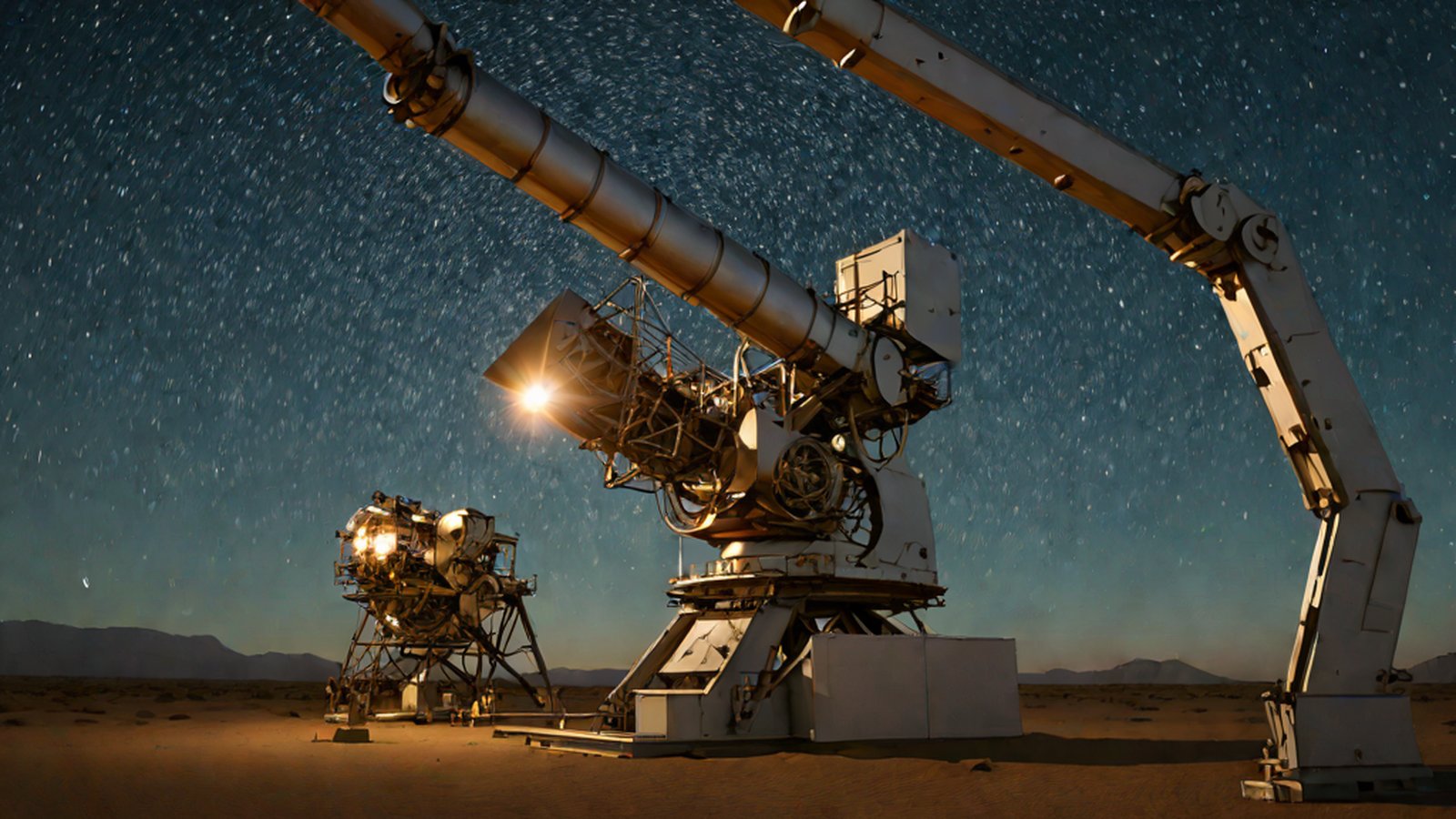
The AI technology 'Deep Loop Shaping,' developed by Google DeepMind and researchers, has maximized the precision of gravitational wave observatories, opening a new chapter in observing the birth and dynamics of the universe.
Listening to the Universe’s Heartbeat: How AI Captures ‘Micro-vibrations’ in Gravitational Wave Telescopes
When we look up at the night sky, the universe feels like an infinitely quiet and static space. However, according to scientists, the universe is actually full of very dynamic ‘sounds.’ It’s just that we humans lacked the sensory organs to hear those minute vibrations. Recently, humanity has succeeded in detecting extremely subtle tremors coming from the deepest parts of space through a special ‘hearing aid’ called Artificial Intelligence (AI).
Today, we will explore how AI is completely changing the way we observe the universe through the latest research published by Google DeepMind and its research team. This study has garnered significant attention in the scientific community, earning recognition for its value by being published in the world-renowned scientific journal ‘Science’ Using AI To Perceive The Universe In Greater Depth.
Why It Matters
Until now, our primary tool for observing the universe has been ‘light.’ We used telescopes to gather light from distant stars, take photos, and analyze them. However, light has a fatal drawback: it cannot reach our eyes if it is obscured by massive nebulae or planets. On the other hand, ‘gravitational waves’ are different.
Gravitational waves are ripples in spacetime caused by the violent movement of massive celestial bodies like black holes. These ripples pass through any obstacle in the universe to reach us. To use an analogy, they are like letters that have traveled billions of light-years, carrying messages containing the secrets of the universe.
The problem is that these gravitational waves are incredibly faint. The precision required to detect gravitational waves must be at a level capable of noticing if the distance to the farthest star from Earth changes by the thickness of a single human hair. The observatory built to capture these near-impossible changes is LIGO (Laser Interferometer Gravitational-Wave Observatory).
However, LIGO is so sensitive that its measurements fluctuate wildly even from the vibration of a truck passing near the observatory or the small sound of trees swaying in the wind. For humanity to properly understand the birth of the universe and the secrets of black holes, ultra-precision control technology that could ‘perfectly stabilize’ this sensitive equipment was essential Using AI to perceive the universe in greater depth.
The Explainer
1. Precision of 1/10,000th of a Proton
Let’s imagine for a moment. Suppose you have a very precise ruler, and the scale on this ruler is tens of thousands of times smaller than a ‘proton’ found inside an atomic nucleus. In reality, gravitational wave observatories measure length with an unimaginable accuracy of about 10 to the power of minus 19 (10^-19) meters. This corresponds to approximately 1/10,000th the size of a proton Using AI to perceive the universe in greater depth – ONMINE.
To maintain this level of precision, the mirrors installed inside the observatory must be perfectly isolated from external environmental disturbances. They must remain in an extremely calm state, like a balloon floating without even a slight movement in the middle of an anechoic chamber where all noise from the world is blocked Using AI to perceive the universe in greater depth – ONMINE.
2. How AI Holds the Mirrors: ‘Deep Loop Shaping’
The savior that appeared here is a new AI control technique called ‘Deep Loop Shaping’ Using AI to perceive the universe in greater depth.
To put it simply, it’s similar to using high-performance ‘noise-canceling’ earphones to hear the sound of a pin dropping on the floor at a very noisy construction site. However, AI’s role goes beyond simply blocking sound. The moment the observation equipment detects a minute external vibration, Deep Loop Shaping controls the equipment in real-time to counteract that vibration, correcting the mirror’s position in units of 0.00000…1mm. It acts as a ‘transparent hand’ that keeps the equipment from shaking even when external noise enters Using AI to perceive the universe in greater depth - ONMINE.
3. "Listening to the Universe’s Bass"
Professor Rana Adhikari, a physics professor at Caltech, explained this wondrous process with a very sensory analogy.
"Studying the universe using gravity instead of light is like ‘hearing’ instead of ‘seeing.’ Thanks to this research, we are now able to tune our channels exactly to the grand bass sound of the universe." Using AI to perceive the universe in greater depth - Solega Blog
In other words, it means AI filters out all kinds of surrounding noise, allowing us to focus entirely on gravitational waves, the deepest and grandest tremors of the universe.
Where We Stand
Currently, this AI technology has succeeded in dramatically improving the control capabilities of gravitational wave observatories. According to research results published in the journal ‘Science’ in September 2025, this technology is not just a theory in the lab but is being deployed to stabilize LIGO, the world’s most sensitive instrument, proving its real-world performance Breakthrough AI research — Google AI, Using artificial intelligence to perceive the universe with greater depth.
In the past, human scientists had to manually adjust numerous physical variables one by one. But now, AI learns on its own to find the optimal state of stability. This is a case that demonstrates how powerful AI can perform in the realm of precision that goes beyond human intuition Using AI to perceive the universe in greater depth.
What’s Next
What kind of future will unfold if humanity can ‘hear’ the universe more deeply and clearly?
- Finding the Origins of the Universe: The process of the universe expanding is often compared to a balloon inflating The mystery of how big our Universe really is. If we can observe gravitational waves more precisely, we can secure decisive evidence about when and with what force this ‘cosmic balloon’ first began to inflate (the Big Bang).
- The Start of Next-Generation Space Science: The ‘Deep Loop Shaping’ introduced this time will be a key to opening the next generation of gravitational wave science Using AI To Perceive The Universe In Greater Depth. It is expected that we will capture wondrous cosmic dramas in real-time, such as the collision events of more distant black holes or the end of massive stars.
MindTickleBytes AI Reporter’s Perspective
Gravitational wave observation is the ultimate challenge in precision engineering that humanity can attempt. When that precision descends to units much smaller than an atom, human senses and calculations are bound to hit their limits. At this very point, the way AI acts as a control technology providing ‘unshakable comfort’ is very symbolic.
AI has now moved beyond simply chatting as a chatbot or drawing cool pictures. It has now become a reliable assistant helping to solve the question humanity has held for thousands of years: "How did the universe begin?" Every time we listen to the grand heartbeat of the universe in the future, a great translator called AI will be there with us, clearing away the complex noise.
References
- Using AI to perceive the universe in greater depth - Google DeepMind
- Using AI To Perceive The Universe In Greater Depth - AI Future Thinkers
- Using AI to perceive the universe in greater depth - AI Pro Blog
- Using AI to perceive the universe in greater depth - ONMINE - ONMINE
- Using AI to perceive the universe in greater depth - Robotic Content
- Using artificial intelligence to perceive the universe with greater depth - AI Sckool
- Using AI to perceive the universe in greater depth – ONMINE - ONMINE (Accuracy and Mirror isolation)
- Using AI to perceive the universe in greater depth - Solega Blog - Solega Blog (Expert Quote)
- The mystery of how big our Universe really is - BBC Future (Universe expansion analogy)
- Breakthrough AI research — Google AI - Google AI (Publication date)

- Deep Learning Shaking
- Deep Loop Shaping
- Gravity Loop Control
- 10 times the size of a proton
- The same size as a proton
- 1/10,000th the size of a proton
- Observing cells with a microscope
- Hearing instead of seeing (tuning into the bass)
- Finding a way by drawing a map