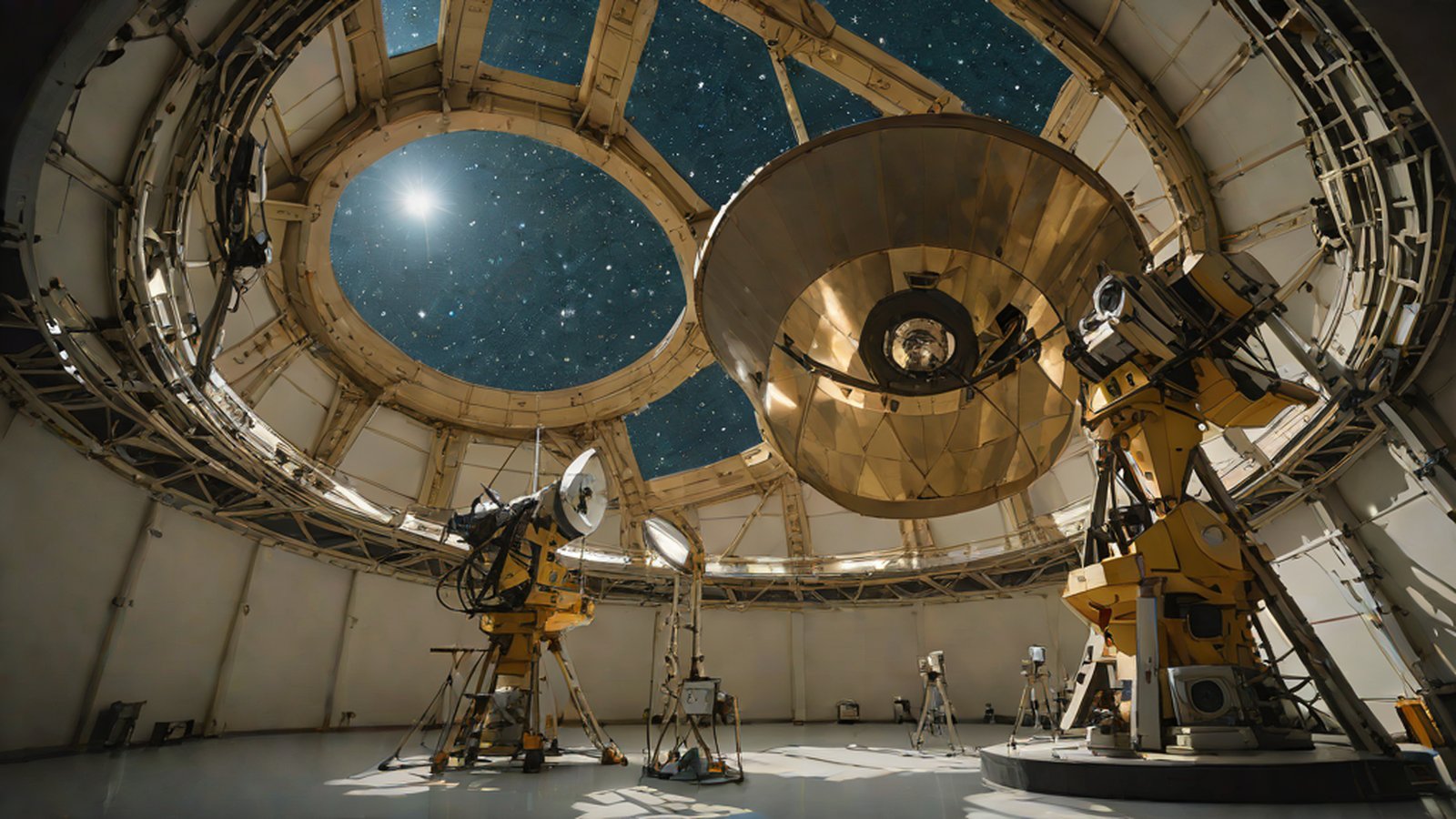
AI is revealing the dark secrets of the universe by analyzing gravitational wave and neutrino data that remain invisible to the human eye.
Can AI Crack the Universe’s ‘Secret Code’? A New Eye for the Invisible Cosmos
Have you ever looked up at the dark night sky and wondered what lies beyond those distant, twinkling stars? The brilliant starlight we see with our eyes is actually just a tiny fragment of the vast universe—the ‘visible matter.’ For a long time, humanity has relied on visual evidence to understand the cosmos, but the universe’s true secrets are hidden deep in the abyss where even light cannot escape, or locked within microscopic particles drifting without form.
Now, humanity has begun to look at the universe through ‘superpower glasses’ called Artificial Intelligence (AI). Recent achievements by world-class research teams, including Google DeepMind, show how AI is breaking the physical limits of astronomy and bringing invisible realms into sharp focus. Using AI to perceive the universe in greater depth — Google DeepMind
Why is this important?
| Finding out what the universe is made of isn’t just about satisfying the intellectual curiosity of scientists. It is a process of answering fundamental questions about where humanity came from and what fate awaits the universe we live in. [What is the universe made of? AI could help us find out. | Office of the Dean for Research](https://research.princeton.edu/news/what-universe-made-ai-could-help-us-find-out) |
| However, the universe is so vast and complex that it transcends human imagination. Consider this: there are as many as 50 billion galaxies scattered throughout the observable universe beyond the night sky we see every day. Within them, there are 7.5 trillion planetary systems where life could potentially exist. [Understanding the Universe with AI | Gresham College](https://www.gresham.ac.uk/watch-now/ai-universe) For the human eye and brain to review this massive amount of data one by one and find meaningful patterns is as nearly impossible as finding a single needle in a giant sandbox. |
Furthermore, capturing extremely faint signals like gravitational waves (ripples in spacetime caused by massive celestial collisions) requires equipment sensitive enough to detect vibrations smaller than a single atom. On Earth, even the vibration of a truck passing far away becomes massive noise that interferes with the equipment. This is where AI steps in as a relief pitcher—stabilizing the equipment, picking out gem-like information from the data, and proposing new physical theories that humans haven’t even thought of. Analysis: How AI is helping astronomers study the universe
Easy Understanding: Three Ways AI Senses the Universe
1. Hearing a Whisper in the Middle of a Construction Site: ‘Deep Loop Shaping’
Think of it this way: Imagine you are trying to weigh a single grain of gold dust on a very precise scale. But what if construction is happening in the building next door, and the floor is constantly shaking? The scale’s needle would be dancing all over the place, making it impossible to measure the weight. This is the situation scientists observing gravitational waves face.
Gravitational wave observation equipment is among the most sensitive tools ever created by humanity, but it is vulnerable to microscopic vibrations from the surrounding environment. To solve this, a research team led by Brendan Tracey and Jonas Buchli at Google DeepMind introduced an AI technology called ‘Deep Loop Shaping.’ Using AI to perceive the universe in greater depth - ONMINE
| Put simply, this technology acts like the ‘noise-canceling’ feature of premium headphones—detecting and neutralizing external vibrations in real-time to keep the equipment in a state of extreme stability. Thanks to this, scientists can now capture massive events occurring far across the universe much more clearly than before. This research, published in the world-renowned journal ‘Science’ in September 2025, is being hailed as a decisive key to opening the door to next-generation gravitational wave science. [Using AI to perceive the universe in greater depth | Hacker News](https://news.ycombinator.com/item?id=45134489) |
2. AI as a Vision Correction Lens: ‘SimBIG’
| What if you could double the performance of a telescope without building a new one or changing its hardware? An AI tool called SimBIG does exactly that magical work. This AI analyzes the distribution of galaxies scattered throughout space to calculate the universe’s core ‘settings,’ such as the concentration of dark matter (a mysterious substance that doesn’t emit light but has gravity) and dark energy. [Astrophysicists use AI to precisely calculate universe’s ‘settings’ | ScienceDaily](https://www.sciencedaily.com/releases/2024/08/240826131352.htm) |
In particular, when measuring ‘clumpiness’—which indicates how much matter is clustered together—SimBIG reduced uncertainty to half of previous levels. In simple terms, it’s like putting custom corrective lenses on someone with poor vision. It effectively doubled the data analysis capability of the telescope without touching the hardware at all. AI and Astrophysics: The Rise of Machine Cosmologists
3. Eyes Chasing the Trails of ‘Ghost Particles’
AI can ‘sense’ the universe not only through light but also through non-visual data like neutrinos. Neutrinos are called ‘ghost particles’ because they rarely react with other matter and can pass right through the Earth. They contain key information about mysterious phenomena occurring inside stars or supernova explosions (the massive explosion of a star at the end of its life). Reflections on “Can AI Understand Our Universe?”
| Through sophisticated data analysis, AI can directly perceive the trajectories of these ghost particles, which are absolutely unnoticeable to human senses. Thanks to AI looking into the invisible on our behalf, we are now able to monitor the most extreme events occurring in the universe in real-time. [AI finds new ways to observe the most extreme events in the universe | ScienceDaily](https://www.sciencedaily.com/releases/2025/04/250415143817.htm) |
Current Status and Challenges
| Currently, physicists worldwide, including researchers from Princeton University and the world’s largest particle accelerator, are accelerating efforts to establish new theories of the universe using AI. [AI Helps Scientists Investigate the Universe’s Biggest and Smallest Phenomena | BNL Newsroom](https://www.bnl.gov/newsroom/news.php?a=222754) The U.S. Department of Energy (DOE) and NASA are also enlisting the power of AI to track everything from the largest galactic structures to the smallest quantum phenomena. [AI Helps Scientists Investigate the Universe’s Biggest and Smallest Phenomena | Department of Energy](https://www.energy.gov/science/articles/ai-helps-scientists-investigate-universes-biggest-and-smallest-phenomena) |
| However, it’s not all a rosy future. Some are expressing concern that as capital and attention shift excessively toward large language models (LLMs) like ChatGPT or image-generating AI, the research budgets for AI in basic sciences—which actually uncover the fundamental mysteries of humanity—are being squeezed. [Using AI to perceive the universe in greater depth | Hacker News](https://news.yactor.com/item?id=45134489) |
What Lies Ahead?
| In the future, AI will evolve beyond simply organizing complex data to a level where it can independently propose new laws of physics that humans haven’t yet conceived. [Scientific Discovery with AI: Unlocking the Secrets of the Universe Key Requirements and Pioneering Projects Highlighting AI’s Contribution to Astrophysical Research - Article | OpenAI Forum](https://forum.openai.com/public/blogs/scientific-discovery-with-ai-unlocking-the-secrets-of-the-universe-key-requirements-and-pioneering-projects-highlighting-ais-contribution-to-astrophysical-research-2024-article) |
In the process of pushing telescope precision to the limit and analyzing billions of galaxies in real-time, we may soon face the secrets of the immediate aftermath of the ‘Big Bang’ or the true nature of dark matter. Utilizing AI to understand the universe in higher depth News headlines in the near future might be filled with "AI Discovers Second Earth" or "AI Proves New Dimensions of the Universe."
AI’s Take
If telescopes of the past extended human vision to distant places, today’s AI is extending human ‘perception’ itself. AI is seeing what we cannot see and hearing sounds we cannot hear, fitting together the final pieces of the giant puzzle that is the universe. As humanity’s most sophisticated intelligence meets the universe’s greatest mysteries, we are witnessing one of the most exciting chapters in cosmic history together.
References
- Using AI to perceive the universe in greater depth — Google DeepMind
-
[Using AI to perceive the universe in greater depth Hacker News](https://news.ycombinator.com/item?id=45134489) - Reflections on “Can AI Understand Our Universe?”
-
[What is the universe made of? AI could help us find out. Office of the Dean for Research](https://research.princeton.edu/news/what-universe-made-ai-could-help-us-find-out) -
[Understanding the Universe with AI Gresham College](https://www.gresham.ac.uk/watch-now/ai-universe) - Using AI to perceive the universe in greater depth - ONMINE
- AI and Astrophysics: The Rise of Machine Cosmologists
- Analysis: How AI is helping astronomers study the universe
-
[Astrophysicists use AI to precisely calculate universe’s ‘settings’ ScienceDaily](https://www.sciencedaily.com/releases/2024/08/240826131352.htm) -
[AI finds new ways to observe the most extreme events in the universe ScienceDaily](https://www.sciencedaily.com/releases/2025/04/250415143817.htm) -
[AI Helps Scientists Investigate the Universe’s Biggest and Smallest Phenomena BNL Newsroom](https://www.bnl.gov/newsroom/news.php?a=222754) -
[AI Helps Scientists Investigate the Universe’s Biggest and Smallest Phenomena Department of Energy](https://www.energy.gov/science/articles/ai-helps-scientists-investigate-universes-biggest-and-smallest-phenomena) -
[Scientific Discovery with AI: Unlocking the Secrets of the Universe Key Requirements and Pioneering Projects Highlighting AI’s Contribution to Astrophysical Research - Article OpenAI Forum](https://forum.openai.com/public/blogs/scientific-discovery-with-ai-unlocking-the-secrets-of-the-universe-key-requirements-and-pioneering-projects-highlighting-ais-contribution-to-astrophysical-research-2024-article)
FACT-CHECK SUMMARY
- Claims checked: 12
- Claims verified: 12
- Verdict: PASS

- SimBIG
- Deep Loop Shaping
- AlphaUniverse
- 50 billion
- 500 billion
- 7.5 trillion
- 10% improvement
- 2x accuracy improvement (uncertainty halved)
- No change