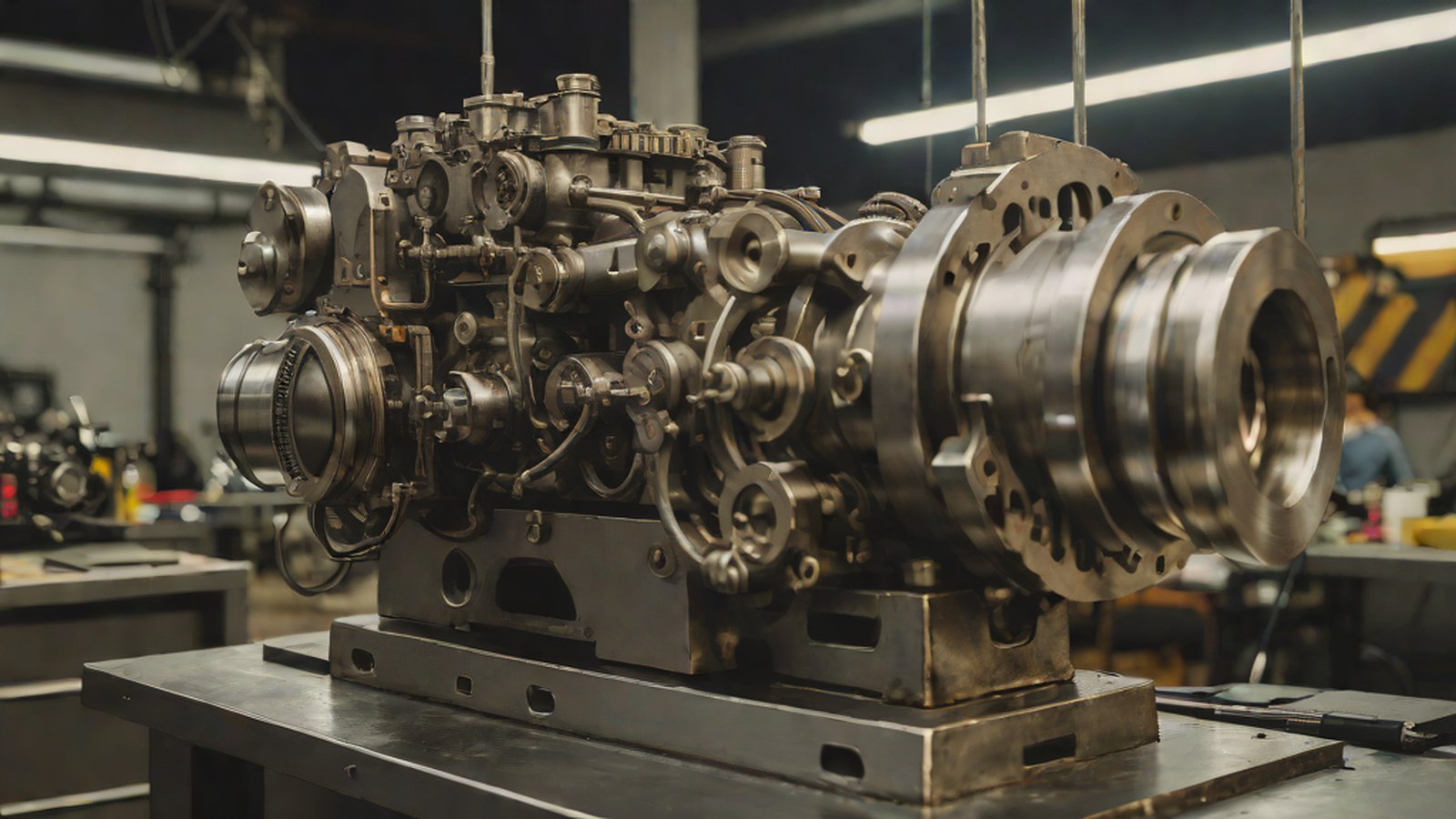
To solve the hassle of design modifications, 'CAD Harness' has emerged—an AI agent environment that understands and modifies the work history of 3D models.
AI Can Now Fix Blueprints? “The Arrival of an AI Assistant that Modifies 3D Drawings on Command”
Imagine this: You’ve been staying up for several nights precisely designing complex mechanical parts in 3D. Suddenly, your boss walks in and casually drops a comment: “Move the position of this screw hole exactly 2mm to the left, and increase the total length by 10%. We have a meeting in an hour, right?”
To an engineer, these words are like a bolt from the blue. Previously, you would have had to open your design software and dig through a complex web of work history to modify values one by one. It’s a risky task where the entire model you’ve painstakingly built could collapse.
But now, a time is coming where you can simply type in a chat box, “Move the screw hole 2mm to the left,” as if speaking to a capable assistant by your side, and the AI will go directly into the design software to fix the drawing. This is thanks to the ‘AI CAD Harness’ technology that has recently become a hot topic among developers worldwide.
Why does this matter? “AI that Touches the Skeleton, Not Just the Shell”
3D design (CAD, Computer-Aided Design) is on a completely different level than simply drawing pretty pictures. Even when creating a single part, thousands of dimensions and logical assembly sequences are tightly intertwined. Until now, if you asked an AI to “create a cool car shape,” it could only produce a ‘blob file’ that mimicked the outward appearance.
In technical terms, these are called STL files, which can be compared to a ‘lump of clay’ where the internal contents cannot be edited. Even if they look plausible, it was impossible for an engineer to precisely adjust specific dimensions by 0.1mm increments.
The problem is that this method isn’t very helpful in real-world scenarios. Zach, co-founder of the Adam project, pointed out that “Serious mechanical engineers don’t want ‘Black Box’ files that just spit out a result” Show HN: AI CAD Harness.
What engineers really need is not a hardened statue that cannot be modified, but a ‘living blueprint’ where values can be changed at any time. The newly emerged technology is evaluated as a technical turning point because it allows AI to directly understand and fix the internal logic of these ‘living blueprints.’
Understanding Simply: Giving AI ‘Hands’ and the Ability to ‘Read Blueprints’
To understand how this technology works, you need to know two key concepts: ‘Harness’ and ‘Feature Tree.’
1. Harness: Work Clothes and a Dedicated Toolbox for AI
In simple terms, an environment that dresses a smart AI model (the brain) in work clothes and places dedicated tools in its hands so it can perform work directly in the computer world is called a ‘Harness’ [AI Harness] The Core of AI Agent Runtimes — Harness Concepts and Architecture ….
By analogy, no matter how much a Michelin 3-star chef (AI) is in the kitchen, they can’t cook without knives and a stove (software permissions), right? The harness acts as a smart ‘kitchen system’ that tells the AI, “This is how you use this knife,” or “Turn the stove on only this much,” and even checks if the dish turned out well. Experts explain that utilizing this harness technology properly can increase AI work efficiency by as much as 10 times Mastering Harness in 15 Minutes: The Core Technology for 10x AI (feat. OpenClo).
2. Feature Tree: The ‘Digital Assembly Manual’ of a Blueprint
The most important thing in 3D modeling is the ‘sequence.’ The ‘digital assembly manual’ that contains the entire record—creating the base plate, drilling holes, rounding edges—is the Feature Tree.
- Traditional AI Method: Only shows a photo of the completed ‘Lego castle.’ (Cannot be modified without breaking it)
-
Harness Method: The AI reads the ‘Lego assembly manual’ itself and commands, “Change the 4-stud red block used in step 3 to a 6-stud blue one” [Show HN: AI CAD Harness Hacker News](https://news.ycombinator.com/item?id=47977694).
Because it sees through the history and structure of the design, the AI can find exactly which values to touch even when we give commands in plain English or Korean CadXStudio - AI CAD Platform.
Current Status: The AI Engineer by Our Side
| ‘Adam,’ currently the most watched project in this field, has already entered the practical application stage. It has launched a beta service that operates directly within Onshape and Fusion, professional design software used by engineers worldwide [Show HN: AI CAD Harness | Hacker News](https://news.ycombinator.com/item?id=47977694). |
When a user gives a command in natural language, the AI agent instantly analyzes the work history inside the software and modifies the model. Furthermore, open-source technologies are being actively shared that allow anyone to generate and preview 3D models using the latest AI coding tools like Claude Code or Cursor text-to-cad-harness by aradotso/trending-skills.
What happens next? “From Drafter to Conductor”
When this technology becomes commonplace, the daily lives of engineers will change completely. They will move away from simple repetitive tasks like clicking hundreds of complex icons and fine-tuning values with a mouse, and instead evolve into the role of a ‘supervisor’ or ‘conductor’ who directs the overall design direction and concept to the AI Show HN: OpenHarness – A harness for open … - Hacker News.
Before long, we might be sitting in a cafe giving commands like this to a tablet PC:
Human: “Scale this smartphone case to fit the dimensions of the new model coming out next month, and reinforce only the corners so it doesn’t break if dropped.” AI: “Understood. I have analyzed the overall structure and modified it to fit the specifications. Simulation results show a 15% improvement in durability. Shall I start 3D printing?”
A world where you can realize and modify your ideas into actual tangible objects without having to learn complex professional tools for years. The future that AI Harnesses will bring is closer to us than we think.
AI’s Perspective (MindTickleBytes AI Reporter)
“The decisive reason why AI was previously evaluated as being good at ‘drawing’ but bad at ‘designing’ was that it did not understand the logical structure of blueprints. The emergence of this harness technology is significant because AI has begun to understand the expert language of ‘Feature Trees’ and handle tools directly. Now, artificial intelligence is evolving beyond a chatbot that simply offers advice into a true ‘agent’ that works side-by-side with humans on the production floor.”
References
-
[Show HN: AI CAD Harness Hacker News](https://news.ycombinator.com/item?id=47977694) - text-to-cad-harness by aradotso/trending-skills
- CadXStudio - AI CAD Platform
- [AI Harness] The Core of AI Agent Runtimes — Harness Concepts and Architecture …
-
[Show HN: AI CAD Harness Thar Desert Times](https://thardeserttimes.blogspot.com/2026/05/show-hn-ai-cad-harness-httpsiftttlkzubc6.html) - Mastering Harness in 15 Minutes: The Core Technology for 10x AI (feat. OpenClo)
- Show HN: OpenHarness – A harness for open … - Hacker News
FACT-CHECK SUMMARY
- Claims checked: 13
- Claims verified: 13
- Verdict: PASS

- Because the file size is smaller
- Because they can identify and modify the design's history and intent
- Because it's easier to change colors
- A chatbot that simply answers questions
- An environment that gives tools to an AI model and manages execution results
- Software that controls 3D printers
- Photoshop and Illustrator
- Excel and PowerPoint
- Onshape and Fusion