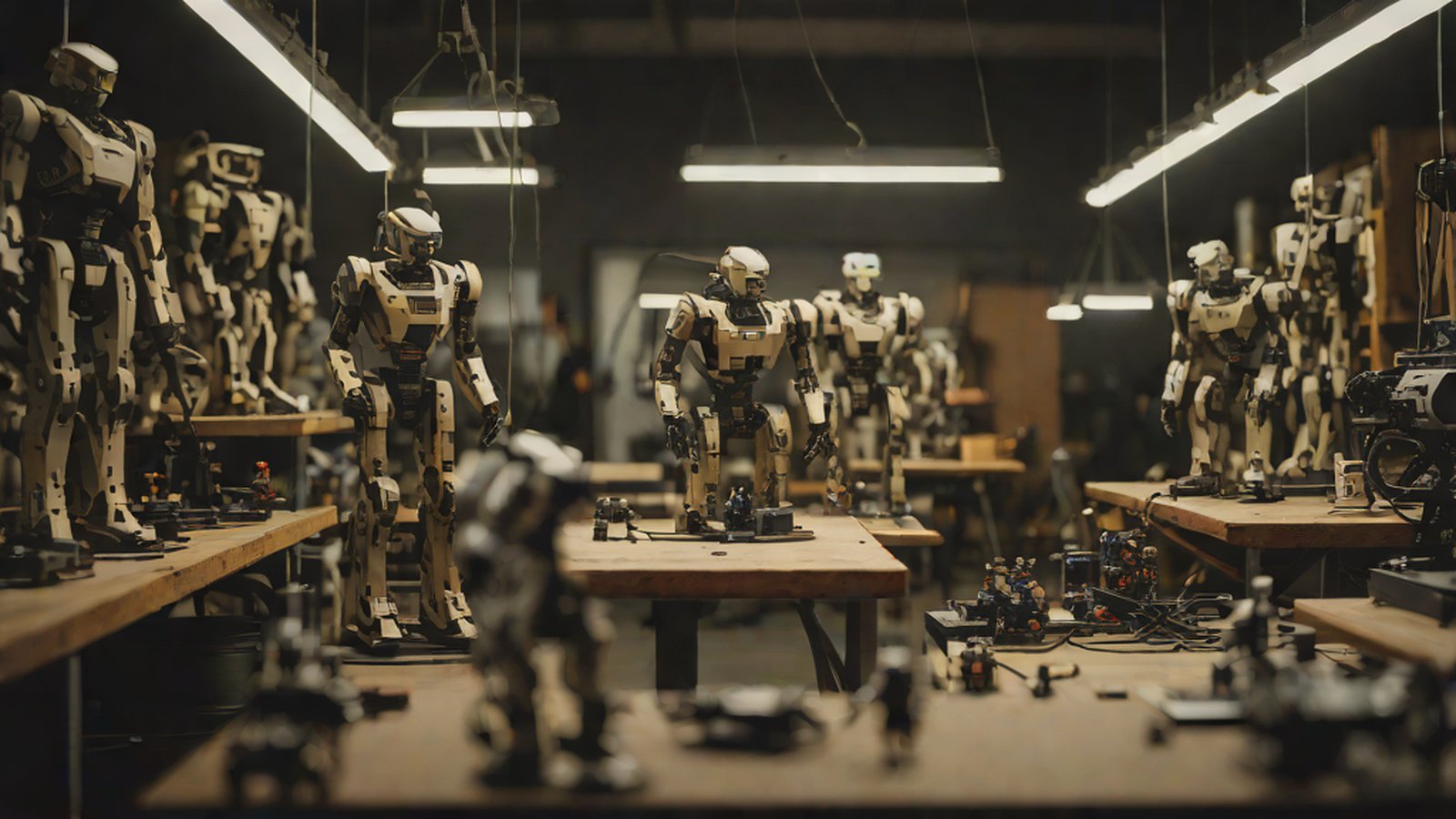
Robotics, once the exclusive domain of a few experts, is explosively evolving into an era where anyone can design and build their own custom robots at home, thanks to 3D printers, global open-source knowledge sharing, and cutting-edge AI technology that handles complex physics calculations.
Imagine this. On a relaxing Sunday morning, while having coffee, you look at your desk and see eraser crumbs, paper clips, and crumpled receipts scattered all over. Normally, you’d find a wet wipe and clean it up yourself, but today you sit comfortably in front of your computer and lightly tap your keyboard: “Draw me a blueprint for a cute little pincer cleaning robot, about 15cm the size of my palm, that can sweep up small trash on the desk.” Moments later, artificial intelligence displays a highly detailed 3D robot blueprint on your screen. You send this file to the 3D printer in the corner of your living room, and the machine quietly hums as it prints out plastic parts one by one. After assembling the printed parts and typing in a few lines of command code downloaded from the internet, your very own little cleaning robot, which only existed in your imagination moments ago, starts bustling around the desk clearing away the eraser crumbs.
| Does it sound like a scene from a sci-fi movie set in the distant future? Surprisingly, these things—which used to require massive costs running into tens of thousands of dollars and advanced expertise like a Ph.D. in robotics—are now frequently happening in the living rooms and on the desks of ordinary people. Recently on Hacker News, a famous US IT tech community and a mecca for developers worldwide, a list of no less than 61 different 3D printable robots that individuals can print and assemble at home caused a massive stir [[Show HN: Browse 61 3D Printable Robots | HN Enhanced](https://hn.makr.io/item/48139017)]. How have robots, once only seen in highly restricted corporate advanced research labs or gigantic auto factories carrying heavy chunks of metal, come so close to our lives as ordinary hobbies and educational toys? Today, MindTickleBytes will take an easy and fun look at the astonishing phenomenon of ‘robot democratization’ created by the combination of 3D printers, open source, and cutting-edge AI technology. |
Why It Matters
For a long time, building a robot yourself in everyday life was an uncharted territory firmly locked behind the massive barriers of ‘enormous capital and high-level expertise’. To create smoothly moving joints like human arms or legs, solid metal had to be precisely cut with machinery, and countless wires had to be intricately tangled to form delicate electronic circuits like a human nervous system. Furthermore, you had to flawlessly write programming code that controls motors through high-level mathematical calculations so the robot could move smoothly without falling over. This was a colossal project that was almost impossible to attempt unless you were a wealthy global megacorporation or a government-funded research institution. To the general public, a robot was nothing more than an expensive, finished product to pay for and watch at a large supermarket or exhibition.
In recent years, however, two massive technological waves that seemed completely unrelated have started to smoothly tear down this solid barrier. They are the ‘democratization of 3D printers’ and the spread of a warm ‘Open Source’ culture (a technology-sharing method where anyone can freely view and modify software blueprints or hardware designs without restrictions), where experts worldwide share their know-how for free on the internet.
First, let’s look at the active role of 3D printers driving hardware innovation. 3D printers, which melt plastic filament and build it up layer by layer based on 3D modeling data on a screen to create three-dimensional objects, have now become affordable enough for ordinary households to purchase without hesitation. This means that inventors no longer need to spend a lot of money and time outsourcing parts processing to factories. As long as you have a robot blueprint file on your computer, you can print anything from complex, precise gears to foundational joint parts right on your desk whenever you want.
Here, the most crucial second element explosively combines. Robotics engineers and hobbyists around the world have begun to release the 3D printable blueprints and codes of robots they perfected through tears and hundreds of failures completely free of charge on the internet. For example, if you visit Creazilla, a massive platform that shares 3D graphic models with people worldwide, anyone can unconditionally download over 550 different free robot 3D model files right now [550+ Free Robot 3D Models].
This shift has fundamentally changed the way we approach technology. In the past, large corporations monopolized the entire ecosystem from machine design to sales, but now, global collective intelligence is taking its place. It has opened an era of incredible opportunity where, just like downloading necessary apps from an app store on a smartphone, you can download ingenious robot blueprints created by people around the world, essential Bills of Materials (BOM), and core control codes that move the robot with just a few mouse clicks.
The place that most intuitively shows this trend is specialized sharing platforms like orobot.io. On this website, you can browse 23 types of 3D printable robots designed and built by users from around the world, just like an online shopping mall. What’s more innovative is that you don’t just look at their exteriors; you get the full package—from parts lists to 3D printer drawings and core control codes—allowing you to immediately start ‘making your own robot’ right on the spot [orobot.io — Home for 3D Printing Robots: Fast, Cheap, and Functional]. A true ‘democratization of manufacturing’ is being realized, as the cutting-edge technology of robotics escapes closed laboratories and pours into the living rooms of the general public.
The Explainer
To easily understand what this massive and seemingly complex change has to do with our daily lives, let’s compare it to delicious cooking. Imagine there are Michelin 3-star chefs who cook phenomenally well. Just a few decades ago, to taste their fantastic dishes, you had to buy an expensive flight ticket, visit a high-end restaurant in Paris or New York, and pay a hefty price for a meal. Their cooking secrets were closely guarded. Then one day, these chefs suddenly started sharing all their secret recipes 100% free of charge on YouTube and their personal blogs. (This is ‘open source’, the knowledge sharing of robotics engineers).
At the same time, an amazing change occurred in your ordinary kitchen. By simply downloading the chef’s recipe file from the internet and inputting it, a miracle $100 smart oven appeared that perfectly handles everything from tricky ingredient preparation to subtle heat control to produce top-tier dishes on its own. (This is a personal ‘3D printer’ that makes the parts for you).
Simply put, you are now in exactly the same situation where you can enjoy high-end French cuisine at home without ever stepping outside, simply by choosing a recipe and pressing the start button on your magic oven. The only difference is that the final output walking out of that oven isn’t a delicious meal, but a ‘robot’—a smart mechanical device that makes its own judgments and moves smoothly.
Currently, countless maker communities are overflowing with diverse and exciting ‘robot cooking recipes (open-source mechanical blueprints)’ that stimulate the imagination. A prime example of explosive popular appeal is a cute little robot called ‘Otto DIY’. This educational robot, which anyone can easily build like assembling Lego blocks, waddles on two feet while rolling its big eyes on a square head, and dances cutely to music. It also cleverly avoids obstacles using ultrasonic sensors. The assembly is so intuitive that even elementary school students can build it in half a day over the weekend with their parents. Beyond being a toy, this small robot becomes the world’s greatest teacher, intimately teaching the logic of coding and the basics of mechanical engineering [Otto DIY is a 3D printable open source robot].
There are also plenty of more advanced projects with slightly higher difficulty levels. The ‘Modular Bipedal Robot’ project, released for free on Thingiverse, a global 3D model sharing community, is quite serious. This robot is very delicately designed to analyze terrain, walk stably, and make judgments without human intervention. Moving beyond a toy that wanders around a room, it serves perfectly as a practical educational material offering an optimal exploration opportunity for engineering students or adult hobbyists who want to study electronics and control theory deeply [Bipedal Companion Robot (Open Source, 3D Printable)… - Thingiverse].
Where We Stand
We have now reached a stage where we can build complex mechanical devices useful in rough industrial sites or factories right on our cramped desks, going far beyond the level of cute toys. These are projects that look like miniature versions of the massive industrial robotic arms that used to move heavy chunks of metal amid sparks in automobile factories, scaled down to fit the size of a bedroom.
The ‘Thor’ robotic arm project, inspired by the name of the hammer-wielding god of thunder in Norse mythology, is a prime example of this success. Surprisingly, this robotic arm has no fewer than 6 joints (called ‘degrees of freedom’ in robotics)—like a real human shoulder, elbow, and wrist—enabling free 3-dimensional movement up, down, left, and right. This majestic robot boasts a rather massive presence with a total height of 625mm. Despite being made of plastic parts, thanks to its meticulous mechanical design, it possesses the strength to easily and safely lift heavy objects up to 750g (heavier than a bottle of water). This attractive Thor project is also transparently open-sourced on the internet, from its blueprints to its control codes. Without having to purchase commercial robot equipment costing tens of thousands of dollars, it is being innovatively used in university education settings and for programming practice by robot enthusiasts [GitHub - AngelLM/Thor: DIY 3D Printable Robotic Arm · GitHub].
What makes our hearts swell even more is the fact that not only amateur makers but also world-class researchers at prestigious universities have begun to willingly release their cutting-edge research results to the public. The human ‘hand’ has small, complex bones, ligaments, and muscles intricately intertwined, making it a monumental challenge in global engineering to naturally mimic it with a robot.
However, a research team led by Hyun-jun Park and Dong-han Kim at Kyung Hee University in South Korea has surprisingly succeeded in developing a state-of-the-art ‘Anthropomorphic Robot Hand System’ that highly precisely mimics the bone and joint structure of an actual human hand. Unlike stiff, conventional robot pincers, this robotic hand can smoothly bend its joints like a real person and stably grasp various objects, from round balls to thin paper.
| What truly deserves applause is that they didn’t just hide this great result—the fruit of years of blood and sweat—tightly away in academic papers and patents. The research team made the bold decision to generously release the detailed blueprints, complete with every screw hole marked, entirely free of charge to the world so that anyone on the planet with a 3D printer can try assembling this cutting-edge robotic hand that looks exactly like a human’s [[Korea: The 3D Printable Open-Source Anthropomorphic Robot Hand System (HRI) - 3DPrint.com | Additive Manufacturing Business](https://3dprint.com/264274/korea-3d-printable-open-source-anthropomorphic-robot-hand-system-hri/)]. Thanks to this, a massive ladder of knowledge has been created, allowing even a student in a small rural school in Africa or a university student in South America to vividly experience the highest level of advanced technology in their room at no cost. |
What’s Next
The romantic combination of 3D printer technology and the global open-source community we have examined so far is astonishing enough to change human lives. But there remained one inevitable regret that hindered the public from creating freely. The general public was ultimately stuck at the level of simply ‘downloading’ a ‘ready-made blueprint’ meticulously completed by someone brilliant, and printing and assembling it exactly as it is, without being able to change a single millimeter.
Let’s return to the cooking analogy once more. You can exactly follow a recipe a famous chef posted on a blog to make a great dish, but what if you want to break out of the existing mold and create ‘your own dish’ that produces completely new flavors and aromas the world has never seen before? You would have to learn high-level culinary techniques dealing with the chemical bonds of ingredients and precise temperature control from scratch.
Robotics is exactly the same. What if you wanted to design a completely new custom robot from scratch reflecting only your imagination? For example, building a flat cleaning robot that wipes dust off narrow window frames. To do this, you had to cross the massive barrier of learning how to proficiently use expensive and complex professional 3D design programs (CAD software) and acquiring specialized mechanical engineering knowledge to calculate the forces each part would endure. It was virtually impossible for a non-expert to master this overnight.
However, even this final barrier, which seemed like it would never fall, proved to be a paper tiger in the face of the recently exploding ‘Generative AI’ technology. The freedom to create truly customized hardware is finally opening up.
Recently, we’ve been experiencing the magic of telling ChatGPT in a casual sentence, “Write a touching novel about a cat traveling to space,” and having it write a smooth text in just a few seconds as an everyday occurrence. But now, this incredible creative ability doesn’t just stop at text and pictures. A completely unbelievable technology has emerged where even a person with zero mechanical engineering knowledge can simply type in everyday text like, “Make me a round robot that cleans up toys on the living room floor,” and the computer magically draws a perfect 3D robot blueprint that understands the intent and can be immediately printed with a 3D printer.
Researchers at Duke University in the US recently officially announced to the world a revolutionary AI program called ‘Text2Robot’ (meaning it converts text characters into actual robot models) [Duke researchers create program that can 3D print functional …]. The operating principle of this program is simple, but looking inside, it is incredibly sophisticated.
When a user inputs in natural, everyday language (Text), “Design a sturdy 4-joint robotic arm that can pick up a heavy textbook and place it on a desk,” the AI perfectly understands the objective. Then, based on vast amounts of global mechanical engineering data, it instantly calculates in just a few seconds the headache-inducing variables that would take a human engineer nights to figure out—how thick the joints need to be to support the weight, how to make space for the motors, and whether parts will collide. As a result, the user receives a customized 3D blueprint that can be immediately sent to a 3D printer and output without errors.
The true greatness of this AI lies in its ‘understanding of physics’. The AI doesn’t just act as a graphic designer drawing pretty pictures floating on a monitor. It has been meticulously trained to calculate complex physical laws strictly present in the real world—such as gravity, friction, and motor rotational force (torque)—when generating blueprints.
Thanks to this, the blueprints spat out by this AI aren’t just pretty pictures to look at. When the parts are actually printed and assembled, a real, physical robot is born that functions brilliantly exactly as originally intended, without breaking under the weight of heavy motors [Duke researchers create program that can 3D print functional …]. Zachary Charlick of Duke University, who participated in this research, explained that this is a symbolic result showing that the infinite capability of artificial intelligence, which used to write text on monitors, is boldly expanding beyond the digital world into the field of physical ‘machine manufacturing’ that we can touch with our own hands [Duke researchers create program that can 3D print functional …].
The perfect encounter of powerful AI and affordable 3D printers will completely transform our upcoming future. Now, you don’t need to work hard to get a Ph.D. in robotics or become a technician cutting heavy chunks of metal to turn your brilliant ideas into reality. You are fully prepared if you just have a warm and rich imagination to make the world a slightly more convenient place, and the basic text-input ability to clearly explain what you want to the AI in writing.
Imagine it. “Design an assistive robotic cane custom-fitted for my grandmother, covered in a very light and soft sponge material, so that my beloved grandmother sitting in her wheelchair can easily pick up a remote control dropped on the floor without painfully bending her back.” A world where your affectionate words are transformed into precise 3D blueprints through a massive AI brain, and those files are printed by a small 3D printer in your living room, reborn as a warm assistive device in the real world that you can gift to your grandmother.
A world where you directly design and build a household assistant robot that is 100% perfectly tailored to your own lifestyle, and where curious elementary school students print out the wacky inventions they only imagined into real physical hardware in just a few hours, cheering with joy. The era of the perfect ‘personalized 1-person 1-robot factory’ is already here, where your mind’s imagination immediately becomes a relentlessly running production line, rather than the massive factory conveyor belts of large corporations.
AI’s Take
MindTickleBytes’ AI Reporter’s Take: The ‘Open Source’ spirit, where countless intellectuals around the world generously share valuable knowledge for humanity without any economic conditions or compensation. And the powerful ‘Generative AI’ that replaces the most difficult hardware machine design process, which is hard for ordinary humans to master, in just a few seconds. The dramatic convergence of these two technological worlds is completely shaking up and reinventing the massive capital-centric manufacturing paradigm that has stood firm for hundreds of years.
Robotics is no longer a difficult and boring discipline for an elite few geniuses locked in university labs or thick textbooks. This tool of knowledge is now perfectly wide open to everyone from young children to the elderly, evolving into the most creative and joyful play culture that materializes the wacky imagination in your head into immediate reality right before your eyes in just a few hours through the magic wands of AI and 3D printers. What kind of robot is your imagination ready to print out?
References
-
[Show HN: Browse 61 3D Printable Robots HN Enhanced](https://hn.makr.io/item/48139017) - 550+ Free Robot 3D Models
- orobot.io — Home for 3D Printing Robots: Fast, Cheap, and Functional
- Otto DIY is a 3D printable open source robot
- Bipedal Companion Robot (Open Source, 3D Printable)… - Thingiverse
- GitHub - AngelLM/Thor: DIY 3D Printable Robotic Arm · GitHub
-
[Korea: The 3D Printable Open-Source Anthropomorphic Robot Hand System (HRI) - 3DPrint.com Additive Manufacturing Business](https://3dprint.com/264274/korea-3d-printable-open-source-anthropomorphic-robot-hand-system-hri/) - Duke researchers create program that can 3D print functional …

- AutoRobot
- Text2Robot
- RobotGPT
- 250g
- 500g
- 750g
- Anthropomorphic Robot Hand
- Bipedal Robot Legs
- Humanoid Robot Spine