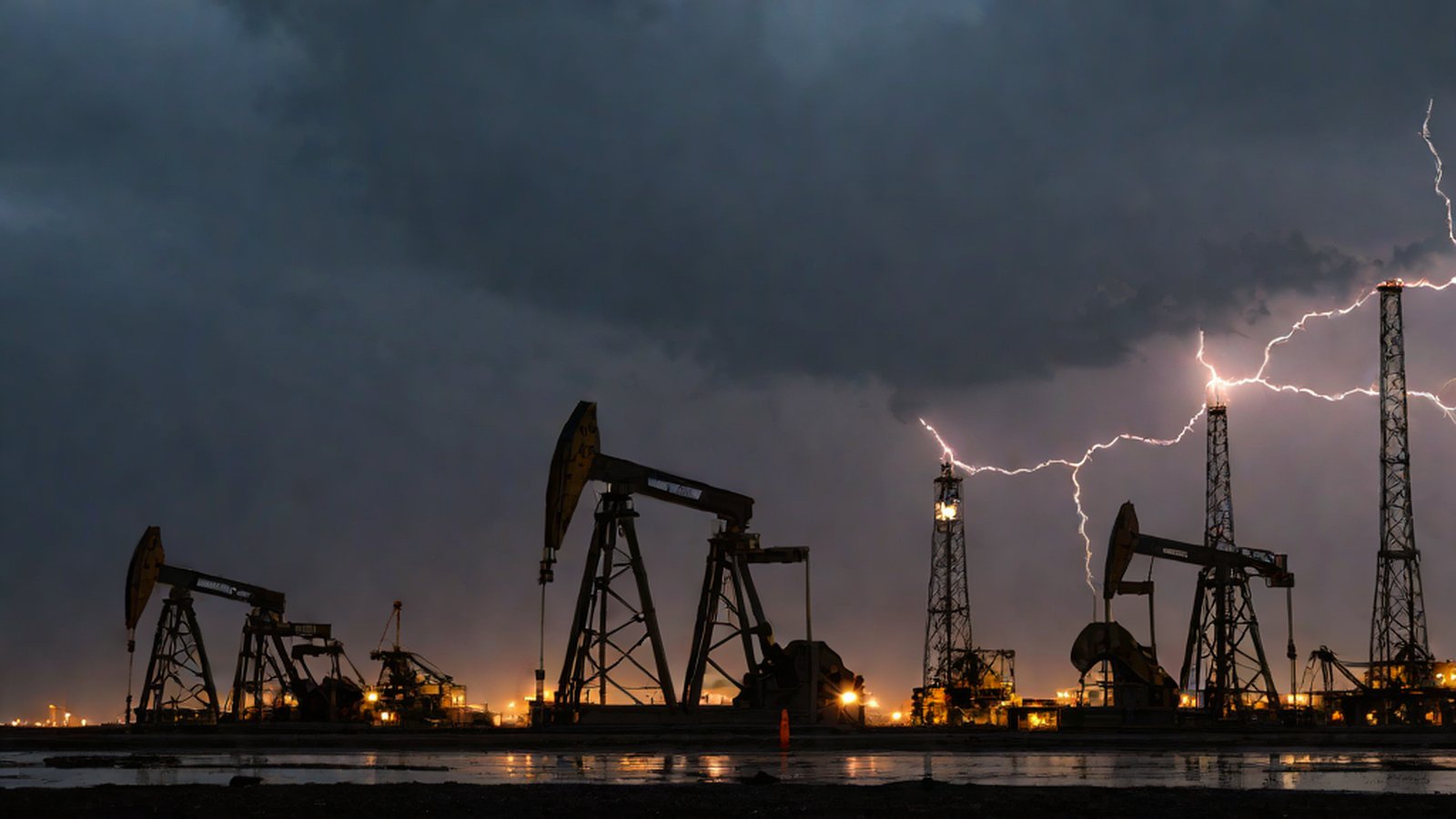
The Middle East crisis triggered by the armed conflict between Israel and Iran has caused international oil prices, the KRW-USD exchange rate, and global government bond yields to skyrocket simultaneously, plunging the global economy and the Korean market into an unprecedented panic sell.
Imagine this: On an ordinary payday morning, you head to work feeling good, grabbing your usual cup of coffee. But you notice that gas prices at the station have jumped overnight, and there’s a notice at your lunch spot that the price of an imported beef burger set has risen due to the exchange rate. To make matters worse, in the afternoon, you receive a chilling text message from the bank stating that your mortgage interest rate is set to rise significantly. How would it feel to have three massive holes suddenly ripped into your wallet?
This gloomy and suffocating scenario is, unfortunately, the cold and harsh reality currently facing the global economy, and especially the South Korean economy. These days, whenever you turn on the news, there are reports of the stock market turning blue with fear, and the voices of economic experts are filled with unprecedented concern. What exactly is happening behind the scenes of our lives?
The cause began in the far-off Middle East. As the military conflict involving Israel, Iran, and the United States escalated beyond mere posturing toward a full-scale war, the three core gears that drive the global economy—international oil prices, the KRW-USD exchange rate, and global government bond yields—have all begun to skyrocket simultaneously. The media and the markets are calling this the dreaded ‘Triple Surge’ [Triple Surge in Oil, Exchange Rate, and Interest Rates | Korea Economic Daily](https://www.hankyung.com/article/2026051844701).
Today, I’ll explain exactly what this ‘Triple Surge’ means, why these three negative factors are exploding at the same time, and what kind of terrifying butterfly effect they will have on our daily lives and precious bank accounts—explained as simply and clearly as a smart friend talking over a cup of coffee.
Why It Matters
Even if you haven’t studied economics deeply, you probably instinctively feel that the terms ‘gas prices,’ ‘exchange rate,’ and ‘loan interest’ are closely intertwined with our lives. When these three skyrocket at once, it’s like a massive merchant ship (our economy) sailing the ocean suddenly having three large holes torn in its hull. With water pouring in from three different directions, it becomes incredibly difficult for the ship to stay afloat.
The first hole is ‘Oil Prices.’ When oil prices rise, it doesn’t just mean higher costs for a weekend drive. From chemical plants that make the plastic containers we use every day to the large trucks that transport flour and vegetables to the supermarket, and even the power plants that generate electricity to run factories—costs explode everywhere. Eventually, the numbers on the price tags of the snacks, ramen, and cosmetics we pick up at the store start to climb.
This surge is particularly cruel for South Koreans. This is because South Korea has an economic structure that is extremely dependent on foreign energy, ranking first in crude oil consumption among OECD member countries [Korea Ranks 1st in OECD Crude Oil Consumption... Directly Hit by Triple Blow of Oil, Exchange Rate, and Interest Rates | Seoul Economic Daily](https://m.sedaily.com/article/20014869). When oil prices rise, South Korea’s economy is often the first to be hit hard due to this Achilles’ heel.
The second hole is the ‘Exchange Rate.’ What does it mean when the value of the dollar reaches for the stars and the KRW-USD exchange rate surges? Put simply, it means that while you used to pay 1,300 won for a $1 imported loaf of bread, you now have to pay 1,500 won. Prices for everything from essential food resources like wheat, corn, and beef to expensive core components in smartphones and cars jump instantly. With prices already rising due to oil, the rising exchange rate pours fuel on the fire, causing a double or triple whammy of inflationary pain. Some are even engaged in heated debates over whether this weakened won is due to expanded overseas investment or excessive liquidity [Weakened Won, 'Is it My Fault or Yours?'... 3 Issues Shaken by the Exchange Rate](https://magazine.hankyung.com/business/article/202512181363b).
The third hole is ‘Interest Rates.’ When global government bond yields rise, the loan interest rates at your local bank naturally follow suit. Whether it’s those who stretched their finances to the limit to achieve the dream of homeownership or self-employed individuals who borrowed money to run a restaurant, the burden of monthly interest payments grows like a snowball. People with less disposable income naturally cut back on dining out and shopping, and businesses unable to sell products stop hiring, starting a terrifying vicious cycle.
Ultimately, this triple surge acts like a giant black hole that raises production costs for companies, empties consumers’ pockets, and sucks the vitality out of the entire economy. It is because of this brutal chain reaction that investors in global stock markets are succumbing to extreme fear and rushing to sell off their stocks in what is known as a ‘Panic Sell’ [Triple Explosion of Oil, Exchange Rate, and Interest Rates... The World is Panic Selling - Financial News](https://www.fnnews.com/news/202603041315586910).
The Explainer
So why are these three economic indicators, which usually move independently, rising all at once as if they had made a pact? At the epicenter of it all is the Middle East, thick with the smell of gunpowder and hot desert winds.
Let’s imagine the situation like a scene from a tense spy thriller. The psychological warfare between Israel and Iran crossed a line, escalating into an armed conflict with missiles and drones streaking across the night sky. With signs of U.S. involvement, the situation has grown out of control. Furthermore, as the U.S. President set a chilling ‘48-hour ultimatum’ as a deadline for resolving the dispute, the immediate fear that a full-scale war could break out tomorrow has swallowed global financial markets [Triple Crisis of High Oil, High Exchange Rate, and Rising Bonds... KOSPI Panic 'Predictions are...' | News1](https://www.news1.kr/finance/general-stock/6110674).
Let’s trace how this fear of war turns into specific economic waves.
1. Fear of Middle East War → Skyrocketing Oil Prices
The Middle East is the heart that pumps the world’s crude oil. What if war burns down oil production facilities or blocks the narrow sea lanes where massive tankers pass? A primal fear that the global economy will be paralyzed due to a lack of oil to run factories and move cars hits the market. It’s like how bottled water and ramen instantly disappear from local supermarkets and prices jump when news of an approaching typhoon breaks.
2. Spreading Fear → Surging KRW-USD Exchange Rate (Rising Dollar Value)
When war breaks out or the world turns chaotic, what do global investors trust the most? It’s the currency guaranteed by the world’s strongest power: the ‘US Dollar.’ To avoid risk, investors sell stocks in countries like South Korea and start hoarding cash dollars. Since everyone is looking for dollars, the dollar’s value becomes more precious, while the relative value of our currency falls, causing the exchange rate to rise.
3. Fear of Inflation (Rising Prices) → Surging Global Bond Yields
This is the most complex but interesting part. Usually, when a war breaks out, people flock to buy ‘US Treasuries’ (documents where the US government promises to pay interest), which are considered the safest assets. Normally, when the popularity of government bonds increases, the interest rate (yield) falls.
But this time was different. What dominated people’s minds was not the war itself, but the fear of inflation: ‘What if oil prices skyrocket and global prices spiral out of control?’ [Triple Shock of Oil, Exchange Rate, and Interest Rates... 'Korea Most Vulnerable to Stagflation...' | Seoul Economic Daily](https://www.sedaily.com/article/20014733).
Think of it this way: skyrocketing prices mean the value of money is melting away. Suppose a laptop you can buy for 1 million won today will cost 1.3 million won next year. If you invested in a government bond paying 5% interest, you get back 1.05 million won next year. The laptop price rose by 300,000 won but your interest was only 50,000 won, so you’ve effectively suffered a huge loss. Consequently, investors sold off even their government bonds, leading to the paradoxical situation where bond yields spiked sharply.
On top of this, Google released ‘TurboQuant,’ a powerful market analysis AI, adding a variable that shook the financial industry. As a storm from AI landed on top of the dark clouds of rising oil and interest rates, the domestic financial market fluctuated wildly and stock prices plummeted [Financial Market Fluctuates Due to 'Triple Negative Factors' of Oil, Interest Rates, and TurboQuant... KOSPI... | MI News](https://www.m-i.kr/news/articleView.html?idxno=1359006). Eventually, the KOSPI index fell into a state of panic where no one could predict the immediate future [Triple Crisis of High Oil, High Exchange Rate, and Surging Bonds... KOSPI Panic 'Predictions are Meaningless'](https://www.msn.com/ko-kr/money/경제/고유가-고환율-국채-급등-트리플-위기-코스피-패닉-예측은-무의미/ar-AA1Zc9mq).
Where We Stand
Looking at the current indicators in cold numbers is truly nerve-wracking.
As of the 18th, Brent crude futures—the benchmark for European oil—rose vertically to $110.93 per barrel. The psychological threshold of $110 has been ruthlessly breached ['Triple Surge' in Oil, Exchange Rate, and Interest Rates - Nate News](https://news.nate.com/view/20260518n29935) ['Triple Surge' in Oil, Exchange Rate, and Interest Rates — TradingView News](https://kr.tradingview.com/news/hankyung:89c8ebab965a7:0/). US West Texas Intermediate (WTI) also recorded $106.25 per barrel, skyrocketing like a beast by 10.52% in a single day [[World Economic Trends Briefing for the Second Week of May] KOSPI Flat, KOSDAQ Plummets... Exchange Rate and Interest Rates Rise Together](https://v.daum.net/v/20260516123738126).
Conversely, gold prices—traditionally a safe asset—actually fell to $4,539 per ounce, an unusual phenomenon [[World Economic Trends Briefing for the Second Week of May] KOSPI Flat, KOSDAQ Plummets... Exchange Rate and Interest Rates Rise Together](https://v.daum.net/v/20260516123738126). This is because, in this moment of crisis, an extreme hoarding mentality has kicked in where people don’t even trust gold and are selling it off to secure ‘cash dollars’ they can use immediately ['Triple Surge' in Oil, Exchange Rate, and Interest Rates... The World is Panic Selling | Daum | Financial News](https://v.daum.net/v/20260304134127320).
In this chaos, optimistic forecasts from the past have lost their power. There was a time when analysts predicted that inflation in developed countries would stabilize, interest rates would fall, and exchange rates would gradually decline [Samil Insight: 2025 Domestic and International Economic Outlook, December 2024 - Finding a Way for Survival Amidst Peak Uncertainty](https://www.pwc.com/kr/ko/insights/samil-insight/samilpwc_economic-outlook2025.pdf) [Samil PwC l Samil Insight, Samil Management Research Institute, December 2025](https://www.pwc.com/kr/ko/insights/samil-insight/samilpwc_economic-outlook2026.pdf), but reality is moving in the exact opposite direction.
Economic expert Oh Gun-young, head of Shinhan Premier Pathfind, delivered a sharp warning: "Stock market surge because interest rates are being cut? That’s a historic delusion." [Technical Analysis of Stock Prices, Interest Rates, and Exchange Rates: Beware of the Won-Yen Rate at 950 - YouTube](https://www.youtube.com/watch?v=ShYjHJeljcs). He pointed out the painful truth that even if interest rates are lowered, stock prices are bound to plummet if corporate performance is destroyed by skyrocketing oil prices.
What’s Next
The most feared worst-case scenario is the arrival of ‘Stagflation.’
Stagflation is the most difficult economic illness to treat, where the economy stops growing (Stagnation) but prices skyrocket (Inflation). Simply put, it’s a situation where your salary stays the same but grocery prices double.
If the South Korean economy, already weakened in its basic strength, is hit by the punches of surging oil prices and exchange rates, companies will collapse unable to handle raw material costs, and consumers will tightly close their wallets. Ultimately, there is a stark warning that the entire nation is likely to slowly sink into the bottomless swamp of stagflation [Triple Shock of Oil, Exchange Rate, and Interest Rates... 'Korea Most Vulnerable to Stagflation...' | Seoul Economic Daily](https://www.sedaily.com/article/20014733).
For the time being, the financial market is expected to continue its roller-coaster ride with no clear end in sight. Unless the Middle East conflict is resolved dramatically, the march of high oil prices and exchange rates is unlikely to stop easily.
In the face of such a storm, it is very dangerous to engage in ‘debt-fueled investing’ based on the hasty assumption that "this must be the bottom." There is a reason why experts are asserting that we are in a market where "prediction is meaningless" [Google News - Overview](https://news.google.com/stories/CAAqNggKIjBDQklTSGpvSmMzUnZjbmt0TXpZd1NoRUtEd2lobW9UYUVCRjdkNzVQbFR4ZEF5Z0FQAQ?hl=ko&gl=KR&ceid=KR:ko). Rather than recklessly raising the sails, now more than ever is the time for the mature wisdom of securing plenty of cash and waiting for the economic waves to calm.
MindTickleBytes AI’s Perspective
“This is the most painful economics lesson, showing how gunfire on the other side of the planet changes our dinner table prices and mortgage interest rates. In an hyper-connected era, ‘another country’s war’ is a matter of ‘my survival.’ When fear dominates the market, defensive risk management to protect assets is the greatest virtue and the biggest gain, rather than chasing reckless profits.”
References
[Triple Surge in Oil Prices, Exchange Rates, and Interest Rates | Korea Economic Daily](https://www.hankyung.com/article/2026051844701)['Triple Surge' in Oil, Exchange Rate, and Interest Rates — TradingView News](https://kr.tradingview.com/news/hankyung:89c8ebab965a7:0/)['Triple Surge' in Oil, Exchange Rate, and Interest Rates... The World is in a Panic Sell - Financial News](https://www.fnnews.com/news/202603041315586910)[Financial Market Fluctuates Due to 'Triple Negative Factors' of Oil, Interest Rates, and TurboQuant... KOSPI... | MI News](https://www.m-i.kr/news/articleView.html?idxno=1359006)['Triple Surge' in Oil Prices, Exchange Rates, and Interest Rates - Nate News](https://news.nate.com/view/20260518n29935)[Triple Shock of Oil, Exchange Rate, and Interest Rates... 'Korea Most Vulnerable to Stagflation...' | Seoul Economic Daily](https://www.sedaily.com/article/20014733)[Triple Crisis of High Oil, High Exchange Rate, and Rising Bonds... KOSPI Panic 'Predictions are...' | News1](https://www.news1.kr/finance/general-stock/6110674)[Korea Ranks 1st in OECD Crude Oil Consumption... Directly Hit by Triple Blow of Oil, Exchange Rate, and Interest Rates | Seoul Economic Daily](https://m.sedaily.com/article/20014869)[Triple Crisis of High Oil, High Exchange Rate, and Surging Bonds... KOSPI Panic 'Predictions are Meaningless'](https://www.msn.com/ko-kr/money/경제/고유가-고환율-국채-급등-트리플-위기-코스피-패닉-예측은-무의미/ar-AA1Zc9mq)['Triple Surge' in Oil, Exchange Rate, and Interest Rates... The World is Panic Selling | Daum | Financial News](https://v.daum.net/v/20260304134127320)[Google News - Overview](https://news.google.com/stories/CAAqNggKIjBDQklTSGpvSmMzUnZjbmt0TXpZd1NoRUtEd2lobW9UYUVCRjdkNzVQbFR4ZEF5Z0FQAQ?hl=ko&gl=KR&ceid=KR:ko)[Technical Analysis of Stock Prices, Interest Rates, and Exchange Rates: Beware of the Won-Yen Rate at 950 - YouTube](https://www.youtube.com/watch?v=ShYjHJeljcs)[Samil Insight: 2025 Domestic and International Economic Outlook, December 2024 - Finding a Way for Survival Amidst Peak Uncertainty](https://www.pwc.com/kr/ko/insights/samil-insight/samilpwc_economic-outlook2025.pdf)[Samil PwC l Samil Insight, Samil Management Research Institute, December 2025](https://www.pwc.com/kr/ko/insights/samil-insight/samilpwc_economic-outlook2026.pdf)[Weakened Won, 'Is it My Fault or Yours?'... 3 Issues Shaken by the Exchange Rate](https://magazine.hankyung.com/business/article/202512181363b)[Investment Guide for the Month 2026.05: Connect to Hana the Next via QR Code or Subscribe to the KakaoTalk Channel 'Hana the Next'](https://hana1qm.com/resources/web2/pdf/202605/2026년5월투자가이드.pdf)[[World Economic Trends Briefing for the Second Week of May] KOSPI Flat, KOSDAQ Plummets... Exchange Rate and Interest Rates Rise Together](https://v.daum.net/v/20260516123738126)

- Skyrocketing international oil prices
- Surging global government bond yields
- Plunging KRW-USD exchange rate
- A total global halt in government bond issuance
- Fear of devastating inflation (rising prices) caused by skyrocketing oil prices
- Record-breaking earnings announcements from global tech giants
- The lowest level of household debt and a strong domestic market among global nations
- Extremely high dependence on crude oil consumption, ranking first among OECD member countries
- A total lack of trade volume with the Middle East region