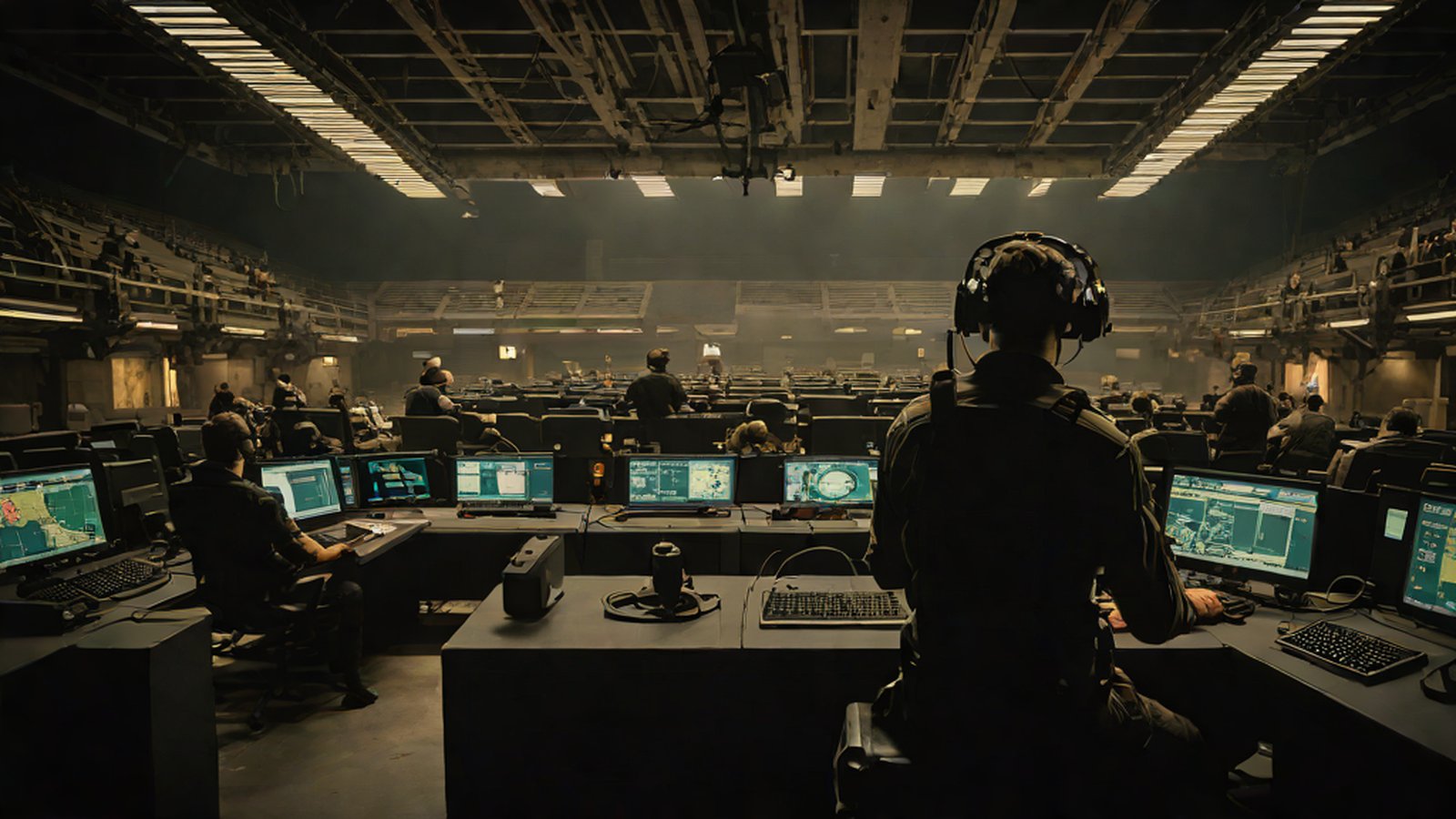
Agora-1 is a revolutionary AI model that allows humans and AI to interact together in the same virtual space (world simulation) in real-time.
Imagine this. On a weekend afternoon, you put on a Virtual Reality (VR) headset and log into an online game. Several characters are running around on the screen. Someone is hiding behind a wall waiting for an opportunity, while someone else exchanges glances with a teammate to coordinate a strategy. But there’s one surprising fact: half of the characters running with you in that space are real people, and the other half are Artificial Intelligence (AI). Even more amazing is that this complex game world itself isn’t a fixed map painstakingly coded by a programmer, but a world that the AI is ‘imagining and drawing’ in real-time according to your movements at every moment.
The AI we commonly know existed beyond the text input windows of smartphones or computers. It was a smart assistant that returned written answers when you typed, “Can you tell me a bibimbap recipe?” or “Please translate this sentence.” However, recent AI technology is completely breaking out of this square text box and stepping into a visual world where time, space, and physical laws exist. The fact that AI is gaining a 3D sense of space like ours means that it is ready to deeply integrate into human life.
In the race to develop technology that allows AI to perceive and act in spaces like reality, leading companies around the world are competing fiercely. In the midst of this, the AI startup Odyssey ML has released a very interesting and surprising research result. They have officially unveiled ‘Agora-1’, a Multi-Agent World Model that allows humans and AI to mingle and interact together in the same virtual simulation in real-time Odyssey ML releases Agora-1 multi-agent world model with…. This news is evaluated as an important milestone that previews how humans and AI will share physical environments in the future, going beyond a simple new product announcement.
Why It Matters
No matter how dazzlingly AI like ChatGPT has developed today, there is still a fatal limitation to overcome: it does not intuitively understand ‘how the world works physically.’ A human baby instinctively learns through a few experiences that pushing a glass on a table causes it to fall to the floor and shatter, even without knowing complex physics formulas for gravity or the properties of glass. However, teaching this three-dimensional sense of space and physical laws to an AI that has only read and learned from text documents is more difficult than one might imagine.
The concept that emerged to solve this challenge is the ‘World Model.’ It refers to a structure where an AI predicts what will happen in the world in the next moment when a certain action is taken by learning from vast amounts of video data and physical interactions, and then generates the result in video form. Simply put, it has acquired the ability to simulate how the world works in its ‘mind.’
So, why is Agora-1, announced by Odyssey ML, special? The answer lies in its ‘Multi-Agent’ nature (the simultaneous existence of multiple entities in one space) Agora-1: The Multi-Agent World Model. Existing world model research has mainly focused on Single-Agent models. This was at the level of releasing a single AI robot in an empty virtual playground and teaching it how to walk or pick up objects by itself.
However, the real world we live in is never an empty playground where we exist alone. Numerous people interact incessantly, and unexpected situations occur everywhere. Agora-1 is remarkably designed so that multiple participants, including human players and AI models, can connect to the same world simulation environment and share the space in real-time Experience Agora-1. This means that the core technology necessary for creating guide robots that navigate through crowds on a busy morning subway or collaborative robots that work in sync with human workers in giant warehouses has finally taken its first step. It signifies an evolution from an AI that simply looks at the world to an AI that lives in the world with us.
The Explainer
If the technical terms feel a bit unfamiliar, let’s use an analogy.
Think of the traditional 3D video games we commonly enjoy. They are like ‘gigantic, elaborately pre-assembled Lego castles.’ Game developers use programs like Unreal Engine to pre-define the sturdiness of walls, the size of doors, and the angle of incoming light with millions of lines of code. Users simply move along allowed paths within the Lego castle that the developers built sturdily. If the developer didn’t pre-program a ‘water spilling’ situation, nothing happens even if you overturn a cup in the game.
On the other hand, latest world models like Agora-1 are closer to a ‘magic sketchbook that thinks for itself.’ In this sketchbook, there isn’t a single pre-completed drawing. Instead, the sketchbook (AI) itself deeply understands the principles of physical laws. When you take the action of “taking a big step forward” in virtual reality, the AI calculates in 0.1 seconds how the field of view should change and what shape the shadow on the floor should take, then draws the next scene on the sketchbook. The world is created in real-time through the AI’s momentary reasoning ability, not through vast amounts of code.
Now, add Agora-1’s greatest weapon, the ‘multi-agent’ capability. This magic sketchbook is no longer the exclusive property of one person. A grand impromptu stage unfolds where multiple people and AIs jump onto one endless canvas, taking on different roles and performing.
Imagine the scene in your head. Within a virtual restaurant canvas, a human participant accidentally bumps into a water cup and spills it (Action). Then, the AI canvas immediately draws the water spreading and flowing across the table (Change in physical environment). At the same time, an AI waiter sharing the same space witnesses the scene, picks up a rag from the corner, and wipes up the water (Real-time interaction). In traditional methods, a programmer would have had to manually input the rule ‘pick up a rag when water is spilled,’ but not anymore. All of this is an organic result created as the AI itself understands the world and shapes the situation in real-time, rather than being based on a script (code) written by someone in advance Agora-1: The Multi-Agent World Model. A complete ecosystem is established where each individual’s small actions affect the entire world, and that changed world in turn leads to the reactions of other participants.
Where We Stand
At this point, you might have a reasonable doubt: “Will this imaginary technology actually work properly in reality?” After all, there is still a big difference between the world inside a computer and the physical laws of reality. Odyssey ML wanted to clearly prove to the public that this technology isn’t just a theory written on a lab whiteboard. So, surprisingly, they released a ‘Playable research preview’ version that anyone can access on a website and play directly Odyssey ML releases Agora-1 multi-agent world model with….
The most interesting part is the demonstration method they chose. Instead of a complex manual, Odyssey ML chose to simulate the deathmatch mode (where participants compete for survival in one space) of ‘GoldenEye’, a classic masterpiece shooter game familiar to many Odyssey ML introduces Agora-1, a multi-agent world model that…. This classic game, which people used to enjoy by splitting a small TV screen into four with friends, has now become a testing ground for cutting-edge AI.
When you access the preview and start playing, a tense confrontation begins as humans and several AI characters are entangled in the same virtual space, chasing and avoiding each other. On the surface, it might look like an old game with somewhat crude graphics. However, the technical magic happening behind the screen is completely different. This screen is not drawn by a traditional 3D game engine. Only a single, massive AI model called Agora-1 absorbs all the input values of the various players running around in an instant, calculates how the entire space should change, and continuously ‘generates’ and live-broadcasts new video screens in real-time Experience Agora-1.
When a human player fires a gun and a brick breaks, this world simulated by the AI in real-time immediately reflects the physical destruction effect on the screen. And the AI characters in the same room perceive the sound of the breaking brick and hurriedly hide behind other cover. It is a wondrous sight where a single AI model controls everything from the generation of physical laws to the intelligent judgment of multiple characters at once.
What’s Next
| Immediately after Odyssey ML’s surprise announcement, a very heated discussion took place on Hacker News, a giant community where Silicon Valley engineers and global IT experts gather, about how technologies like Agora-1 will change the world in the future [Agora-1: The Multi-Agent World Model | Hacker News](https://news.ycombinator.com/item?id=48183748). |
Above all, the field experts are most excited about is real-world Robotics. One Hacker News user provided a very sharp insight: “For this technology to ultimately transition successfully to real-world robots, the AI must perfectly learn the internal world state of the virtual world itself.”
What does this mean? Until now, robot researchers mainly used 3D game engines to train robots. This was because game engines allowed a type of ‘cheating’ by looking at internal data (exact 3D coordinates of objects, weight, etc.). However, when a robot is brought into the real world, such perfect internal data cannot possibly exist. On the other hand, world models like Agora-1 do not have cheat keys to open internal data; they train by seeing the world with cameras and internalizing physical laws themselves. Robots trained this way can adapt much faster to new environments even if they are dropped into the streets of the real world away from virtual space, just as we humans see the world with our eyes and intuitively grasp the situation.
| Of course, it’s not all a rosy future. In the Hacker News discussion, ‘truly unbounded problems’ were cited as a giant barrier that such world models must overcome [Agora-1: The Multi-Agent World Model | Hacker News](https://news.ycombinator.com/item?id=48183748). While simulation within a narrow and limited map where a gunfight occurs might be a brilliant success, whether AI can reliably withstand the complexity of a real metropolitan center where weather changes frequently, thousands of cars are entangled, and infinite variables pour out will be the biggest technical challenge ahead. |
Nevertheless, we are clearly standing at a historic turning point. We are entering the era of truly Embodied AI (AI that has a physical reality and interacts with the world), sharing the same air as AI and influencing each other’s actions in real-time, moving beyond the era of chatbots that only spat out text from monitors. In the not-too-distant future, we will routinely see our cars and dozens of autonomous AI vehicles smoothly navigating narrow alleys while watching each other, and robots in factories quickly reading human facial expressions to lift heavy objects at the right timing. Agora-1 is the great first sketchbook drawn by humanity toward that dynamic future we only vaguely dreamed of.
Perspective from MindTickleBytes’ AI Reporter
“The expansion of world models from single-agent to multi-agent carries a very symbolic meaning. AI is now evolving from a lonely genius assistant that only shouted given answers into a true partner that knows how to understand others’ actions and cooperate immediately in a complex and noisy world. True technological innovation in the future will start not just from the sophisticated graphics we see, but from that invisible power of connection that calculates momentary interactions among numerous participants without error. The stage for tomorrow, where we live and breathe with AI, is already being prepared.”
References
- Odyssey ML releases Agora-1 multi-agent world model with…
- Agora-1: The Multi-Agent World Model
- Experience Agora-1
-
[Agora-1: The Multi-Agent World Model Hacker News](https://news.ycombinator.com/item?id=48183748) - Odyssey ML introduces Agora-1, a multi-agent world model that…

- It increased document translation speed by 10 times compared to existing AI.
- Humans and multiple AIs can interact in real-time within the same world simulation.
- It is a technology that drastically reduces computer battery consumption.
- A multiplayer-based 'GoldenEye' deathmatch simulation
- A real-time price prediction dashboard for the stock market
- A program that analyzes medical records of doctors and patients
- Lego blocks assembled according to a pre-arranged blueprint
- An automated answering machine that repeatedly plays recorded voices
- A magic sketchbook that calculates and draws the physical laws of the next scene in real-time according to the user's actions