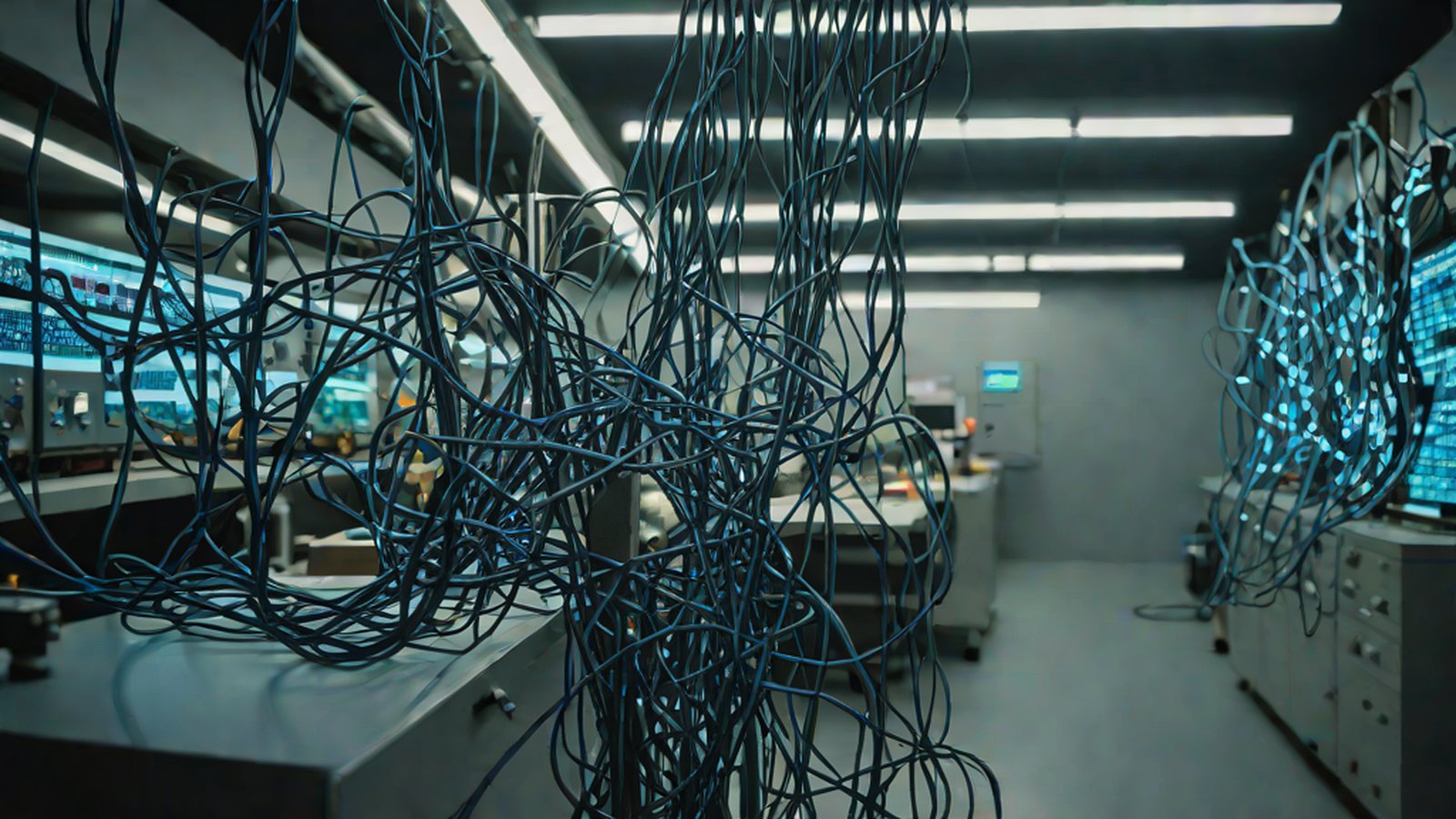
Tendril is a self-extending AI technology where the AI autonomously programs and permanently utilizes the features it needs, without developers having to hand it the tools.
Imagine you commissioned a highly skilled carpenter to build a complex, beautiful wooden house. However, just as construction is about to begin, a tricky situation arises: a specialized curved saw, capable of cutting wood in a specific circular angle, is missing from the toolbox. How would a typical human worker or a conventional robot of the past react in this situation? They would probably stop working, display an error message saying, “This task is impossible without a curved saw,” or request the owner, “Please go buy a new tool.”
But the special, new technology we are discussing today behaves in an entirely different way. Instead of spitting out an error and halting, it pauses its work, gathers scrap metal lying around, melts it in a hot fire, and hammers away to forge a perfect curved saw tailored exactly to its needs right on the spot. Furthermore, it doesn’t just use the saw once and throw it away; it carefully registers it in a corner of its toolbox and naturally pulls it out to use proficiently the next day when building another house.
This magical story is no longer an exaggerated scene from a sci-fi movie. A new artificial intelligence project called ‘Tendril,’ which is rapidly emerging as the hottest topic among software developers and AI researchers worldwide, is actually doing exactly this.
| If you look up the word ‘Tendril’ in an English dictionary, you will have an “aha!” moment realizing why this name was attached to this innovative project. The English word tendril refers to a slender, threadlike stem that climbing plants, such as ivy or grapevines, use to cling to and climb up other objects like walls or pillars [TENDRIL | definition in the Cambridge English Dictionary](https://dictionary.cambridge.org/us/dictionary/english/tendril). |
Shall we dive a little deeper from a botanical perspective? According to botanical encyclopedias, a tendril is a specialized structure where a plant’s leaves or stems have mutated for survival. This tendril possesses a keen sense (thigmotropism) that, upon physical contact with a surrounding object, allows it to detect the object, coil around it, and grip it tightly. Thanks to these tendrils, climbing plants can structurally support themselves in harsh, barren, and complex natural environments, extending infinitely higher towards the sky and wider across the terrain Tendril — Grokipedia.
The reason this new AI is named Tendril is very clear. When the AI encounters an unfamiliar problem (a wall) it needs to solve, instead of giving up or stepping back, it generates a new form of software code (a tendril) to tightly embrace and break through the problem. Just as plants adapt their structures and expand their supports in response to changing environments, this AI demonstrates the phenomenal ability to extend and invent new software tools tailored to the complex tasks it faces.
Why It Matters
Then why is this technology so crucial to our daily lives and the future of tech? To fully understand its impact, we first need to clearly point out the fatal limitations of the current generation of AI technologies we use every day.
Think about the voice assistants in your smartphones or the conversational AI chatbots sweeping the globe. They possess vast knowledge from reading countless books and are incredibly smart, capable of conversing as naturally and fluently as humans. However, they essentially resemble entities trapped inside a giant glass box. This is because these AIs are strictly designed to use only the ‘tools pre-provided by human developers.’
For instance, if you ask an AI, “What is the fine dust level and weather in Seoul today?”, the AI fetches the ‘meteorological agency weather search tool’ that human developers connected months ago to find the answer. If you instruct it to “Book a flight ticket for tomorrow,” it uses a pre-built ‘airline reservation tool.’ But what if human developers hadn’t pre-connected a tool in the system to perform the specific function you requested? No matter how smart or massive the AI’s brain is, it will freeze and say, “I’m sorry. I do not have the authorization or function to perform that task directly in the system.” In other words, while previous AIs were proficient at ‘using’ tools, they could not ‘create’ tools that didn’t exist in the world.
However, Tendril tackles and breaks down this massive wall of limitation head-on. According to Tendril’s official development repository, this project is a sort of ‘self-extending agentic sandbox’ that demonstrates a model’s ability to autonomously discover, build, and continuously reuse tools across multiple work sessions GitHub - serverless-dna/tendril · GitHub.
Put simply, Tendril evolves on its own without developers having to spoon-feed it every single tool. A ‘Sandbox’ means an isolated environment where new codes can be safely tested without worrying about breaking the computer system, much like children playing safely in a sandbox. And an ‘Agent’ means a proactive AI that goes beyond simply executing instructions to autonomously planning and acting toward a final goal.
When these technologies are combined, the AI can think like this: “To analyze this complex user data, I need code that reads Excel files and automatically draws graphs. Since there is no external tool, I must write that code right now and permanently add it to my feature list.” It judges on its own and puts it into immediate execution.
This paradigm shift is bound to bring massive ripples to our daily lives and the entire IT industry. Until now, countless tech companies had to pour enormous amounts of time and money into hiring dozens of developers to manually connect thousands of external tools (APIs) just to make AI assistants a little smarter.
But what if this ‘self-extending pattern’ like Tendril becomes commonplace? Users will just casually toss the final goal to the AI: “Analyze this month’s household ledger and create a report to reduce food waste.” The AI will then autonomously create and utilize intermediate tools in real-time, such as a bank app connector, an image analyzer for receipts, and an Excel document generator. This means AI can evolve inherently without the endless input of human labor, which will act as a massive driving force to explosively accelerate the pace of AI tech development and our work efficiency.
The Explainer
Then how on earth can such magical things happen inside a computer in real-time? Let’s break down the complex technical principles so anyone can easily understand how a computer program can self-modify its code during execution, add new features, and use them on the fly.
The Tendril project did not create everything from scratch but was built upon two core technologies as its backbone: the latest ‘AWS Strands Agents SDK’ provided by Amazon Web Services (AWS) and ‘Tauri,’ which allows developers to build fast, lightweight desktop applications GitHub - serverless-dna/tendril · GitHub. Here, an SDK (Software Development Kit) is like a box of professional-grade Lego blocks. By utilizing a robust AI toolbox that someone else had already built well, Tendril’s foundation was laid quickly.
But the part where the real magic happens lies in Tendril’s unique method of making the system recognize the newly created tools. Generally, the smartphone apps or computer programs we use require turning the device off and on or restarting the app when a new feature (update) is added. This is because they are designed to read their entire structure only the moment the program first boots up.
However, Tendril boldly discards this outdated philosophy and adopts a highly flexible and innovative method called ‘scan-on-invocation’ See the Building Self-Extending CLI Tools article, AWS DevOps & Developer Productivity Blog.
As an analogy, it’s like the kitchen of a very busy, high-end restaurant (the traditional computer program). Suppose the head chef says mid-cooking, “I need a new copper frying pan to cook this steak!” and buys one from outside. In a conventional kitchen, you would have to pause service, turn off all the stoves, register the new pan in the ledger, and then restart service just to use that pan. It’s a frustrating system where the flow is constantly interrupted.
But the magical kitchen using the ‘scan-on-invocation’ method is entirely different. In this innovative kitchen, whenever the chef opens the cooking tools cupboard (whenever a command is executed), the kitchen management system scans the inside of the cupboard in 0.1 seconds. If it finds a new frying pan, it immediately says, “A new frying pan has been added! Use it for cooking right away!” and gently places it into the chef’s hand without needing to turn off the kitchen’s open sign.
The way Tendril actually works perfectly matches this analogy. Inside the Tendril system, there is a small folder named tools/. When the AI autonomously writes new Python programming code to invent a tool, this code is slipped neatly into this folder as an independent file.
The very next moment, whenever Tendril attempts to execute a task via its Command Line Interface (CLI, a method of entering text on a black screen), the application glances into this tools/ folder in the blink of an eye. And simply by discovering new features there, it automatically slips them into the AI’s tool bag in real-time without the complex process of turning the whole program off and on [Building Self-Extending CLI Tools with Strands Agent |
AWS DevOps & Developer Productivity Blog](https://aws.amazon.com/blogs/devops/building-self-extending-cli-tools-with-aws-strands/). Thanks to this process of absorbing code naturally without pausing, an endlessly expanding AI could be born. |
Where We Stand
Listening to the explanation so far, Tendril feels like an omnipotent AI that effortlessly transcends human limitations and evolves infinitely. However, the cold reality of software engineering doesn’t roll as smoothly as a beautiful theory.
| In Hacker News, the world’s largest IT community where tech industry front-line experts and Silicon Valley hackers gather, highly realistic and sharp critiques poured out regarding Tendril’s technical experiment and garnered deep empathy [Tendril – a self-extending agent that builds and registers its own tools | Hacker News](https://news.ycombinator.com/item?id=47921377). |
| The core opinion of one expert that received the most support painfully pointed out to Tendril, “Now you have two problems” [Tendril – a self-extending agent that builds and registers its own tools | Hacker News](https://news.ycombinator.com/item?id=47921377). This is a famous joke in the programming world indicating that introducing overly complex technology to solve a specific problem ultimately doubles the pain as you end up having to manage that complex technology itself. |
| Why did experts give such harsh evaluations to this cool Tendril that supposedly grows on its own? A Hacker News critic pinpointed a clear reason. They pointed out that even if you let the AI repeat the process of making tools on its own just a few dozen times, eventually the AI’s entire tool repository will be filled with “noise”—garbage tools that are completely useless in everyday situations [Tendril – a self-extending agent that builds and registers its own tools | Hacker News](https://news.ycombinator.com/item?id=47921377). |
Let’s go back to the kitchen analogy. Imagine buying all sorts of bizarre functional tools—a specialized apple peeler, a dedicated avocado seed knife, special scissors for garlic ends—in an attempt to shorten cooking time. They might be useful at first, but what happens when hundreds of these specialized tools pile up in the drawer? The moment you need a plain kitchen knife to chop scallions, you’ll suffer immense stress sweating and rummaging through a drawer tangled with all kinds of junk.
| The side effects a self-evolving AI like Tendril will experience are perfectly identical. As Hacker News users worried, the tools an AI churns out in urgent situations will overwhelmingly likely be “extremely specific to the task at hand” [Tendril – a self-extending agent that builds and registers its own tools | Hacker News](https://news.ycombinator.com/item?id=47921377). |
If you ask, “Organize today’s meeting minutes,” instead of creating a general-purpose text summarization tool, the AI might forge a ‘tool that specifically extracts statements made by a particular person in the marketing department’s morning meeting on May 27, 2026, into Excel’. It becomes disposable digital trash that is completely useless when summarizing another department’s meeting minutes the very next day.
| The biggest problem is that the AI does not throw away these useless tools it created. A terrible redundancy problem occurs where thousands of features doing essentially the same work, with only slightly different names, are duplicated [Tendril – a self-extending agent that builds and registers its own tools | Hacker News](https://news.ycombinator.com/item?id=47921377). Eventually, the AI falls into a swamp where it gets confused reading through thousands of tool manuals every time it receives a new prompt, becoming much slower and dumber than when it had no tools. |
What’s Next
Despite these painful limitations and critiques, the innovation the Tendril project has thrown into the IT world cannot be lightly disparaged. This is because it represents the first serious attempt by an artificial intelligence, which used to passively consume only the tools spoon-fed by humans, to proactively grasp the situation, create tools, and pioneer its own intellectual ecosystem.
Although the current Tendril might look like an overzealous novice chef making a mess of the kitchen drawer, unable to organize the numerous tools it has created. However, the fact that it has proven this autonomous architecture works successfully—where an AI writes code, saves it to the computer, and instantly summons it for reuse without rebooting the system, all without human intervention—is an enormous leap forward.
Future experts agree that for self-extending artificial intelligence like Tendril to achieve truly useful evolution, it must essentially combine the ‘ability to discard’ tools as boldly as the ‘ability to create’ new ones.
Recall the botanical tendril metaphor again. If a climbing plant unconditionally extends tendrils in all directions, it will collapse under its own weight. For a plant to grow sturdy, it needs the wisdom of nature to cut off dead branches and useless tendrils where nutrients no longer flow.
The core challenge of future AI development will be focused on how to properly ‘prune’ these ‘software tendrils’. An ‘auto-decluttering’ ability must be introduced, allowing the AI to scan and discard disposable tools that haven’t been used for over a month, or to compress similar tools into a single, general-purpose integrated tool. Only when this complex technical puzzle is successfully solved will we meet a perfectly independent digital assistant that continuously adapts to ever-changing environments and infinitely expands its intelligence.
AI’s Take
As with all great innovations, the unexpected barrier of ‘decluttering’ always awaits on the path to perfect automation. The ability to create tools on its own demonstrated by Tendril is undoubtedly a magical advancement that marks an epoch in the history of artificial intelligence. However, true independence and the completion of intelligence cannot be achieved merely by adding features.
For artificial intelligence to not lose its way in an endlessly expanding sea of data and code, and to become truly smart, it must learn not only the explosive energy to create endlessly but also the mature wisdom to boldly discard what is useless. Just as a tree without pruning cannot grow healthily, only an AI that has learned to forget and delete can branch out into a taller, sturdier tech ecosystem of the future.
References
-
[TENDRIL definition in the Cambridge English Dictionary](https://dictionary.cambridge.org/us/dictionary/english/tendril) - Tendril — Grokipedia
- GitHub - serverless-dna/tendril · GitHub
-
[Building Self-Extending CLI Tools with Strands Agent AWS DevOps & Developer Productivity Blog](https://aws.amazon.com/blogs/devops/building-self-extending-cli-tools-with-aws-strands/) -
[Tendril – a self-extending agent that builds and registers its own tools Hacker News](https://news.ycombinator.com/item?id=47921377)

- The property of growing towards sunlight
- A slender stem that wraps around surrounding objects upon contact
- Roots that create their own nutrients
- Scan-on-invocation
- Auto-reboot
- ML Compiling
- The risk of autonomously creating computer viruses
- Creating too many tools, filling the tool repository with 'noise'
- Cloud server costs being too high