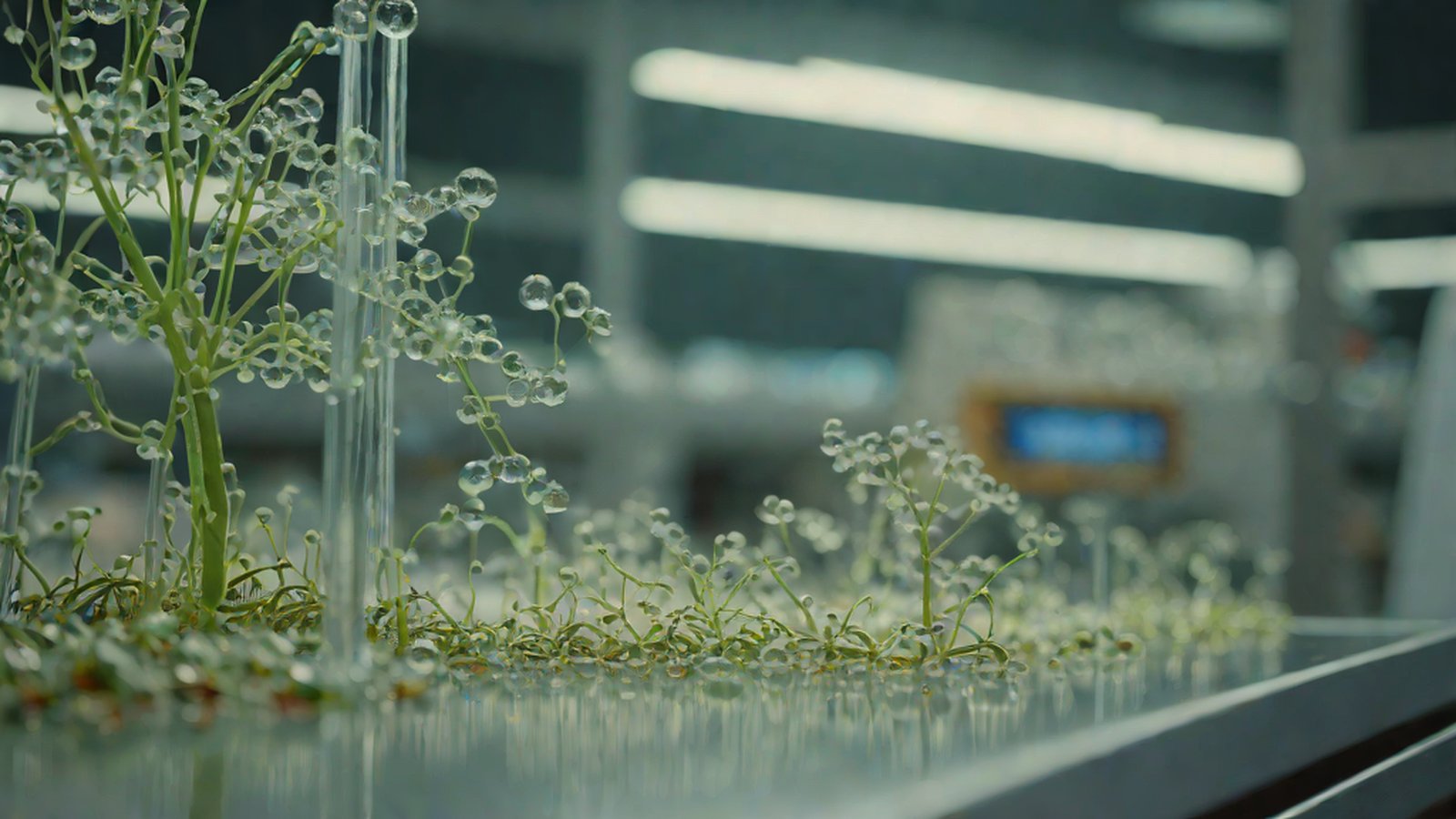
OpenAI has launched 'GPT-Rosalind,' a specialized AI model for pharmaceuticals and drug development, positioning it as a research partner for scientists beyond just a tool.
Imagine this: Early in the morning, a scientist in a white coat sits at a laboratory computer with a morning coffee. Instead of fumbling through hundreds of pages of complex papers or databases with a mouse, they casually talk to the Artificial Intelligence (AI) on the screen.
“Can you design a new compound structure that can neutralize this specific virus? And optimize the experimental plan for me to conduct this afternoon.”
As soon as the question ends, the screen displays the optimal drug structure and detailed experimental sequences, having instantly calculated countless variables that would take the human brain decades to process. Does it sound like a scene from a science fiction movie? Surprisingly, it is not. This is a reality that has begun to happen in top-tier laboratories around the world right now.
| Moving beyond voice assistants that live in our smartphones and tell us the weather to help us choose our outfits, AI is now directly diving into the front lines of “curing diseases”—one of humanity’s greatest challenges and aspirations. On April 16, 2026, OpenAI, the creator of ChatGPT that startled the world, introduced ‘GPT-Rosalind,’ an AI model specifically built to assist in life sciences research and drug development [[Introducing GPT-Rosalind for life sciences research | OpenAI](https://openai.com/index/introducing-gpt-rosalind/)]. |
The name of this intelligent model was inspired by ‘Rosalind Franklin,’ the great scientist who laid the solid foundation of modern molecular biology by uncovering the double-helix structure of DNA [OpenAI Launches GPT-Rosalind for Life Sciences Research]. While the Rosalind Franklin of the past provided humanity with the crucial key to unlocking the secrets of life, today’s digital Rosalind is helping the process of creating new life-extending medicines using that key. What special capabilities does this new AI researcher possess, and how will it change our lives and health in the future?
Why It Matters
Bringing a new drug to the world—whether it’s a cold medicine we easily find at a pharmacy or a cancer drug prescribed at a hospital—is a much more difficult and arduous task than finding a tiny needle in a seemingly endless beach. This is because countless chemical substances must be combined in various ways and tested one by one to see if they can cleanly treat only the target disease without side effects when they enter the human body. This process typically consumes more than 10 years of time and astronomical costs.
| GPT-Rosalind, the first dedicated model released by OpenAI as it boldly entered the life sciences field, was designed to accelerate this tedious and complex “Drug discovery” process at a tremendous speed that transcends human limits [[OpenAI introduces GPT-Rosalind, its drug discovery AI | pharmaphorum](https://pharmaphorum.com/news/openai-introduces-gpt-rosalind-its-drug-discovery-ai/)]. This model goes far beyond the level of simply reading papers floating on the internet and summarizing them plausibly. It handles tasks that require high-level expertise, such as biology, genomics (the precise analysis of all DNA containing all genetic information of an organism), and medicinal chemistry, very skillfully [[Introducing new capabilities to GPT-Rosalind | OpenAI](https://openai.com/index/introducing-new-capabilities-to-gpt-rosalind/)]. |
What does this technical advancement mean for our ordinary daily lives? The fact that the speed of drug development is dramatically increasing means that the time it takes for treatments for incurable diseases, for which there is currently no cure, to reach the hands of us and our families will be drastically reduced.
Industrially, the scale of the impact this change will bring is also enormous. Currently, this project is leading directly to a massive pharmaceutical research and development (R&D) investment of approximately $2.6 billion [OpenAI GPT-Rosalind: 0.751 BixBench, $2.6B Pharma Bet [2026]]. $2.6 billion is an amount beyond imagination, enough to build several state-of-the-art large general hospitals. The fact that such massive capital and the world’s expectations are focused on this single AI objectively proves how immense the potential of this technology is.
The Explainer
So, what specifically can GPT-Rosalind do in the laboratory? Let’s look at it through two easy-to-understand metaphors.
First Metaphor: Picking a Lock in Pitch Blackness Imagine a bad cell that causes a disease that makes us sick as a “lock” with a very complex and bizarre shape. Developing a new drug is the process of carving a new “key” that fits perfectly into only this lock. By analogy, the traditional method was a tedious process of accidentally finding a match by poking millions of pieces of metal (chemical substances) into the keyhole one by one in a dark room while blindfolded.
On the other hand, GPT-Rosalind is like a “genius master key maker” who peers through the internal structure of the lock with X-ray vision and draws a 3D blueprint of the most suitable key at once. In fact, GPT-Rosalind is optimized for high-level reasoning such as protein engineering (a cutting-edge technology that artificially modifies the structure of proteins, the basic unit of life, to have functions useful to humans) and biological structural modification [OpenAI Launches GPT-Rosalind To Accelerate Drug Discovery]. It precisely calculates the secret relationship between chemical properties and biological structures mathematically to predict which ingredients will most effectively strike disease cells.
Second Metaphor: Providing a Perfect Robot Kitchen to a Executive Chef Even a 3-star Michelin chef (AI) with an abundance of culinary knowledge (data) about everything in the world cannot make delicious food without a cutting board, knife, and stove. Therefore, along with this intelligent model, OpenAI has released a Life Sciences research plugin that anyone can access for free [OpenAI Launches GPT-Rosalind To Accelerate Drug Discovery].
| Simply put, a plugin is auxiliary software that is connected to add specific capabilities to a main program, just like installing an app to add new features to a smartphone. Beyond just having a text conversation on a computer screen, through this plugin, the AI is directly connected to the researchers’ “Scientific workflows” (the continuous process of handling data and dealing with experimental equipment and analysis tools in an actual laboratory) [[Introducing GPT-Rosalind for life sciences research | OpenAI](https://openai.com/index/introducing-gpt-rosalind/)]. |
This is exactly like building an automated top-of-the-line robot kitchen for a chef who used to just recite recipes, which can handle cutting ingredients and controlling the heat on its own. Now, the AI can intervene directly in complex and long long-term projects where researchers have to switch between various tools, handling tedious and tiring tasks with ease.
Where We Stand
So, can we be prescribed a miracle drug that GPT-Rosalind created alone at a local hospital or pharmacy tomorrow? Unfortunately, it’s not at that stage yet. However, it is already achieving results that would surprise everyone in the field of basic science research.
First, let’s look at the objective intelligence performance. This model recorded an incredibly high score of 0.751 in an AI performance evaluation test specifically for the life sciences field called ‘BixBench’ [OpenAI GPT-Rosalind: 0.751 BixBench, $2.6B Pharma Bet [2026]]. Achieving this score in a professional evaluation reminiscent of a difficult medical or pharmacy school graduation exam means that this AI has moved beyond the level of parroting basic biological knowledge and is smart enough to be immediately put into actual complex research.
| Furthermore, OpenAI is not sitting in a back room dreaming this massive dream alone. National laboratories and global pharmaceutical giants, where the world’s best brains are gathered, have already held hands tightly with GPT-Rosalind. It has partnered with the world-renowned Los Alamos National Laboratory in the United States to research catalyst design (the task of designing magical substances that speed up slow chemical reactions in an instant) using AI [[OpenAI debuts GPT-Rosalind, a new limited access model for life sciences, and broader Codex plugin on Github | VentureBeat](https://venturebeat.com/technology/openai-debuts-gpt-rosalind-a-new-limited-access-model-for-life-sciences-and-broader-codex-plugin-on-github/)]. In addition, it began full-scale cooperation with global pharmaceutical companies such as Amgen, Moderna, and Novo Nordisk simultaneously with the launch [OpenAI GPT-Rosalind: 0.751 BixBench, $2.6B Pharma Bet [2026]]. These global giants, which we are already familiar with through COVID-19 vaccines or treatments for diabetes and obesity, are pouring enormous amounts of money and time into the overwhelming possibilities of this AI. |
However, not just anyone can turn on a smartphone app and ask this intelligent AI questions. As it deals with very sensitive and complex medical data directly linked to human life, only researchers whose qualifications have been strictly verified through a Trusted access program operated by OpenAI can use it on a limited basis through ChatGPT, Codex, and API systems [OpenAI Launches GPT-Rosalind To Accelerate Drug Discovery].
What’s Next
| OpenAI’s final destination for GPT-Rosalind is very clear. This model will not remain a passive “tool” that researchers use to search for knowledge when they occasionally think of it. It has a firm goal of becoming a “Capable partner” that stands shoulder to shoulder with human researchers, ponders complex problems together, and finds creative solutions [[OpenAI debuts GPT-Rosalind, a new limited access model for life sciences, and broader Codex plugin on Github | VentureBeat](https://venturebeat.com/technology/openai-debuts-gpt-rosalind-a-new-limited-access-model-for-life-sciences-and-broader-codex-plugin-on-github/)]. |
In the future, OpenAI plans to not just release a smart model and end it there, but to continuously expand the AI’s biochemical reasoning capabilities across all scientific workflows [OpenAI launches biotech-specific AI model dubbed GPT-Rosalind]. This will fundamentally change the traditional laboratory landscape that has continued for over 100 years. When AI tirelessly analyzes countless experimental data day and night that would take a human a lifetime, an era of true “collaboration” where human researchers exercise higher-level creative insights based on those analysis results will finally open.
AI’s Take
The emergence of GPT-Rosalind marks the grand beginning of a perfect partnership that combines human “intuition” with the overwhelming “computational power” of AI, moving beyond simple technological progress. We have begun to look clearly through the new lens of AI at the complex puzzles of life that were difficult to solve with only the human brain. If the path to treating incurable diseases, which has been aimlessly long and painful, is drastically shortened with the dedicated assistance of AI, humanity’s clock for perfectly conquering fatal diseases such as cancer or genetic disorders will turn much faster than we imagined.
References
-
[Introducing GPT-Rosalind for life sciences research OpenAI](https://openai.com/index/introducing-gpt-rosalind/) - OpenAI launches biotech-specific AI model dubbed GPT-Rosalind
-
[OpenAI debuts GPT-Rosalind, a new limited access model for life sciences, and broader Codex plugin on Github VentureBeat](https://venturebeat.com/technology/openai-debuts-gpt-rosalind-a-new-limited-access-model-for-life-sciences-and-broader-codex-plugin-on-github) -
[OpenAI introduces GPT-Rosalind, its drug discovery AI pharmaphorum](https://pharmaphorum.com/news/openai-introduces-gpt-rosalind-its-drug-discovery-ai) -
[Introducing new capabilities to GPT-Rosalind OpenAI](https://openai.com/index/introducing-new-capabilities-to-gpt-rosalind/) - OpenAI Launches GPT-Rosalind To Accelerate Drug Discovery
- OpenAI Launches GPT-Rosalind for Life Sciences Research
- OpenAI GPT-Rosalind: 0.751 BixBench, $2.6B Pharma Bet [2026]

- Alan Turing, the founder of AI
- Rosalind Franklin, who contributed to the discovery of DNA structure
- A Lead Researcher at OpenAI
- An independent doctor to replace humans
- A capable partner collaborating with scientists
- A simple calculator for adding numbers
- Yes, anyone can sign up for free and use it immediately.
- No, it is only available to qualified users through OpenAI's programs.
- It is not yet complete and is undergoing internal testing.