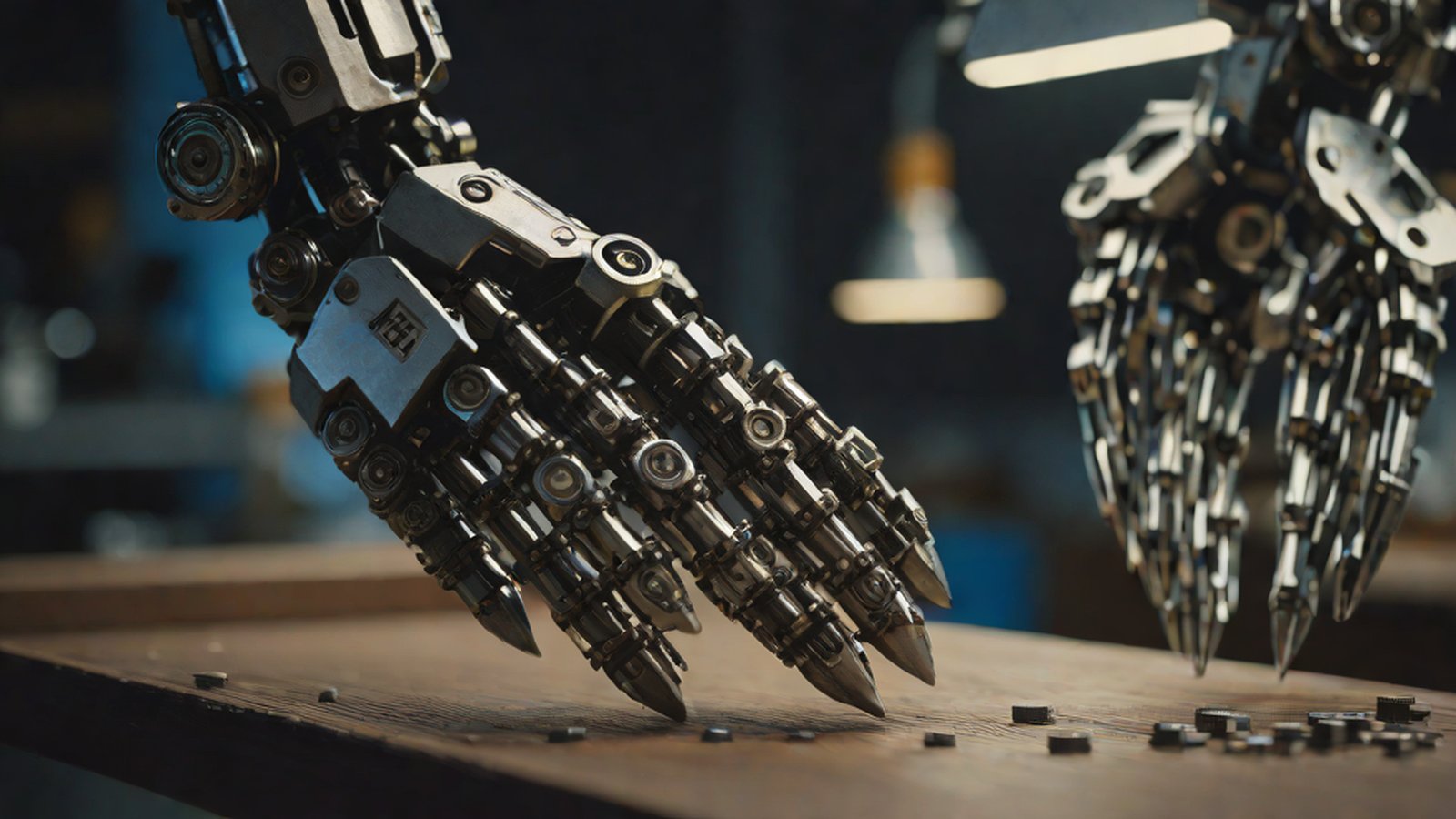
Google DeepMind has unveiled 'Gemini Robotics On-Device,' an AI model that runs locally on robotic devices without an internet connection, opening an era where robots can judge and perform complex actions on their own.
Introduction: What if Robots Had a ‘Personal Brain’?
Imagine a critical situation where a robot must rescue someone in a deep forest without an internet signal or in an underground facility where radio waves are blocked. Until now, smart robots usually had to be connected to an external brain called the ‘Cloud’ (a giant server on the internet) to make complex decisions. If the internet was cut off, the robot would quickly become as useless as a ‘tin can.’ It’s similar to how wireless earbuds can’t play any sound if they lose their connection to a smartphone.
| However, robots have now begun to stand on their own without the ‘lifeline’ of the internet. Google DeepMind recently announced ‘Gemini Robotics On-Device,’ a new AI model that allows robots to see, hear, and move by themselves without the internet [Gemini Robotics On-Device brings AI to local robotic devices | Hacker News](https://news.ycombinator.com/item?id=44366409). |
This technology implants an entire ‘intelligent brain’ called AI directly into the robot’s body. Simply put, instead of waiting for instructions from a remote server, the robot can think and act immediately on the spot. What kind of innovation will this change bring to our daily lives? MindTickleBytes explains it simply.
Why It Matters
We’ve all had the frustrating experience of a smartphone voice assistant saying, “Please check your internet connection,” and failing to work. Robots were the same. However, when the ‘On-Device’ method—where AI runs directly inside the device without going through an external server—is introduced, three major changes occur.
- Faster than Light Response (Low Latency): Information doesn’t need to travel over the internet to Google’s servers and back. To use an analogy, it becomes as fast as the spinal reflex that makes you pull your hand away when you touch a hot pot before your brain even issues a command. A robot can stop or turn in 0.001 seconds as soon as it detects an obstacle.
- Thorough Privacy Protection: Sensitive data about what the robot saw or what conversations it had in our homes is not transmitted to external servers. Since all data processing ends inside the robot, it can be used with peace of mind in factories where security is vital or in highly personal spaces like homes.
-
Limitless Areas of Activity: Robots can smartly play their roles even in disaster sites with unstable internet, remote areas where radio waves don’t reach, or regions where communication costs are a burden [Google rolls out new Gemini model that can run on robots locally TechCrunch](https://techcrunch.com/2025/06/24/google-rolls-out-new-gemini-model-that-can-run-on-robots-locally/).
The Explainer
1. VLA Model: “A Brain Where Eyes, Ears, and Hands are Integrated”
Gemini Robotics is called a VLA model (Vision-Language-Action Model) DeepMind’s Gemini Robotics On-Device brings advanced AI to local robots. The term is a bit difficult, right? It’s easier to understand if we compare it to our bodies.
In existing robots, the AI that analyzes what is seen with eyes (cameras), the AI that understands human speech (language), and the software that moves the hands (motors) all worked separately. It was as if the eyes, ears, and hands belonged to different people; if you said, “Hey, do you see that red cup? Pick it up and move it,” it would take time and mistakes could occur during the delivery process.
However, in Gemini Robotics, these three are completely integrated into a single brain.
- Vision: “I see a crumpled blue shirt in front of me.”
- Language: “The owner asked me to fold this nicely.”
- Action: “Okay, then I should start folding from the left sleeve like this!”
All these judgment processes are handled simultaneously within a single neural network. Thanks to this, much more natural and smooth movements have become possible GeminiRobotics- Wikipedia.
2. Putting Giant AI into a Robot!
This model was built based on Gemini 2.0, Google’s latest ultra-powerful AI GeminiRobotics- Wikipedia. Gemini 2.0 is a ‘giant’ that has learned knowledge equivalent to thousands of libraries. This ‘on-device’ model is the result of putting it on an efficient ‘diet’ to fit the robot’s body so it can run smoothly inside the device Gemini Robotics On-Device — Google DeepMind.
Where We Stand: Robots Open ‘Zippers’ and Fold ‘Clothes’
One of the most difficult tasks for robots has been handling ‘soft objects.’ Metals or plastics are easy to grab because their shape doesn’t change, but bag fabrics or shirt materials change shape unpredictably whenever touched.
According to Google DeepMind’s announcement, robots equipped with this new model can perform the following sophisticated (dexterous) tasks on their own DeepMind’s Gemini Robotics On-Device brings advanced AI to local robots:
- Delicate Hand Movements: Finding a very small zipper handle on a bag and pulling it open smoothly.
- Understanding Space and Form: Real-time identification of the shape of messy clothes and folding them neatly.
- Performing Complex Commands: Understanding multi-step commands like “Go to the kitchen, pick up the red cup, and put it on the living room table” at once and planning and executing them independently Gemini Robotics On-Device brings AI to local robotic devices - Google DeepMind
| What is particularly surprising is that they do not panic even in ‘Out-of-distribution’ (unseen) situations. Just as an experienced chef can quickly figure out where tools are and start cooking even in a kitchen they’ve never been to, this model showed the ability to adapt without panic even in new environments or in front of objects it hadn’t learned about [Gemini Robotics On-Device brings AI to local robotic devices | Hacker News](https://news.ycombinator.com/item?id=44366409). |
What’s Next
| Google has entered into a partnership with robot manufacturer Apptronik to apply this technology to actual robotic devices GeminiRobotics- Wikipedia. This technology, officially unveiled in late June 2025, will completely change the landscape of the robots we will encounter in the future [Google rolls out new Gemini model that can run on robots locally | TechCrunch](https://techcrunch.com/2025/06/24/google-rolls-out-new-gemini-model-that-can-run-on-robots-locally/). |
Shall we imagine a scene from the future for a moment?
- Our home domestic robot folds laundry and helps with dishes without worrying about external hacking (because the data doesn’t leave the house!).
- Robot arms in factories don’t need to be coded one by one; they immediately understand human speech like “Carefully put this part into that box” on-site and start their work.
- Hundreds of robots in a giant logistics warehouse move in perfect order based on their own judgments without stuttering while trying to exchange wireless internet signals with each other.
| Of course, giant robots that require complex calculations will still need the cloud-based ‘Flagship Gemini’ model [Gemini Robotics On-Device brings AI to local robotic devices | Hacker News](https://news.ycombinator.com/item?id=44366409). However, for ‘lifestyle robots’ that will act and help us directly by our side, this on-device model will become the most essential ‘personal brain.’ |
AI’s Take
Perspective from MindTickleBytes’ AI Reporter
This announcement symbolizes that robots have cut the ‘umbilical cord’ of the cloud and begun true independence. A robot that can think for itself even without the internet will have powerful survival and adaptability, just like a wild animal that can survive without tools. Robots are now moving beyond simple ‘connected devices’ to become ‘real intelligences’ that naturally blend in and coexist with us.
References
- GeminiRobotics- Wikipedia
-
[Gemini Robotics On-Device brings AI to local robotic devices Hacker News](https://news.ycombinator.com/item?id=44366409) -
[Google rolls out new Gemini model that can run on robots locally TechCrunch](https://techcrunch.com/2025/06/24/google-rolls-out-new-gemini-model-that-can-run-on-robots-locally/) - DeepMind’s Gemini Robotics On-Device brings advanced AI to local robots
- Gemini Robotics On-Device — Google DeepMind
- Gemini Robotics On-Device brings AI to local robotic devices - Google DeepMind
- Gemini Robotics On-Device brings AI to local robotic devices - Google DeepMind Blog
- Gemini Robotics On-Device Brings AI To Local Robotic Devices - AI Future Thinkers
FACT-CHECK SUMMARY
- Claims checked: 15
- Claims verified: 13
- Verdict: PASS

- It must always be connected to high-speed 5G internet.
- AI runs directly on the robotic device without an internet connection.
- It cannot move at all without human control.
- Simply pushing objects
- Opening a bag zipper or folding clothes
- Sweeping the floor
- Gemini 1.0
- Gemini 2.0
- GPT-4