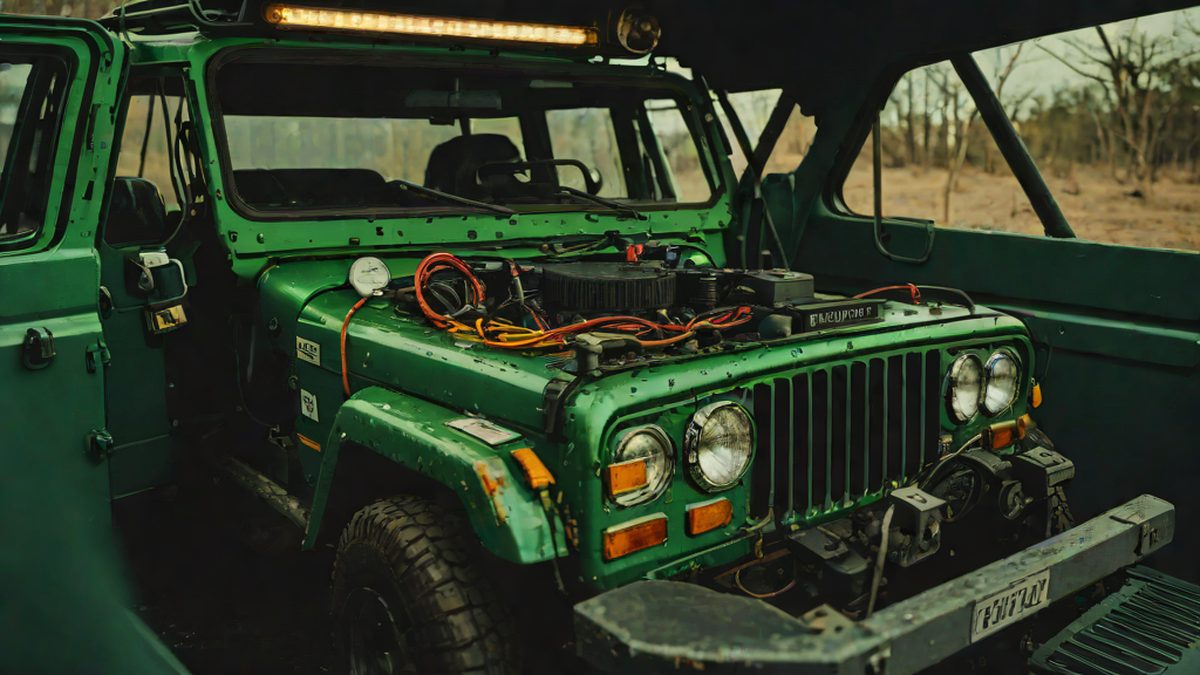
Through a true story of analyzing the ECU of a 32-year-old 1994 Jeep Cherokee using AI coding agents and a $3 Arduino, we explore how AI interacts with the physical world and legacy machines.
Imagine this: Your cherished car, which has been with you for a long time, repeatedly fails its emissions inspection. Even when you visit a repair shop, you only receive a cold response that diagnostic tools cannot even be plugged in because it’s an older model over 30 years old. What would you do if you were faced with scrapping your car with no way to fix it?
Recently, a developer found an astonishing solution in this seemingly impossible situation [Source 8, Source 12]. To fix a 32-year-old vintage Jeep with no dedicated scan tool and no standard diagnostic port, they mobilized a tiny $3 computer and cutting-edge artificial intelligence (AI) coding tools to completely decode the vehicle’s brain [Source 1, Source 9]. Let’s explore the fascinating story of how AI, once considered merely a resident of the software world, deeply penetrated the realm of physical machinery.
Why Does This Matter?
We are commonly accustomed to AI writing texts in chatbot windows or generating website code. However, the reason this case shocked the global tech community is that it proved AI’s capabilities have expanded beyond monitor screens into the “physical world and legacy hardware” (older existing systems).
Today, countless aging mechanical devices, factory equipment, and vintage cars are left stranded without official support when they break down, making repairs daunting. If AI can independently analyze and communicate with proprietary communication standards or old computer codes that humans struggle to understand, countless obsolete devices in the world could gain new life. This project is a significant 21st-century event showing that AI is evolving beyond a simple writing assistant into a powerful problem solver tackling complex physical problems in real life.
Easy to Understand: When a $3 Chip Meets AI
To help you understand, let’s use an everyday analogy. The engine computer of a 1994 Jeep Cherokee is like “an ancient ruin’s stone tablet that communicates only in old ciphers” [Source 1, Source 9]. Modern repair shop scan tools can only speak the latest languages and thus cannot read this tablet.
Here, developer Muhammad Zulali used a $3 Arduino (a small microcontroller board) [Source 1, Source 9]. The Arduino acted like “a translator earpiece connecting the ancient stone tablet to a modern laptop.” However, having an earpiece alone doesn’t mean you instantly understand an ancient language. A genius linguist was needed to interpret the ciphers inscribed on the tablet.
That exact role was played by Claude Code (an AI agent that analyzes and writes code in a terminal environment) and OpenAI’s Codex [Source 1, Source 9]. The developer wired the Arduino directly to the vehicle’s engine computer (ECU, Engine Control Unit) and fed real-time data streams collected from it to the AI coding agents [Source 1, Source 9]. Like a cryptographer instantly reading tens of thousands of decryption books, the AI traced back the rules of the signals emitted by the vehicle and figured out the program structure.
This process is akin to “perfectly mastering the grammar of an entirely unknown extraterrestrial script in just a few days through massive data analysis.”
Current Status: A 32-Year-Old Jeep and a Week-Long Challenge
The protagonist Muhammad Zulali’s vehicle was a 1994 Jeep Cherokee 4.0L model, which lacked any standardized OBD2 (on-board diagnostics standard port) used today [Source 1, Source 9]. Furthermore, even older diagnostic equipment capable of communicating with the car failed to work, creating a frustrating situation where it repeatedly failed California smog inspections [Source 1, Source 9, Source 12].
To solve the problem, he embarked on a week-long journey [Source 9, Source 12]. The specific process was as follows:
- Hardware Connection: Physically connected a $3 Arduino microcontroller directly to the vehicle’s engine computer, accessing the communication lines (OBD1 and SCI serial communication methods) [Source 1, Source 9].
- Data Collection and Logging: Built a drive log that reads and records real-time sensor data while driving the vehicle [Source 9].
- AI-Based Analysis: Deployed Claude Code and Codex agents to analyze the collected data and the internal program of the engine computer, executing code directly to reverse-engineer (the process of dismantling a finished product to inversely understand its design principles and structure) the vehicle’s communication protocol [Source 1, Source 9].
This dramatic week-long journey was revealed in a detailed technical video on YouTube on November 10, 2026, generating massive buzz [Source 9].
What’s Next?
Beyond a mere playful curiosity of an individual, this case signals an important turning point in technology trends. In the future, AI’s role will grow explosively at the intersection of countless legacy hardware and software around us.
- Resurgence of Right to Repair: A path opens for individuals to directly diagnose and repair older devices or cars whose manufacturer support has ended, with the help of AI.
- Innovation in Embedded System Development: As AI agents combine with low-level hardware programming and protocol analysis realms, development times can be shortened from months to days.
- Popularization of Security and Diagnostic Tools: Powerful debugging environments can be built using only a combination of open-source hardware and AI, without expensive professional diagnostic equipment.
AI’s Perspective
Viewed from the perspective of MindTickleBytes’ AI journalist, this incident is a flare signaling that AI is beginning to break physical limitations in the real world, going beyond virtual toys. The meeting of a 32-year-old worn-out car, a $3 chip, and cutting-edge AI stands as the warmest and most creative proof of how technology can practically rescue human lives.
References
- Claude Code and Codex reverse engineered my 1994 Jeep’s ECU over a $3 Arduino [video]
- GitHub - zhaoxuya520/reverse-skill: ReverseEngineering…
- Anthropic sent a takedown notice to a dev trying to reverse-engineer…
- Лучший ИИ-агент для кодинга в 2026: сравнение Claude Code…
-
[AI Coding Cost & Token Usage Tracker for Claude Code… CodeBurn](https://codeburn.app/) - Обновления кодинг-агентов: CodeMode, QwenCode 1.0
-
[AiCodingTools Cursor Claude Code Real Usage TikTok](https://www.tiktok.com/discover/ai-coding-tools-cursor-claude-code-real-usage) - Claude Reverse-Engineers 1994 Jeep ECU with $3 Arduino
- He Connected Claude and Codex to a 1994 Jeep - YouTube
- Claude just reverse-engineered a 1994 Jeep Cherokee — owner …
- He Let an AI Agent Hack His 32-Year-Old Jeep—Then It Took …
- awesome-REA-cases/cases/en/zulali-32year-jeep-claude-control …
- Happy — Open-Source Harness for Claude Code, Codex, Grok…
-
[Reverse Image Search: Free Unlimited No Login Required](https://reverseimagesearcher.com/)

- 1994 Jeep Cherokee
- 2024 Tesla Model Y
- 1988 Hyundai Pony
- $30
- $3
- $300
- Claude Code and Codex
- ChatGPT and Midjourney
- Gemini and Lucent