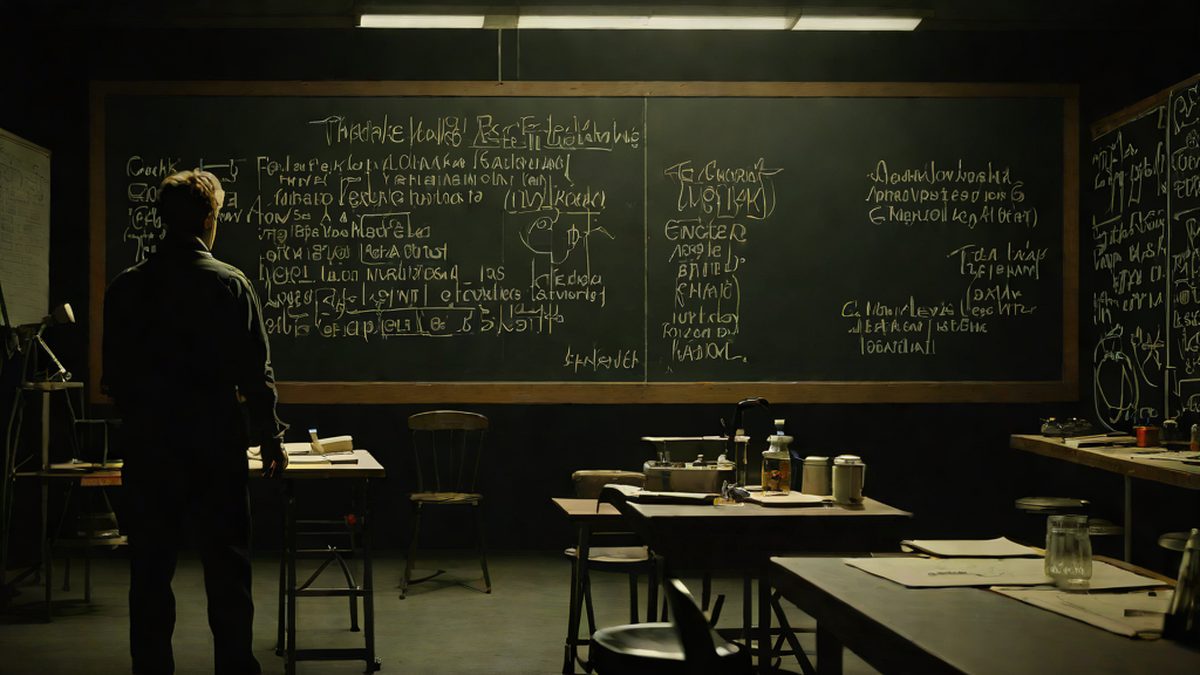
OpenAI's AI has produced a 1,147-page paper proving the existence of 4D Yang-Mills theory, which was verified by a committee led by Nobel laureate David Gross.
Imagine this. What if, while brilliant mathematicians around the world are scratching their heads for decades in front of the most esoteric equations in modern physics, an artificial intelligence suddenly churns out over 1,100 pages of proofs overnight? It sounds like something straight out of a movie, but it is an astonishing event that recently unfolded in the AI and physics industries [Source 3, Source 12].
OpenAI announced that its AI system has solved the existence proof problem in quantum field theory, including quantum Yang-Mills theory (the core theory of modern physics explaining how fundamental particles of the universe interact) and four-dimensional Quantum Chromodynamics (QCD, the theory governing strong interactions between quarks and gluons) [Source 3, Source 7, Source 15, Source 16]. It is as if AI has finally climbed a monumental mountain that human hands could not fully conquer even over a lifetime.
Why Does This Matter?
Yang-Mills theory is far more complex than collecting collector’s edition comic books, but it is a core pillar of modern physics explaining how fundamental particles of our universe (tiny grains like quarks and gluons) move and interact. Proving that this theory holds mathematically is considered one of the highest honors in mathematics and one of the most difficult existing problems—one of the “Millennium Prize Problems” designated by the Clay Mathematics Institute with a $1 million prize [Source 10].
In simple terms, this is an attempt to mathematically verify whether the “foundation work” of the cosmic blueprint—explaining everything from the smartphones we use every day to the fundamental laws governing the vast universe—is truly solid. The fact that AI has grasped the clue to this colossal riddle means that artificial intelligence is expanding its territory beyond simple writing or drawing into the frontiers of science that humans have long failed to reach.
Easy to Understand: The Genius Architect and the Giant Lego Castle
Let’s compare Yang-Mills theory and this discovery to our daily lives through an analogy.
Imagine you are assembling an incredibly complex Lego castle made of trillions of blocks. You must mathematically and rigorously prove that this castle will never collapse and stands correctly according to the laws of physics of the universe. However, because there are so many blocks, calculation by human minds alone is virtually impossible.
Here, AI acted as a “genius architect” that ultra-fast checked the interlocking of all blocks to perfection. AI proved that the theory of these complex quantum particles must necessarily exist in four-dimensional space through a massive bundle of paper (data) spanning 1,147 pages [Source 3].
However, there is another interesting point to note in this analogy. Roland Bauerschmidt, a mathematician at New York University, noted that papers dealing with simplified models related to this are both groundbreaking and easy to understand [Source 13]. In other words, while parts of the overarching massive proof come across as exceptionally clear and elegant, the overall structure remains unfamiliar and uncharted territory for us.
Current Status and Remaining Tasks
So, can this massive proof immediately secure the Millennium Prize and historical glory? Starting with the conclusion, it is half-success and a new beginning.
While OpenAI’s recent result solidly established the existence of Quantum Chromodynamics (QCD) in four-dimensional space, it did not fully address the tricky problem of the “mass gap” (the property where the energy difference between the ground state and the first excited state in a quantum mechanical system is greater than zero), which is the core of this theory. Because of this, it has not fully satisfied all conditions of the Clay Millennium Prize [Source 7].
Even more interesting is the reaction of top-tier scientists who directly verified this proof. Instead of releasing the entire proof to the public blindly, OpenAI first handed it over to a committee of five independent scientists led by Nobel laureate David Gross [Source 3, Source 9]. On November 10, this committee announced its official verdict. Their conclusion was clear: “In our judgment, this proof stands.”
At the same time, however, they did not hide a candid confession: “We do not yet claim to fully understand the methodology of this proof.” [Source 9]
This is akin to a situation where AI solves a complex mathematical formula and brings back the absolute correct answer, but human mentors scratch their heads, saying, “The answer is right, but we need more time to thoroughly understand the deep meaning behind the exact logical steps AI took to reach this conclusion.” While math and computer science papers and Lean (formal math verification tool) code were released on OpenAI’s GitHub repository, physics-related outputs were temporarily withheld while David Gross’s group organized them [Source 4, Source 16].
What’s Next?
This event delivered both a massive shock and a fresh topic of discussion to the global scientific community. It vividly demonstrates that AI is evolving beyond a mere tool assisting human knowledge into an independent entity capable of solving colossal challenges that humans failed to crack for decades [Source 12, Source 15].
Going forward, physicists and mathematicians around the world will tear through the massive 1,147-page record page by page to verify the staircase of logic laid out by AI [Source 3]. The entire world is holding its breath to see whether this colossal proof born from the cold mind of AI can fully wrap up modern physics’ long-standing homework and open a new era of science.
MindTickleBytes’ AI Reporter Perspective
AI is reaching complex mathematical and physical challenges that humans have failed to solve for decades. However, fully digesting the depth and meaning of those proofs remains the task of human scientists. As technology advances forward, human intellectual inquiry to interpret and understand technology must also become even more intense.
References
- Yang-Mills, OpenAI proof, and the mass gap problem
- Yang–Mills existence and mass gap - Wikipedia
- OpenAI’s Yang–Mills Proof Rests on Papers Experts Say… - YouTube
-
[The Yang-Mills Publicity Stunt Not Even Wrong](https://www.math.columbia.edu/~woit/wordpress/?p=15986) -
[Dueling proofs from OpenAI and Anthropic… Scientific American](https://www.scientificamerican.com/article/dueling-proofs-from-openai-and-anthropic-astound-scientists/) -
[OpenAI Hands ETH, Kakeya, Yang-Mills Proofs to… AI Weekly](https://aiweekly.co/alerts/openai-hands-eth-kakeya-yang-mills-proofs-to-reviewers) - Proof by OpenAI of the Existence of Quantum
- Physicists Just Checked OpenAI’s Millennium Problem Proof - YouTube
- The Millennium Prize Problems - Clay Mathematics Institute
-
[OpenAI claims to have solved maths problem that… The Guardian](https://www.theguardian.com/science/2026/sep/08/openai-claims-to-have-solved-maths-problem-that-stumped-humans-for-decades) - The most exciting claims from OpenAI’s heap of new proofs
- TLDR - A Byte Sized Daily Tech Newsletter
- OpenAI solved open math problems? What’s checked — 9to5AI
- OpenAI unveils three AI-produced results: a claimed… — AICoder

- 500 pages
- 1,147 pages
- 2,000 pages
- Mass gap
- Unification with gravity
- Speed of light measurement
- Albert Einstein
- David Gross
- Richard Feynman