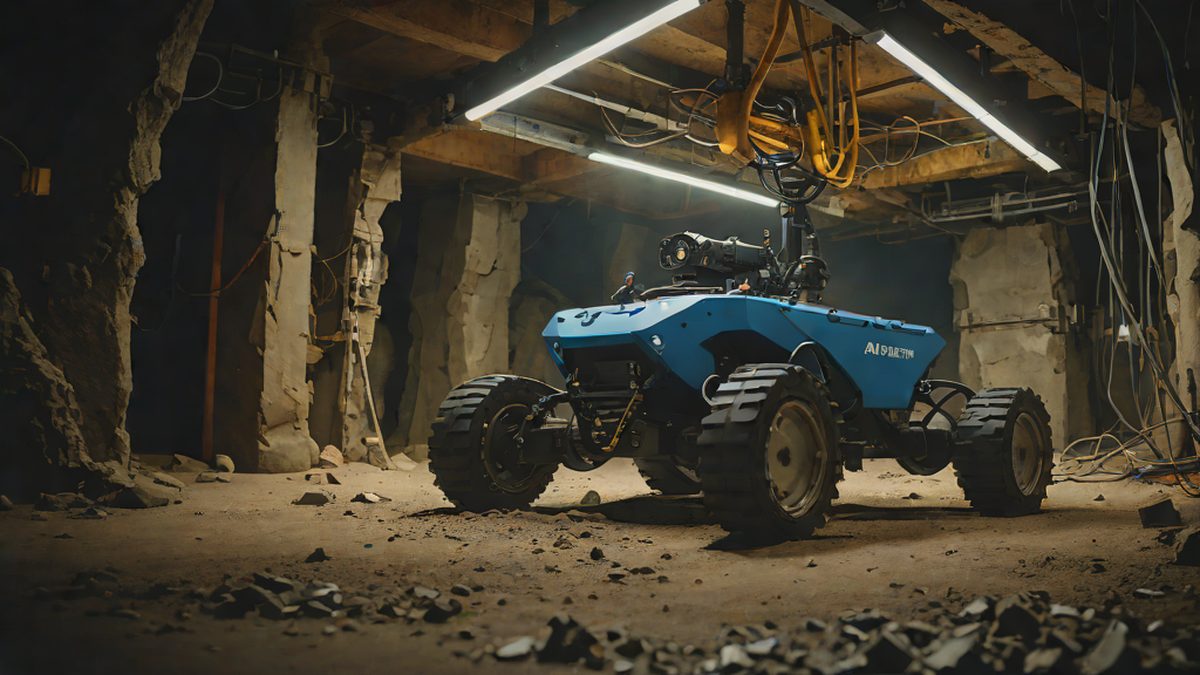
Explore an innovative framework that combines vision-language models, which understand both vision and language, with reinforcement learning, enabling AI agents and robots to set high-level goals and maximize learning efficiency in complex environments.
Imagine being placed in a virtual world or real-world factory as complex and vast as a maze. In front of you are dozens of paths, and to reach the final reward, you must make hundreds of correct choices. What if hints (rewards) for making the right moves were given only once, right at the end of the game? You would likely wander in circles, not knowing which way to go.
To use an analogy, it’s like having to find an exit blindfolded inside a giant maze. Without any milestones to tell you whether you are heading in the right direction, escaping becomes nearly impossible even if you smash into walls tens of thousands of times. The reality facing artificial intelligence (AI) and robots is quite similar. Until now, AI has excelled at recognizing what is in front of its eyes or answering text-based questions, but it has faced extreme limitations in multi-step decision-making problems that require long and complex journeys.
However, researchers have recently found an exciting and powerful combination to break through these limitations: combining models that understand both vision and language with reinforcement learning (an AI learning method where optimal behaviors are learned through trial and error via rewards) [Goal-Guided Reinforcement Learning via Fine-Tuning Vision-Language Models, [Quick Review]Fine-TuningLargeVision-LanguageModelsas…]. Let’s have a comfortable chat over a cup of coffee about what this technology is and why it will change our lives.
Why Is This Important?
While smartphone assistants and chatbots we use understand speech and text well, it is a completely different story when they need to become robots that independently judge and move in the real world, or agents (AI programs that autonomously perform goals) that handle complex tasks.
Simply put, instructions in words alone cannot enable a robot to clean a room or cook by itself. For a robot to clean a house and cook, it must look at the messy scenery in front of it (vision) and be able to make high-level plans such as “First, pick up the toys on the floor (Goal 1), and then run the vacuum cleaner (Goal 2).” However, conventional reinforcement learning agents have frequently lost their way in environments with sparse rewards and long horizons [Goal-Guided Reinforcement Learning via Fine-Tuning Vision-Language Models].
Although Large Language Models (LLMs, AI models trained on massive amounts of text to write and converse like humans) can generate high-level goals to act as guides, previous approaches relied manually on vague prompts without separate task adaptation, resulting in inconsistent and inappropriate goals [Goal-Guided Reinforcement Learning via Fine-Tuning Vision-Language Models].
The new framework studied here allows AI not just to read text, but to look at the world with its eyes and independently set concrete goals, maximizing learning efficiency [Goal-Guided Reinforcement Learning via Fine-Tuning Vision-Language Models]. This lays the foundation for autonomous vehicles, home robots, and complex logistics automation systems to dramatically reduce trial and error and learn much faster and smarter.
Understanding Simply: The Lost Explorer and the Smart Compass
To easily understand this complex technology, let’s look more deeply into the ‘Explorer in a Maze’ analogy.
Imagine you entered a giant underground cave exploration game. The goal is to find the ‘diamond’ deep inside the cave. However, the cave is vast, and there isn’t a single guidebook until the end of the game telling you whether you’re on the right track. You just wander around randomly until you happen to find the diamond. In such a situation, no matter how good the AI agent’s computing power is, it will exhaust itself slamming into random walls thousands or tens of thousands of times. This is the ‘problem of sparse rewards and long horizons’ experienced by reinforcement learning [Goal-Guided Reinforcement Learning via Fine-Tuning Vision-Language Models].
Imagine giving it a smart compass called a Vision-Language Model (VLM, a multimodal generative AI model that receives and understands images and text simultaneously and outputs text) [VisionLanguageModelsExplained].
- Seeing and Understanding with Eyes: A VLM fundamentally processes photos or screens (vision) and descriptions (language) together [VisionLanguageModelsExplained]. This is like an explorer scanning the scenery inside a cave with their eyes and assessing the situation (“Ah, there’s a stone bridge ahead?”).
- Setting Sub-goals: Since finding the final diamond all at once is difficult, the VLM makes language sub-goals on the fly, such as “Let’s first open the wooden box in front” and “Then let’s light a fire to illuminate the path.”
- Getting Smarter Through Fine-Tuning: Of course, it cannot be perfect from the start. Researchers pre-trained the VLM offline using CCGP-2M, a massive multimodal goal preference dataset created based on interaction trajectories within games [Goal-Guided Reinforcement Learning via Fine-Tuning Vision-Language Models].
- KLTDPO Optimization Technique: The core of fine-tuning here is a technique called KLTDPO (Kullback-Leibler Token-level Direct Preference Optimization), which combines token-level KL regularization with distribution-robust reweighting. Simply put, it is the process of delicately refining the AI so that it does not set erratic or dangerous goals, but instead acts as the most rational and safe guide aligned with past successful experiences and preferences [Goal-Guided Reinforcement Learning via Fine-Tuning Vision-Language Models].
Because this solidly fine-tuned VLM offline whispers precise guidance like “This goal is needed right now” to the online reinforcement learning agent, the agent can quickly find rewards without wandering [Goal-Guided Reinforcement Learning via Fine-Tuning Vision-Language Models].
Current Status: How Far Has It Come and What Can It Do?
The AI research community is rapidly entering an era of multimodal and agentic AI where vision, language, and action are integrated, moving beyond the era of merely processing text.
Academia and research institutes are verifying this convergence of vision-language models and reinforcement learning from various angles:
- Craftax-Classic Environment Experiments: Recent studies show that applying the VLM-guided reinforcement learning framework allowed it to collect diamonds much earlier than previous state-of-the-art baseline models, achieve the highest total scores and rewards, and attain the highest success rates across most achievement tasks [Goal-Guided Reinforcement Learning via Fine-Tuning Vision-Language Models].
- Rise of Vision-Language-Action (VLA) Models: A paradigm is spreading to control general-purpose robots by integrating visual recognition, language understanding, and action prediction into a single architecture [ForgeVLA: FederatedVision-Language-ActionLearningwithout…]. This enables robots to simultaneously interpret human speech and surrounding visual information to perform sophisticated physical manipulation tasks.
- Evolution of Various Optimization Algorithms: As reinforcement learning takes a core role in fine-tuning language and vision models, techniques to align models based on rewards and preferences beyond traditional supervised prediction are being actively researched [Fine-TuningLanguageModelswithReinforcementLearning…].
However, challenges clearly remain. Computing costs when handling complex real-world environments or massive datasets, and establishing safety nets to ensure AI finds completely correct alternatives when unexpected variables arise, are homework items for the industry to solve going forward.
What Lies Ahead?
The future direction of AI development will center around ‘Agentic AI’ that goes beyond ‘AI that thinks’ to ‘AI that plans and executes on its own.’
- Popularization and Advanced Development of Robotics: Industrial robots that previously performed only standardized tasks on assembly lines will evolve into general-purpose robots equipped with VLA models and goal-directed reinforcement learning that can judge and move on their own even in unpredictable environments such as homes or complex disaster sites [ForgeVLA: FederatedVision-Language-ActionLearningwithout…].
- Expansion from Simulation to the Real World: Goal-directed frameworks thoroughly verified in virtual game environments (e.g., Craftax-Classic) are expected to be rapidly ported to various real-world domains such as autonomous driving, drone control, and complex software engineering agents [Goal-Guided Reinforcement Learning via Fine-Tuning Vision-Language Models].
- Smarter with Less Data: Without relying solely on numerous human demonstrations or expensive human feedback, self-refining capabilities where AI maximizes its own exploration efficiency through multimodal preference datasets and sophisticated offline-online combined learning will become commonplace.
Dear readers, the future we will face is not merely an AI that writes text well, but a world with a reliable digital companion that observes the world with its eyes, defines problems on its own, and accomplishes goals to the very end.
AI’s Perspective
Beyond simply understanding the landscape before it, the evolution of AI that sets its own goals for ‘what to do next’ will be the key to conquering the physical world beyond digital space.
References
- Goal-Guided Reinforcement Learning via Fine-Tuning Vision-Language Models
- [Quick Review]Fine-TuningLargeVision-LanguageModelsas…
-
[Affordance-GuidedReinforcementLearningvia… Papers with Code](https://paperswithcode.co/paper/2407.10341) - Keyframe-GuidedStructured Rewards forReinforcementLearningin…
- Fine-TuningLargeVision-LanguageModelsas Decision-Making…
-
[AgenticRL: Self-Refining AgenticReinforcementLearning… alphaXiv](https://www.alphaxiv.org/abs/2606.03963) - EASIEST Way toFine-Tunea LLM and Use It With Ollama - YouTube
-
[Qwen3.5Fine-tuningGuide Unsloth Documentation](https://unsloth.ai/docs/models/qwen3.5/fine-tune) - VisionLanguageModelsExplained
- Proceedings of the 8th Conference on RobotLearning(CoRL 2024)
-
[Frontiers A transformer-basedreinforcementlearningframework for…](https://www.frontiersin.org/journals/artificial-intelligence/articles/10.3389/frai.2026.1922657/full) - Vision-LanguageModels— Building VLMs with Hugging Face
- Fine-TuningLanguageModelswithReinforcementLearning…
- ForgeVLA: FederatedVision-Language-ActionLearningwithout…
- ImprovingVision-Language-ActionModelFine-Tuningwith…

- Absolute lack of visual information
- Sparse rewards and long horizons
- Excessive memory usage of language models
- KLTDPO (Kullback-Leibler Token-level Direct Preference Optimization)
- Qwen3.5 Unsloth Fine-Tuning
- QT-Opt Deep Reinforcement Learning
- LLM-Guided RL Framework
- Vision-Language-Action (VLA) Model
- Craftax-Classic Multi-preference Dataset