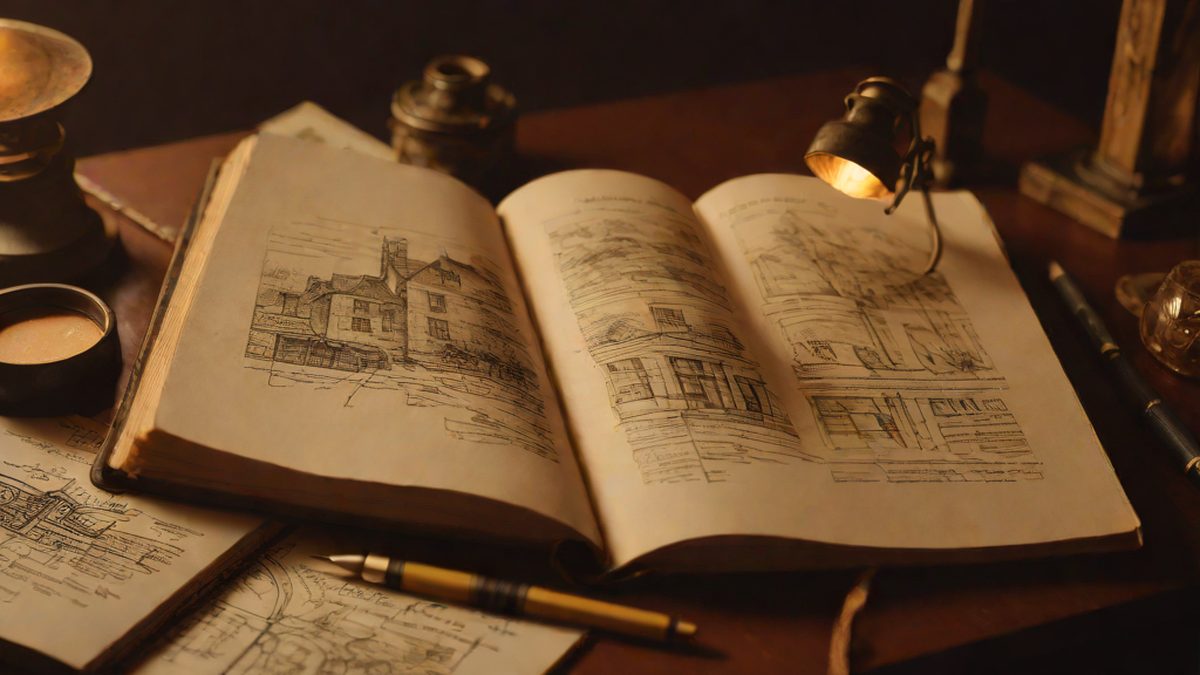
OpenAI's latest flagship reasoning model, GPT-6.2 Astra, opened new horizons in humanities research by identifying the author of an 1808 sketchbook that had remained a mystery for 200 years, using minimal prompts in just 22 minutes.
Imagine this: an old sketchbook created in 1808 has been sleeping deep within the museum archives for a long time. With not a single name written on its cover or inner pages, this anonymous sketchbook remained a mystery for over 200 years, completely unknown as to whose hands it was born from. Historians spent decades racking their brains chasing the clues in the handwriting and sketches, but failed to find decisive evidence. Recently, however, an artificial intelligence (AI) model neatly solved this long-standing mystery in just 22 minutes [Source 3, Source 12]. What on earth happened?
Why does this matter?
We often think AI is only proficient at writing source code, summarizing text, or solving quizzes. However, this incident is a decisive turning point showing that AI’s role has penetrated deep into high-level intellectual domains such as humanities and historical research, far beyond simple computation or clerical assistance [Source 3].
Historian Professor Mark Humphries conducted a new experiment with an anonymous 1808 sketchbook housed in the Beinecke Library at Yale University [Source 2]. He was curious to see how far an AI equipped with cutting-edge technology could uncover if given this mystery. The results were astounding. The AI solved in the blink of an eye homework that experts had failed to solve for decades, proving its potential as a new companion in exploring humanity’s intellectual heritage [Source 3, Source 12]. This suggests that the paradigm of historical, archaeological, and art-historical research could completely change in the future. This shift is significant in that it acts as an intellectual catalyst, organically connecting minute fragments within vast records that humans easily overlook.
Easy to Understand: The Meeting of a Superpowered Librarian and a Master Detective
The hero behind this remarkable achievement is OpenAI’s newly introduced flagship reasoning model, GPT-6.2 Astra (a cutting-edge AI model combining vast data and deep thinking capabilities) [Source 5, Source 7]. The secret to Astra’s ability to solve such difficult historical problems in an instant lies in two major weapons: the 1M-token context window (the massive amount of information the AI can remember and process at once) and its image understanding capabilities [Source 7].
This can be easily understood with an analogy.
As a first analogy, the 1M-token context window is like “a superpowered librarian who has crammed thousands of history books and archives from libraries around the world into their head and cross-references them in real time.” While ordinary AI forgets its memory after reading a few pages of a book, Astra can simultaneously lay out centuries of vast historical records, family trees, and military logs to find contradictions or connections.
As a second analogy, Astra’s reasoning process is not simple word matching, but resembles “Master Detective Sherlock Holmes, who uncovers the identity of the culprit by combining minute fingerprints and footprints at a crime scene.” By synthesizing subtle handwriting characteristics in the sketchbook, the depicted historical background, and specific terrain details, it logically traces back the identity of the true culprit (author) like fitting puzzle pieces together.
Current Situation: Until the Truth Was Revealed After 200 Years
How did the experiment proceed? While testing OpenAI’s new product, historian Professor Mark Humphries casually threw out a request to find the author of an anonymous 1808 sketchbook kept in the Yale University Library [Source 2, Source 4]. Even though he entered only minimal prompting (simple instructions given by a user to AI) without complex or lengthy explanations, Astra began searching through vast historical databases on its own [Source 2].
The results were phenomenal. The AI found a strong candidate matching the sketchbook’s author in just 22 minutes and finally confirmed the author’s identity in 35 minutes [Source 3, Source 4].
“The owner of the sketchbook, which had remained an unnamed bundle of drawings for 200 years, was Louis-Guy-Charles-Guillaume de Rohan-Chabot (1780–1875), a French aristocrat who served as a British Army officer [Source 12].”
Of course, AI is not infallible. In an interview, Professor Humphries candidly stated that while Astra brilliantly figured out the author’s identity, it failed to locate the exact location of the associated diary [Source 3]. This shows that current AI is not an omnipotent god that solves everything perfectly, but rather a tool that still needs to collaborate with human researchers. Nevertheless, the fact that it found in 20 minutes a link that human researchers struggled to find for decades is enough to command admiration. This cooperative relationship will become an important key to maximizing research efficiency across academia in the future.
What’s Next?
This incident proved how powerful a weapon artificial intelligence can be in restoring humanity’s lost history and truth, moving far beyond simple entertainment or writing tools. Professor Humphries emphasized that modern language models have now completely broken away from the category of simple mathematical operations and reached a level where they can autonomously conduct complex historical research [Source 3].
In the future, countless unclassified documents, undeciphered ancient manuscripts, and artworks of unknown provenance piled up in museums and libraries will gain new life through the hands of AI. An era is rapidly approaching where the gaps in history textbooks that we took for granted are filled one by one thanks to artificial intelligence’s sharp reasoning capabilities. What other forgotten history will see the light of day through the eyes of AI next? An exciting future awaits us.
MindTickleBytes AI Reporter’s Perspective
GPT-6.2 Astra’s recent performance shows that technology is not a threat replacing the human domain, but rather the most powerful magnifying glass expanding human intellectual limits. Just as it found a name again for a sketchbook that had been gathering dust for 200 years, AI will become the wisest translator for humanity to communicate with the past in the future.
References
- GPT 6.2 Astra Solves a Historical Mystery
-
[GPT6.2 Astra Solves a Historical Mystery Simon Willison’s Weblog](https://simonwillison.net/2026/Nov/24/astra-historical-mystery/) -
[GPT-6.2 Astra Solves Two-Century-Old Historical Mystery ForkLog](https://forklog.com/en/gpt-6-2-astra-solves-two-century-old-historical-mystery/) - Historian Says AI Solved 200-Year Mystery in 22… - Business Insider
- GPT-6.2 Astra Just FLOPPED: OpenAI Is Getting FLAMED… - YouTube
-
[OpenAI’s GPT-6 Astra on ARC-AGI-3 ARC Prize](https://arcprize.org/blog/astra) - GPT-6.2 Astra - DeepAI
- GPT-6.2 Astra Limited Rollout Revealed: 5 Signals… - Apiyi.com Blog
- GPT-6.2 Astra won’t stop talking - YouTube
- GPT 6 Astra · Free AI Chatbot
- GPT-6.2 Astra: Генератор процедурных планет · тест № 0487…
-
[GPT-6.2 Astra раскрыла загадку 200-летней давности за 22… Дзен](https://dzen.ru/a/awb4MFfwRRDkT0qB) - 200-летняя тайна раскрыта - как ИИ-модель GPT-6.2 Astra обошла…
- Anthropic IPOs, GPT6.2 Astra Arrives, But… - YouTube
-
[Why OpenAI’s latest model is obsessed with bells IBM](https://www.ibm.com/think/news/why-gpt-6-2-astra-obsessed-with-bells)

- 1808
- 1908
- 1780
- 22 minutes
- 3 hours
- 2 days
- Louis-Guy-Charles-Guillaume de Rohan-Chabot
- Napoleon Bonaparte
- Mark Humphries