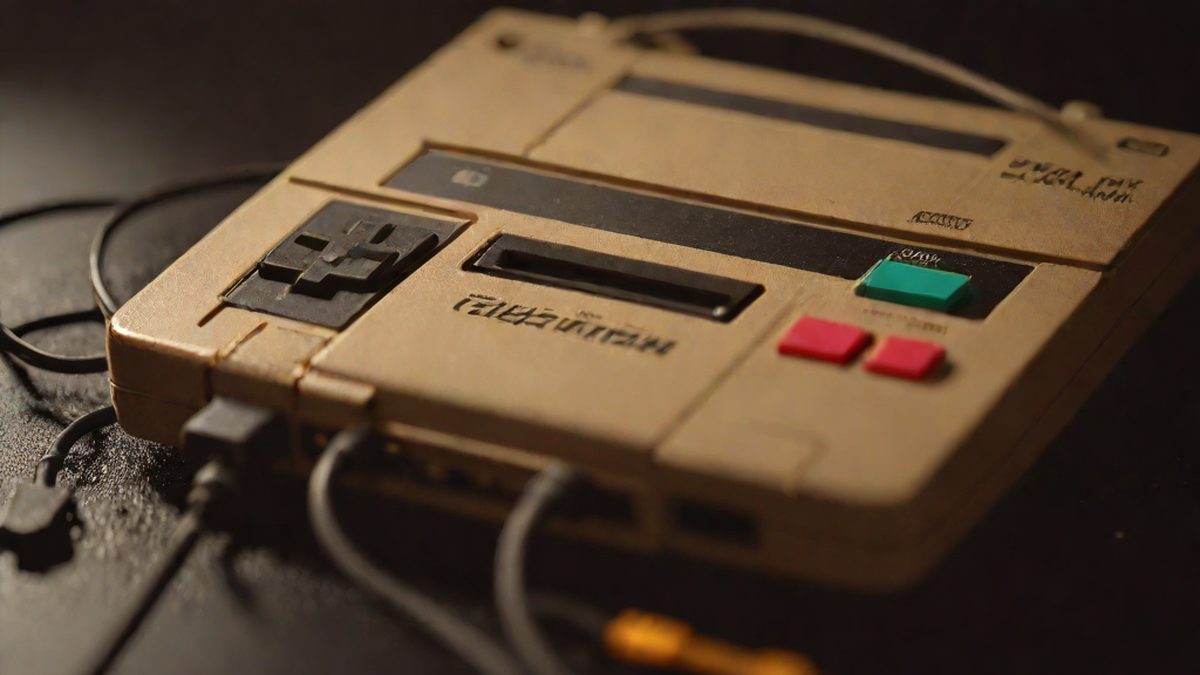
Explore the unique integration project connecting Super Nintendo (SNES) with ChatGPT and the principles behind macOS menu bar utilities.
Imagine sitting on your living room floor as a child, inserting a cartridge into the Super Nintendo (SNES)—a classic retro console of cherished memories—and wondering what it would be like if cutting-edge artificial intelligence could speak to you from within its 16-bit pixelated screen. Witnessing a modern conversational AI operating inside a charming retro device evokes a fresh and surreal emotion, like a scene straight out of a science fiction movie transcending time and space. For a long time, two completely different generations of technology, strictly separated by hardware constraints, are now creating an intriguing intersection.
In this article, we will take a deep dive into ChatGPT for SNES, a unique endeavor bridging nostalgic classic consoles with state-of-the-art artificial intelligence, along with the technical background supporting it [Source 1]. How on earth can a bridge be built between 1990s retro gaming sensibility and modern AI systems? We invite you to the fascinating scene where video game history meets cutting-edge cloud technology.
Why Does This Matter?
As technology develops breathtakingly fast, we constantly search for faster, more powerful, and more expensive devices. Smartphones innovate every year, and artificial intelligence evolves by processing hundreds of billions of parameters across massive cloud datacenters. However, the true romance and fun of technology are often maximized when old analog tools that seemingly have no business together meet the latest digital technology.
Projects like ChatGPT for SNES might look like mere curious toys [Source 1]. However, hidden behind them is an excellent engineering case proving how flexibly and scalably modern cloud-based AI services can be combined with diverse interfaces. Much like transplanting the latest communication chip into an old typewriter or vintage vacuum tube radio to breathe new life into it, it broadens the horizons of possibility regarding how the AI technology we use daily can harmonize with the heritage of the past.
Furthermore, a solid infrastructure is essential for such experimental systems to operate seamlessly and stably. As seen in Latest service status for OpenAI, OpenAI’s system maintains a phenomenal uptime rate of 99.998% across 16 core components [Source 3]. Thanks to such a robust cloud backend—failing perhaps once in a million times—even a retro device from decades ago can breathe in real time with modern AI.
Understanding Simply: Bridging Classic Consoles and AI
Let’s explain this complex-looking integration process easily through an everyday analogy.
Artificial intelligence is like an immensely knowledgeable sage sitting in a giant library on the other side of the world, fluent in every language on Earth. On the other hand, the Super Nintendo (SNES) we handle is a naive robot toy built long ago that only understands a few designated button signals and black-and-white or low-resolution graphics. The sage and the toy originally do not share a common language at all. The sage cannot understand 16-bit game console controller signals, and the game console lacks the brain to process complex natural language sentences.
At this point, a “translator” is needed to serve as a flawless bridge between the two entities. Playing this interpreter role is a program quietly running inside a computer. For example, in a macOS environment, utility programs like GitHub - ryanfoxeth/chatgpt-snes-mapper: macOS menu-bar mapper… perform this bridging role admirably [Source 10].
To use an analogy, this interpreter program is like a diligent secretary quietly sitting and waiting in the macOS menu bar (the upper status bar) [Source 10]. To maintain constant background execution, this secretary actively utilizes configuration files such as ~/Library/LaunchAgents/io.github.ryanfoxeth.chatgpt-snes-mapper.plist, a macOS automated startup manager [Source 10]. It is like setting up a standby team in advance on your way to work so you don’t miss any commands from your master. It also possesses the diligence to self-check the app’s current accessibility status so that users can control the application safely and smoothly [Source 10].
Simply put, a unique and ingenious pipeline is completed where input devices or controller signals from the classic console are processed through the computer’s menu bar utility, traveling back and forth with the cloud AI server, and ultimately displaying the AI’s response on the retro screen.
Current Status: How Far Has It Come?
Currently, the combination of classic consoles and artificial intelligence is actively researched in open-source formats amid the fervent curiosity of creative developers and hardware enthusiasts worldwide.
- Menu Bar Utilities and Background Automation: In macOS environments, utilities have been developed that always stand by via background LaunchAgent configurations and seamlessly connect input devices and external APIs without requiring users to worry about them on screen [Source 10]. They lightly reside as menu bar items, checking the system’s accessibility permission status in real-time and supporting smooth data communication [Source 10].
- Stable Cloud-Based Foundation: The fundamental reason why these personal research and experimental bridge programs operate reliably rather than unstably is that, as shown by OpenAI’s service status page (Latest service status for OpenAI), a high-availability infrastructure reaching 99.998% across all 16 components is operational 24/7 [Source 3]. Backed by a solid server environment, lightweight utility programs connected to retro devices can communicate without latency.
Of course, rather than a large-scale commercial service from a major corporation, such systems lean toward creative projects born from developers’ deep spirit of inquiry and affection for past nostalgia. Yet, behind them, the essence of practical software engineering—such as background daemon management, accessibility permission control, and external API integration—is intact.
What Lies Ahead?
Going forward, the convergence of retro devices and cutting-edge artificial intelligence is likely to evolve beyond one-off curiosities into much more colorful and ingenious forms.
- Diverse Hardware Expansion: Experiments may follow where not only the Super Nintendo (SNES) but also various classic hardware such as the Sega Genesis, PlayStation 1, and arcade game boards connect to modern AI through custom hardware adapters and software mappers.
- Contributions from the Open Source Ecosystem: As open-source projects like the macOS menu bar mapper (GitHub - ryanfoxeth/chatgpt-snes-mapper: macOS menu-bar mapper…) are shared with developers worldwide via GitHub, guidelines and ecosystems enabling anyone to easily assemble and expand their own retro AI toys will become even richer [Source 10].
- Importance of Cloud Reliability: As the uptime and response speed of AI services are further optimized, real-time interactions without latency are expected to become even smoother and more natural, even in classic device environments with extremely limited processing capacity [Source 3].
When artificial intelligence technology—which we take for granted in daily life through smartphones and the cloud—joins hands with analog devices stimulating past nostalgia, technology transcends tools that simply improve work efficiency and transforms into wonderful works of art that bring smiles to people’s faces.
AI Perspective (MindTickleBytes AI Reporter)
MindTickleBytes AI Reporter’s Perspective: At the intersection where modern artificial intelligence meets 1990s classic game consoles, there is no technological coldness, but rather an abundance of nostalgia and humor. Behind giant cloud servers and cold statistics of 99.998% uptime [Source 3], the attempts of developers to delicately tune background utilities and accessibility settings to resurrect cherished memories show where the true value of computing lies. Technology is at its most charming when it allows generations to converse across time.
References

- chatgpt-snes-mapper
- openai-snes-bridge
- retro-chat-link
- LaunchAgent (.plist)
- SystemExtension (.appex)
- DaemonService (.conf)
- 98.5%
- 99.998%
- 100.0%