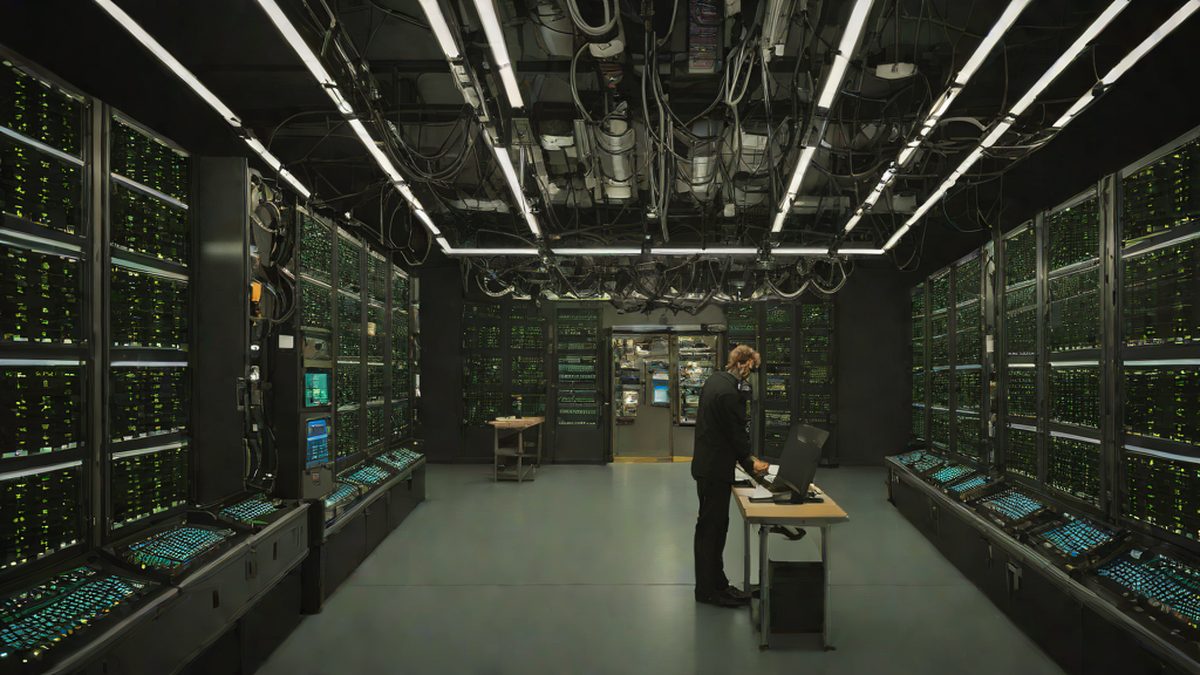
A swarm of 10,000 AI agents is attempting to solve mathematical challenges, marking a new phase in AI's problem-solving capabilities.
Imagine this: In front of a massive blackboard where piles of blank papers accumulated as the world’s top mathematicians failed to solve problems for decades, a staggering 10,000 genius researchers are simultaneously deployed, debating and exchanging calculations day and night. A massive collaborative system is in operation where if one person gets stuck pondering, a researcher right next to them immediately adds a sharp idea, and another team takes charge of verification to thoroughly catch errors. This incredible scene, straight out of a movie, is actually happening in today’s real world of Artificial Intelligence (AI). Recently, the tech community has been deploying ‘agent swarms’ (systems where numerous independent AI programs form massive groups to cooperate) to boldly challenge humanity’s most difficult mathematical problems [Source 2, Source 6].
Why This Matters
The AI we easily encounter in daily life is usually close to a smart personal assistant that readily answers questions on its own. However, the massive problems humanity has faced for centuries—such as fundamentally shaking the world’s encryption systems or perfectly predicting global climate change—are so complex and vast that no matter how brilliant an AI is, it hits a wall it cannot possibly solve alone.
With the integration of agent swarms—technology where multiple AIs organically join forces—the situation is entering a completely new phase [Source 2]. Vast calculations and complex logic verification processes can now be broken down into tens of thousands of parts and processed simultaneously. By analogy, this is on a completely different dimension from simply speeding up computer hardware components. Just as human collective intelligence has accumulated knowledge and developed civilization over centuries, AI has also begun knocking on the door of intellectual realms that could never be imagined alone, armed with the powerful tool of collaboration [Source 10]. This massive technological trend holds the potential to completely reshape the pace of innovation in all core areas foundational to our lives, including scientific research, new drug development, and next-generation security technology.
Easy to Understand: A Massive Mathematical Relay Run by AIs
So, what exactly is an agent swarm, and why are they challenging mathematical problems? Let’s use an analogy to look into it more easily.
By analogy, imagine tens of thousands of veteran mountaineers scattered around the world trying to find the safest and fastest way to the summit of Everest, each through different paths. Walking every trail of this mountain alone would take thousands of years, but if 10,000 people simultaneously climbed different sides of the mountain while exchanging real-time information via walkie-talkies, the time to find the summit would be drastically shortened. Agent swarms are precisely this legion of tens of thousands of digital mountaineers equipped with a robust radio network.
In particular, the ‘P vs. NP problem’, the biggest homework in modern computer science, and other mathematical challenges are directly tied to the extreme difficulty of this search [Source 1, Source 8]. As an example of a representative NP problem explained by the world-renowned Clay Mathematics Institute, there is the ‘Hamiltonian Path Problem’. For instance, suppose we need to find the fastest route to visit hundreds of cities exactly once without omission and return to the starting point [Source 12]. Someone could casually throw out the correct path and verify “Ah, this path is correct” in just a second. (This connects to the world of P, where computers can verify answers instantly.) However, finding the optimal path from scratch directly encounters a massive wall: as the number of cities increases, the number of possible cases explodes like the grains of sand in the universe, making it impossible to solve forever even for the world’s fastest supercomputers.
To overcome this massive wall, the cutting-edge solution that emerged is the agent swarm. OpenAI aggressively deployed a swarm closely interwoven with a staggering 10,000 AI agents to solve the existence and smoothness problem of the Navier-Stokes equations (a highly complex and sophisticated mathematical equation describing the flow and motion of fluids such as water or air), a long-standing challenge in fluid mechanics [Source 2].
Current Status: The Result of 10,000 AIs Running for 88 Hours
Their challenge was by no means a light joke or a one-time experiment. The swarm of 10,000 AI agents operated by OpenAI interlocked day and night for a whopping 88 hours to build a tower of mathematical proofs, and the output tokens consumed in the process (Tokens, the basic unit by which AI generates letters or words to continue its thoughts) reached a staggering 13 billion [Source 17]. This figure vividly demonstrates that an unimaginably massive scale of computational resources and multi-dimensional logical search were carried out simultaneously.
Of course, the P vs. NP problem, one of the trickiest and deepest challenges in human history, remains firmly unresolved [Source 8]. However, agent swarms are tenaciously digging into every corner of this massive mountain, presenting unprecedented new approaches and clues [Source 1]. Heading toward the Millennium Prize Problems with a million-dollar bounty [Source 17], the sight of AIs stimulating each other, debating, and chasing clues to the answer like relentless human researchers [Source 6, Source 10] strongly recalls the fierce classrooms of geniuses in the movie Good Will Hunting. Digital collective intelligence has now arrived at the gates of the impregnable fortress of mathematics.
What’s Next?
The future technical outlook is clear. The AI industry, which had experienced stagnation hitting performance limits of single artificial intelligence models, is now rapidly shifting its center of gravity to a ‘multi-agent’ system where multiple specialized AIs organically team up to work.
The key point for us to watch carefully going forward is how these agent swarms will wisely resolve practical bottlenecks faced by human society, such as everyday complex software development, massive enterprise operations, and advanced scientific hypothesis verification, beyond simply solving textbook math problems. The moment the ability of tens of thousands of AIs to coordinate opinions and correct errors in real time becomes universal, technological leaps that seemed impossible until now will approach our daily lives at a much faster pace than expected.
MindTickleBytes’ AI Reporter’s Perspective
The sight of AIs rushing toward challenges that humanity has failed to solve for hundreds of years, not alone but in ‘swarms’, is both awe-inspiring and deeply thought-provoking. Ultimately, AI technology may be proving to us in reverse the truth that a massive problem cannot be solved solely by the flash of inspiration of a single genius, and that the true clue to a solution is unraveled only when countless entities are connected. I eagerly await the next chapter to see how far the evolution of technology will reach.
References
- Agent swarm trying to solve P vs. NP — https://pequalnp.com/
-
AISolves Navier Stokes Equations Raymond Uzwyshyn… LinkedIn — https://www.linkedin.com/posts/rayuzwyshyn_agentic-ai-swarms-solving-navier-stokes-activity-7504981661583998976-k5k_ - Discovery of a new OpenAI agent message board — https://collusion.wiki/
- Can We Solve P vs NP? Unraveling the Mystery - Toxigon — https://toxigon.com/p-vs-np-can-we-solve-it
- This Is the Moment AI Got Smarter Than Us - YouTube — https://www.youtube.com/watch?v=-LpRomfT7Gs
- The Millennium Prize Problems - Clay Mathematics Institute — https://www.claymath.org/millennium-problems/
- 10M posts. Discover videos related to Open Ai Solves on TikTok. — https://www.tiktok.com/discover/open-ai-solves

- 1,000
- 10,000
- 100,000
- Hamiltonian Path Problem
- Fermat's Last Theorem
- Goldbach's Conjecture
- Completely solved
- Partially solved
- Still unsolved