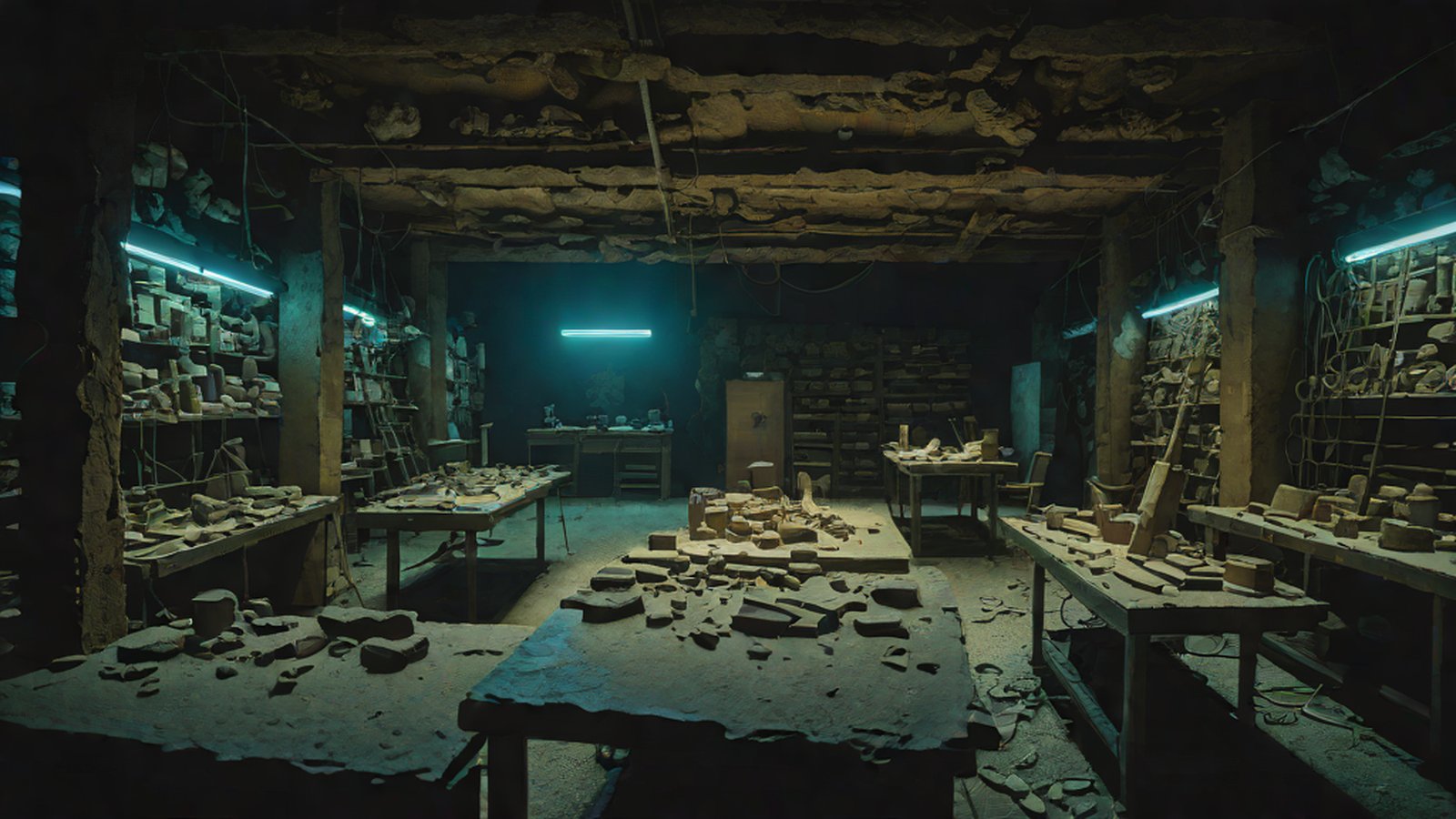
Google DeepMind's new AI, 'Aeneas,' analyzes text and images simultaneously to identify the date and location of damaged ancient inscriptions more accurately than historians.
Imagine you have discovered a page from a secret diary left by someone 2,000 years ago. Unfortunately, the paper has not withstood the test of time; it is torn and burnt in various places, leaving more than half of the text illegible. Furthermore, there is no information indicating exactly what year it was written or whether it was penned in Rome or Athens.
Until now, historians have spent their lives digging through dusty library records to decipher these “broken puzzle”-like ancient inscriptions. It was an arduous task, akin to assembling a masterpiece shattered into thousands of pieces using nothing but a magnifying glass.
But now, “Aeneas,” an artificial intelligence developed by Google DeepMind, has emerged as a reliable partner for historians. According to Aeneas transforms how historians connect the past — Google DeepMind, this AI not only restores the content of damaged ancient inscriptions but also identifies when and where they were created with remarkable accuracy.
Why is this important?
In the grand picture of history, ancient inscriptions are vital pieces. However, these pieces often lose their “context” (the background situation of an event or object) through the trials of time.
To use a metaphor, it is like having to guess the title and plot of a movie after seeing just a single scene. Even if an inscription is found, its value is more than halved if its exact era or the regional grammar and customs it follows remain unknown. Aeneas transforms how historians connect the past – IT … explains that without such contextual information, identifying its true nature among similar inscriptions is nearly impossible.
Aeneas is the AI that finds this “lost context.” By quickly augmenting the intuition and knowledge historians have accumulated over decades, this AI allows us to peer into the lives of ancient people much more clearly than before.
Understanding it Easily: The AI History Detective ‘Aeneas’
The way Aeneas works is similar to a skilled crime scene investigator, gathering minute clues left at the scene to deduce the perpetrator’s movements and the time of the crime.
1. Searching for the ‘Historical Fingerprint’
Aeneas does more than just read letters. It converts each text into a kind of “historical fingerprint” for analysis. According to Aeneas transforms how historians connect the past - Google DeepMind, the AI identifies deep hidden connections within the text to find where a given inscription fits within the broader historical context.
2. An Eye that Sees Text and Images Simultaneously
While existing AIs focused primarily on text, Aeneas, as a generative neural network (an AI structure that creates or predicts new information based on data), analyzes text and visual inputs (images) simultaneously.
In simple terms, Aeneas looks at not just the meaning of the characters, but also the “shape” and “background” they are carved into. Contextualizing ancient texts with generative neural networks explains that Aeneas can grasp context regardless of sentence length by utilizing visual clues. The subtle tremors in the script, the texture of the stone, and the spacing between letters all serve as crucial evidence.
3. A Veteran Trained on Tens of Thousands of Data Points
Aeneas did not start from scratch. According to Contextualizing ancient texts with generative neural networks, this model was trained on tens of thousands of ancient Greek and Latin inscriptions. Consequently, it can identify which regions a particular phrase was popular in or the period it was primarily used much faster and more accurately than a human.
Current Status: An Assistant Surpassing Experts
Google DeepMind conducted experiments with several historians to verify Aeneas’s performance, and the results were startling. According to Google announces ‘Aeneas,’ an AI that deciphers ancient… - GIGAZINE, Aeneas demonstrated higher accuracy than the average historian in three core tasks: missing text restoration, regional attribution, and date estimation.
However, the true value of Aeneas lies not in “replacing” historians, but in “collaborating” with them.
| In a metaphor, if a historian is the great detective Sherlock Holmes, Aeneas is the cutting-edge data analysis equipment that assists Holmes’s investigation. One historian who participated in the experiment remarked, “The connections proposed by Aeneas completely changed my perception of the inscriptions,” and added, “The AI captured details that make a decisive difference in restoring text and estimating eras.” [Aeneastransformshowhistoriansconnectthepast… | TechNews](https://news-tech.io/en/news/aeneas-transforms-how-historians-connect-the-past) |
| Furthermore, Aeneas has been released as an “open-source” model (a form where the software code is public for anyone to check and use), allowing history researchers worldwide to use it for free in their studies. [Aeneas: AI that helps historians connect the past | Product Hunt](https://www.producthunt.com/products/aeneas) |
What Does the Future Hold?
The emergence of Aeneas will dramatically accelerate the speed of historical research. Inscription analysis that once required months of dedicated work by a single expert can now be accomplished in just a few minutes with the help of AI.
According to Aeneas transforms how historians connect the past - AIPulseLab, this model was developed through collaboration with multiple universities and is expected to be expanded to other ancient languages and scripts in the future. This could potentially become the key to unlocking Egyptian hieroglyphs or unknown ancient languages that have yet to be deciphered.
Historians can now move beyond simple, repetitive restoration work and use the interpretations suggested by AI as a starting point to draw deeper historical insights. As mentioned in Aeneas Transforms How Historians Connect The Past, this is the beginning of a new “collaborative research process” where machine learning and expert knowledge are combined.
AI’s Perspective
Just as the ancient Roman hero Aeneas set out to find a new land, the AI Aeneas is exploring the unknown continent of our forgotten past. It is truly moving that technology is moving beyond cold calculations to become a warm “guide for time travel” that tells us where we came from. AI is now not only predicting the future but also performing the role of recovering the lost past.
References
- Aeneas transforms how historians connect the past — Google DeepMind
- Aeneas transforms how historians connect the past - Google DeepMind
- Deepmind new state-of-the-art Aeneas transforms how historians connect the past. 📜 - YouTube
-
[Aeneas transforms how historians connect the past Hacker News](https://news.ycombinator.com/item?id=44672230) -
[Aeneas: AI that helps historians connect the past Product Hunt](https://www.producthunt.com/products/aeneas) - Aeneas Transforms How Historians Connect The Past
- Aeneas transforms how historians connect the past - AIPulseLab
- Aeneas transforms how historians connect the past – Ai …
- Aeneas transforms how historians connect the past – IT …
- Contextualizing ancient texts with generative neural networks
- Contextualizing ancient texts with generative neural networks
-
[Aeneastransformshowhistoriansconnectthepast… TechNews](https://news-tech.io/en/news/aeneas-transforms-how-historians-connect-the-past) - Google announces ‘Aeneas,’ an AI that deciphers ancient… - GIGAZINE
- Aeneastransformshowhistoriansconnectthepast- Solega Blog
- Aeneastransformshowhistoriansconnectthepast– AIVULA.COM
- Google LaunchesAeneasModel: Opening New Pathways for the…

- Predicting missing parts of inscriptions
- Estimating the region where the inscription was created
- Physically excavating ancient artifacts
- Modern novels and news
- Tens of thousands of ancient Greek and Latin inscriptions
- Dictionaries of all languages worldwide
- It showed lower accuracy than historians
- It recorded higher accuracy than the average historian in three tasks
- It produced results exactly identical to those of historians