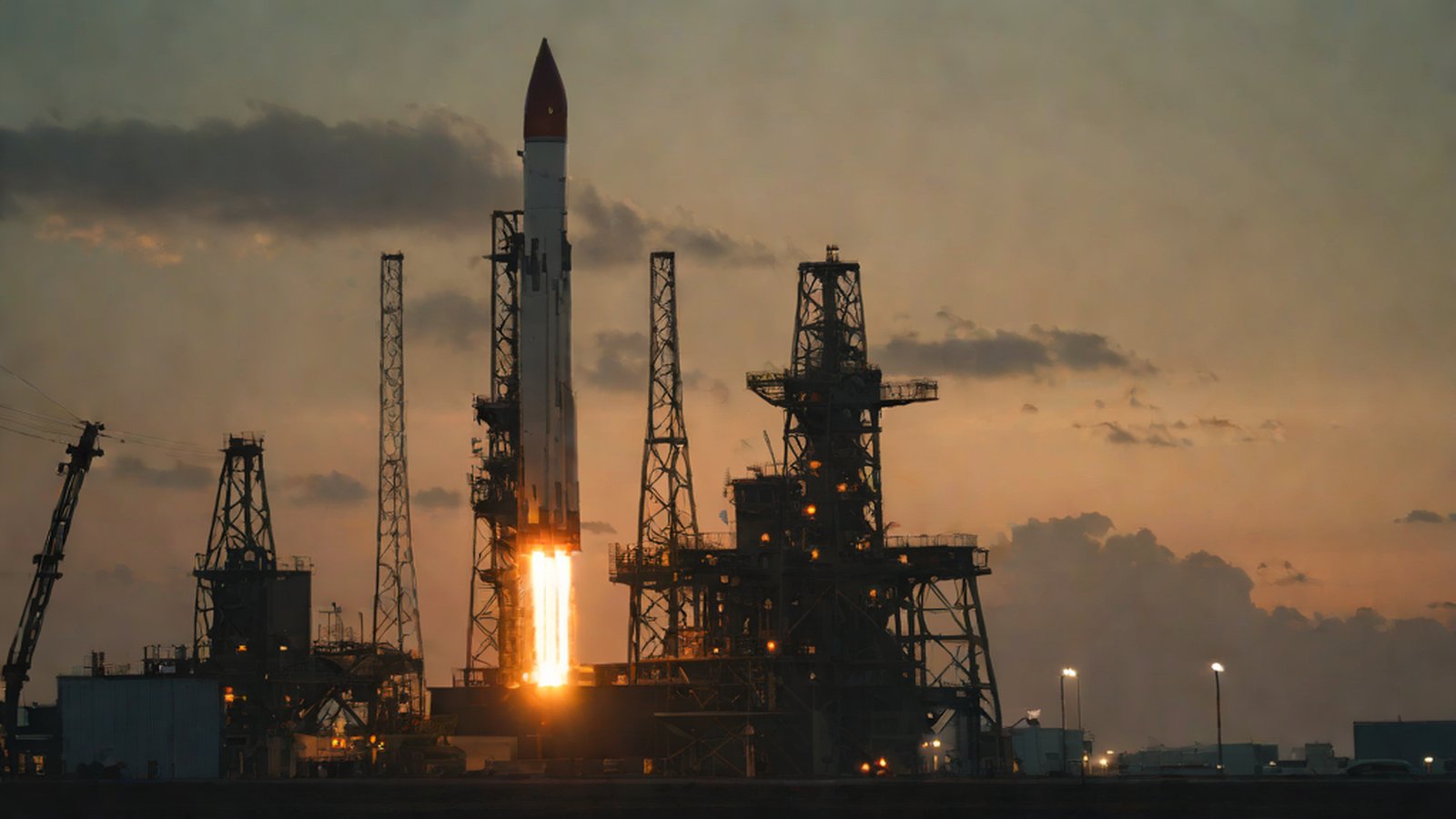
Famed investor Michael Burry warns that if heavily loss-making tech companies like SpaceX or Anthropic go public with $1 trillion valuations, it could inflict massive damage on ordinary people's pension funds, similar to the dot-com bubble.
Imagine checking your retirement account, which you diligently contribute to every month, or the stock application on your smartphone on an ordinary Tuesday morning. You firmly believe that this precious money is safely and soundly diversified in blue-chip companies that reliably generate profits around the world, safeguarding your secure future. But what if a company that looks incredibly glamorous on the outside but incurs massive losses of billions of dollars every year appears on the stock market with an astronomical price tag simply because its ‘future is bright,’ and your pension fund is ‘obligated’ to buy those risky stocks at exceptionally high prices right before your eyes?
Legendary investor Michael Burry, the real-life protagonist of the movie ‘The Big Short’ who accurately saw through the housing market bubble that no one else saw before the 2008 global financial crisis hit, has stepped forward to warn of exactly this nightmare scenario. He raised strong doubts about the market’s enthusiastic valuation that values giant tech companies, such as Elon Musk’s much-hyped space exploration company SpaceX and Anthropic, the creator of the AI model ‘Claude’ considered the strongest rival to ChatGPT, at $1 trillion. ‘Big Short’ investorMichaelBurrysaysneitherSpaceXnor.... Where on earth did the astronomical figure of $1 trillion come from, and why could stories of the distant future, like spaceships and artificial intelligence, threaten our wallets right now?
Why It Matters
When we hear news that giant tech companies in Silicon Valley are valued at hundreds of billions or trillions of dollars, we often easily assume it is a ‘league of their own’ for billionaire founders and venture capitalists. We might brush it off lightly, thinking, “Whether they launch rockets into space or AI writes cool articles, it has absolutely nothing to do with my thin wallet.” However, Michael Burry’s warning, guided by his genius for uncovering the truth behind the numbers, awakens us to the terrifying reality that this massive concentration of capital is in fact very directly connected to the hard-earned retirement funds of ordinary people like us.
Burry is wary of the very situation where companies like Anthropic, OpenAI, and SpaceX in their current state go public (IPO, Initial Public Offering) on the stock market with excessively inflated, high valuations. What he fears most is the structural contradiction where hundreds of billions of dollars of ‘Passive Capital’ will have no choice but to buy these expensive stocks. MichaelBurrysaysneitherSpaceXnorAnthropicisworth$1T. Burry specifically pointed out that this passive capital is none other than the pension funds that ordinary office workers diligently contribute to from their monthly salaries, and ETFs (Exchange Traded Funds) that directly track the stock market indices. MichaelBurrysaysneitherSpaceXnorAnthropicisworth$1T.
It’s much easier to understand if we compare it to a familiar situation. Imagine you ordered the ‘Safety First Assorted Set Menu’ at the most reliable and popular restaurant in your neighborhood. This set menu represents your retirement pension or an S&P 500 ETF. Originally, this set was packed only with excellent dishes that were tasty, reasonably priced, and had consistently generated profits for decades.
However, one day, the restaurant owner changes the menu and forcibly inserts a $1,000 decorative spaceship sausage—extravagantly sprinkled with glowing gold dust on the outside, but completely empty and inedible on the inside—right in the middle of that set menu. You didn’t want that strange and expensive sausage at all, but simply because you ordered the fixed ‘set menu’, you are forced to pay an extra $1,000 on top of the original price.
If giant tech companies go public with outrageously high price tags compared to the actual money they earn and are abruptly included in major stock market indices, countless ETFs and pension funds around the world, designed to mechanically track the proportions of those indices like robots, will have to swallow the bitter pill and sweep up those expensive stocks in large quantities regardless of their own will. In conclusion, Burry’s very sharp and chilling warning is that the final financial backers solidly supporting the bubble-filled valuations of companies suffering billions in deficits every year will not be venture capitalists, but the retirement funds of ordinary citizens who faithfully pour money into their funds every month.
The Explainer
Then why does Michael Burry firmly draw the line and say that these innovative companies, which the whole world is crazy about, are not worth $1 trillion at all? If we strip away the complex technical jargon and look at the ‘numbers’ themselves that the companies have disclosed to financial authorities, we can clearly see exactly where his concerns originate.
SpaceX: An Empty Wallet and Expectations for the Vast Universe
First, let’s take a look at SpaceX, the private space exploration company led by Elon Musk. For an unlisted private company to make a formal debut (IPO) on the stock market where the public can buy and sell shares, it must disclose a formal scorecard to financial authorities and the public—namely, an IPO prospectus—that transparently shows how much money the company has made and where it spent it. SpaceX’s scorecard, recently unveiled through these documents, seems quite astonishing at first glance. The company generated a staggering revenue of $18.7 billion last year. “It Is NotWorth$1tn Let Alone $2tn:”MichaelBurryTakes... - Tekedia. This is a positive signal that the business of launching rockets and building satellite internet systems is not merely a dream in a sci-fi movie but is actually rolling in massive amounts of money in the market.
However, the cold-hearted investor Burry’s eyes lingered not on ‘how much they earned (revenue)’ but on ‘how much they kept (net profit)’. Despite raking in a massive $18.7 billion, SpaceX recorded a staggering net loss (deficit) of a whopping $4.9 billion last year due to excessive facility investments and massive R&D expenditures. “It Is NotWorth$1tn Let Alone $2tn:”MichaelBurryTakes... - Tekedia.
Let’s compare this to commercial real estate around us to feel its severity. A businessman puts up a magnificent skyscraper in the middle of the city for sale on the market. This building is popular through word-of-mouth and collects a handsome $18.7 million in monthly rent every year. Outwardly, it’s an excellent asset anyone would covet. But looking deep into the building’s financial statements, a total of $23.6 million is being drained every year just to pay the electricity bill for keeping the fancy lights on every night, the maintenance costs for repairing old elevators, and paying off the massive loan interest borrowed when the building was first built. In other words, it is a seriously ‘deficit-ridden building’ where $4.9 million of hard-earned money vanishes into thin air every year the owner holds it.
But what if the owner of this building proudly puts a price tag of “$1 billion” on it, citing the romantic reason that “the moon will look better from the roof of our building in the future”? Would any meticulous and rational person actually try to buy that building?
Michael Burry pointed out that there is an impossibly huge gap between SpaceX’s actual dismal financial performance and the future value that investors vaguely enthuse about and expect. “It Is NotWorth$1tn Let Alone $2tn:”MichaelBurryTakes... - Tekedia. After meticulously scrutinizing every line of SpaceX’s IPO documents, he flatly dismissed the idea, stating that there is “nothing” within the documents that serves as a rational basis to value the company at the dream valuation of $1 trillion. 'Big Short' Michael Burry says SpaceX, Anthropic not worth $1 .... Furthermore, he took a direct hit at the overheated, blind investment craze toward a market that thoroughly ignores the reality of the company, saying it is “not worth $1tn let alone $2tn.” “It Is NotWorth$1tn Let Alone $2tn:”MichaelBurryTakes... - Tekedia.
Anthropic and the Shadow of an Endless AI Bubble
It is not just the space industry. The situation is exactly the same for the artificial intelligence sector, which has recently been sucking up the world’s money like a black hole. Anthropic, which developed ‘Claude’, one of the models boasting top-tier capabilities in the conversational AI market, recently attracted huge investments in the market and was proudly valued at a whopping $965 billion. BurryQuestionsSpaceXandAnthropic$1Trillion+. It means that a venture company that is just beginning to stand out has practically almost reached the historical milestone of a $1 trillion valuation.
Regarding this, Burry expressed deep skepticism and doubt on his subscription newsletter service Substack channel as to whether there will ever be a single instance in the future where Anthropic will have a $1 trillion valuation, a feat that only a handful of giant companies in human history (such as Apple and Microsoft) achieved over decades. ‘Big Short’ investorMichaelBurrysaysneitherSpaceXnor..., 'Big Short' Michael Burry says SpaceX, Anthropic not worth $1 ....
He directly compared this madness currently taking place on Wall Street and in Silicon Valley to the worst bubble burst in financial history, an event that left painful scars on the largest number of ordinary people. By realistically adjusting for inflation and placing the monetary values of the past and present on the same baseline, Burry made a terrifying prediction about what would happen if a small number of giant companies like SpaceX, Anthropic, and OpenAI were to go public at their current valuations. He analyzed that the amount of funds these few companies would instantly suck up as they debut on the stock market could absorb capital equal to or greater than the total amount of money swept up by over 300 internet-related companies during the so-called ‘dot-com bubble’ in the early 2000s, when the stock prices of internet companies without substance skyrocketed madly. Michael Burry compares OpenAI, Anthropic, SpaceX IPO ... - MSN.
It is a very specific and chilling warning that just three companies, which have not even proven a clear revenue model, could monopolize the massive funds of greed and bubbles that were once collected by 300 companies in the past, potentially drying up the funds of the entire stock market.
Where We Stand
Then, a strong question naturally arises according to common sense. Why on earth are countless financial experts and market participants on Wall Street, who are supposedly smart, deliberately ignoring these obvious, rational numbers and willingly justifying and accepting these unimaginably astronomical price tags?
The answer lies in the irrational psychology of human beings driving the market. Burry diagnosed that the core driving force leading the current stock market, especially the atmosphere of a blind bull market that seems like it will rise endlessly, is not cold, logical figures such as the actual profits generated by the company or the physical supply of shares issued. In an in-depth conversation with his Substack subscribers, he argued that what currently dominates market volatility is the blind sentiment of investors and grandiose, epic narratives that they will save the world, and that this is having a far more overwhelming and fatal impact on the entire market than the actual supply and demand phenomenon of stocks. Michael Burry Doesn't Think SpaceX, OpenAI, Anthropic IPOs ....
Simply put, people have become deeply captivated by Hollywood sci-fi movie-like ‘stories’ that make their hearts beat, such as “Soon we will all travel in a group to Mars on a rocket built by Elon Musk,” or “In the near future, AI will completely replace all bothersome and hard human labor, and a utopia where we just play and eat will arrive.” Intoxicated by this grand narrative, investors are blindly closing their eyes and throwing wads of cash at it, rather than coldly examining the company’s deficit ledgers and tapping on calculators.
One interesting point to note here is that Michael Burry is not simply a stubborn pessimist who just makes remarks from the outside without understanding the technology at all. He continuously communicates with insiders who know the reality of the industry best, grasping the situation multidimensionally. In fact, Burry recently gathered with Jack Clark, the co-founder of Anthropic—the very company he criticized for being a bubble—and Dwarkesh Patel, a famous IT podcaster in Silicon Valley, to have a very deep and realistic discussion about the realistic technical limitations of artificial intelligence and the actual process of its introduction into our society. #MichaelBurry says #SpaceX and #Anthropic aren't worth $1T # ...Why Michael Burry's AI skepticism can be explained by an ..., Why Michael Burry's AI skepticism can be explained by an ....
In this sharp conversation, Burry coldly pointed out that contrary to the media’s flashy packaging, the way cutting-edge AI technology is actually applied to the harsh industrial sites of our real world will be completely different from people’s romantic, rosy illusions (“That is how most AI implementation will play out”), and he delivered his consistent skeptical stance on the bubbles rampant in the market very directly to the faces of top experts in the related industry. Why Michael Burry's AI skepticism can be explained by an ....
What’s Next
Despite Michael Burry’s lonely yet weighty warning, it is highly likely that a massive and glamorous financial event worthy of going down in history books will unfold ceaselessly right before our eyes in the near future. According to numerous media reports, the successive IPO schedules of companies that have become icons of innovation of our time, such as SpaceX, Anthropic, and ChatGPT’s creator OpenAI, could go beyond simple stock trading and completely flip the topography of the financial market itself. Economic experts predict that this year is poised to be an unprecedented ‘year of blockbuster IPOs’ where funds are concentrated in one place, creating massive ripples across the entire global market. Google News -SpaceXand OpenAI IPOs - Overview, GoogleNews- Elon Musk'sSpaceXIPO - Overview.
While all economic news and investment broadcasts will be enthusiastic about this glamorous giant listing event and rush to pop celebratory champagne, wise people who remember the sharp warning of Michael Burry, who accurately predicted the collapse of the real estate market bubble in 2008, will take a step back amidst the noise of the flashy festival and closely examine the massive bill secretly hidden behind it.
We must make one fact very clearly distinct. The phenomenal technological advancements of sending humanity to Mars and machines conversing fluently like humans certainly hold the great potential to fundamentally change our lives. However, the abstract fact that a company is researching brilliant technologies to change the world is logically a completely separate issue from the fact that the scraps of paper (stocks) issued by that company actually prove an economic value of a whopping $1 trillion at the current point in time.
We can only hope that the massive dreams of space exploration, which symbolizes humanity’s greatest pioneering spirit, and artificial intelligence, which will be responsible for future civilization, do not become entangled with the blind greed of capitalism and degenerate into an overheated game of casino roulette that takes the retirement funds of our ordinary, hardworking neighbors hostage.
AI’s Take
MindTickleBytes AI Reporter’s View: The winds of innovation brought about by new technology always make the sailboat-like market flutter and heat up first. Space travel and artificial intelligence that thinks for itself are definitely the thrilling future of humanity. However, even a hot air balloon that seems to soar high into the sky forever must eventually shatter its illusions and come down to the barren ground of reality when it meets the strict gravity of the capital market, namely the cold numbers of ‘profit’.
The ‘price of expectations’ that inflates faster than the speed of technological development sometimes creates a massive backlash rather than aiding innovation. Now is the most crucial time to strictly and coldly separate the heart that passionately roots for the advancement of great technologies that will completely change human life, from the act of blindly betting our precious retirement funds on limitless expectations. The question Michael Burry posed is simple: “Can that cool technology create $1 trillion in cash right now?” We must prepare to answer this question rationally.
References
- ‘Big Short’ Michael Burry says SpaceX, Anthropic not worth $1 …
- Michael Burry Doesn’t Think SpaceX, OpenAI, Anthropic IPOs …
- Michael Burry compares OpenAI, Anthropic, SpaceX IPO … - MSN
- #MichaelBurry says #SpaceX and #Anthropic aren’t worth $1T # …Why Michael Burry’s AI skepticism can be explained by an …
- Why Michael Burry’s AI skepticism can be explained by an …
- ‘Big Short’ investorMichaelBurrysaysneitherSpaceXnor…
- MichaelBurrysaysneitherSpaceXnorAnthropicisworth$1T
- Google News -SpaceXand OpenAI IPOs - Overview
- BurryQuestionsSpaceXandAnthropic$1Trillion+
- “It Is NotWorth$1tn Let Alone $2tn:”MichaelBurryTakes… - Tekedia
- GoogleNews- Elon Musk’sSpaceXIPO - Overview
- ‘Big Short’MichaelBurrysaysSpaceX,Anthropicnotworth$1trillion

- The 2008 Global Financial Crisis
- The Dot-com Bubble in the early 2000s
- The Oil Shock in the 1970s
- It had no revenue and only recorded losses
- It generated $18.7 billion in revenue but suffered a net loss of $4.9 billion
- Both revenue and net profit broke all-time highs
- Because passive capital like ordinary people's pensions or ETFs will be forced to buy expensive stocks
- Because he is certain that the development of AI technology itself will completely stop
- Because he is jealous that he couldn't buy shares in these companies in advance